

Safety Action
As a result of this occurrence, the operator advised the Australian Transport Safety Bureau that it had replaced both nosewheel steering cables with stainless steel cables. Stainless steel has a higher resistance to corrosion than carbon steel.
Factual Information
On 25 January 2005, a Boeing 727-51C aircraft, registered in Sierra Leone as 9L-LEK, was being operated on a non-scheduled positioning flight from Cairns to Brisbane, Queensland. The crew, which comprised the pilot in command, copilot and flight engineer, were supported by an aircraft maintenance engineer (a passenger) for away from base maintenance. The copilot was the handling pilot for the flight.
Approaching Brisbane, the aircraft was cleared for an instrument landing system approach to runway 01 at Brisbane Airport. There was a 15 kts gusting crosswind from the east. The crew reported that they had visual contact with the runway at about 1,000 ft altitude and flew a stabilised approach to a normal touchdown at about 1606 eastern standard time. The wing spoilers and thrust reversers deployed normally.
The copilot said that as the speed reduced through 100 kts, the aircraft was tending to veer right and that, approaching 80 kts, he had maximum left rudder applied to maintain the aircraft tracking on the runway centreline. Nosewheel steering is controlled by the rudder pedals and by a steering wheel on the pilot in command's side panel. When the copilot is flying the aircraft, it is normal procedure as the aircraft slows during the landing roll for the pilot in command to take control of the aircraft to manoeuvre it using the nosewheel steering wheel. In accordance with normal procedures, the pilot in command took control of the aircraft at about 80 kts. As the copilot relinquished control, he informed the pilot in command that he had maximum left rudder applied.
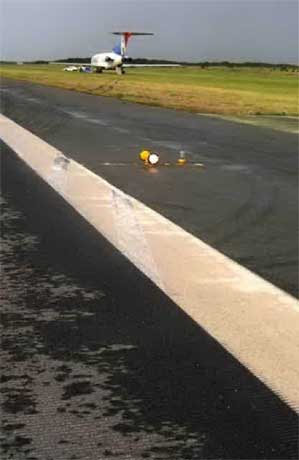
The pilot in command said that when he placed his hand on the nose wheel steering wheel, it felt very loose as he turned the wheel left to maintain the aircraft on the runway centreline. However, there was no response to the steering wheel inputs and, despite the use of differential main wheel braking, he was unable to prevent the aircraft veering right and running off the runway at a speed of between 60 and 70 kts. The aircraft came to rest about 40 m from the runway edge, and was undamaged.
An examination of the nosewheel steering system revealed that one of the carbon steel nosewheel steering cables, linking the steering wheel to the nose gear steering valve, had failed approximately 2.35 m from the ball end. That location was within the forward fuselage section above the nose wheel where the cables were hidden from view and not readily accessible.
A subsequent specialist examination of the failed cable indicated that approximately 70 percent of the cable strands at the failure location exhibited characteristics of severe aqueous corrosion1. The remaining strands showed decreased diameter due to corrosion and had failed under applied tensile loads.
The aircraft had a total time in service of 54,200 hours and 48,000 flight cycles2. The operator advised that the most recent maintenance check on the aircraft was an 'A' check completed in December 2004 and the last 'C' check on the aircraft in December 2003. The operator also advised that, in its maintenance system for the aircraft, the nose wheel steering cable was an 'on condition' item and that, during a 'C' check, there was a requirement to conduct a visual inspection of the cable.
1 Aqueous corrosion is an electrochemical process by which metals or alloys are oxidised in the presence of solutions containing water. Corrosion rates are significantly affected by environmental conditions such as temperature, humidity, and oxygen availability.
2 A flight cycle is a completed take-off and landing sequence.
Summary
On 25 January 2005, a Boeing 727-51C aircraft, registered in Sierra Leone as 9L-LEK, was being operated on a non-scheduled positioning flight from Cairns to Brisbane, Queensland.
Occurrence summary
| Investigation number | 200500302 |
|---|---|
| Occurrence date | 25/01/2005 |
| Location | Brisbane, Aerodrome |
| State | Queensland |
| Report release date | 26/07/2005 |
| Report status | Final |
| Investigation type | Occurrence Investigation |
| Investigation status | Completed |
| Mode of transport | Aviation |
| Aviation occurrence category | Runway excursion |
| Occurrence class | Incident |
| Highest injury level | None |
Aircraft details
| Manufacturer | The Boeing Company |
|---|---|
| Model | 727 |
| Registration | 9L-LEK |
| Sector | Jet |
| Operation type | Air Transport High Capacity |
| Departure point | Cairns, QLD |
| Destination | Brisbane, QLD |
| Damage | Nil |