

Report release date: 27/11/2026
| Occurrence Briefs are concise reports that detail the facts surrounding a transport safety occurrence, as received in the initial notification and any follow-up enquiries. They provide an opportunity to share safety messages in the absence of an investigation. Because occurrence briefs are not investigations under the Transport Safety Investigation Act 2003, the information in them is de-identified. |
What happened
On the evening of 8 August 2026 at Proserpine/Whitsunday Coast Airport, Queensland, a safety vehicle approached the active runway with the intention of carrying out a procedural runway and wildlife inspection.
At about the same time, an Atec Zephyr aircraft was on approach to the airport. The pilot reported that they made a radio broadcast on the common traffic advisory frequency (CTAF) advising that they were 10 NM (18.5 km) inbound for a full stop landing.
The aerodrome reporting officer (ARO) then made a broadcast on the CTAF at 1707 local time, advising of their intention to enter runway 11 and recalled hearing their own broadcast being transmitted through an external speaker. The ARO also recalled hearing the automated aerodrome frequency response unit (AFRU) beep-back response and did not recall hearing any radio broadcasts from aircraft prior to entering runway 11 (see Aerodrome frequency response unit (AFRU) section).
At about this time, the aircraft was on a 3 NM (5.5 km) final for runway 11. The pilot reported to the ATSB that they made another radio call advising of their intention to land. The beep-back response was received by the pilot, who reported that no other responses were heard. The pilot of the aircraft reported that they did not hear the broadcast from the ARO.
Prior to landing, the pilot observed the safety vehicle on the centreline of runway 11 and continued their approach. They reported that the vehicle appeared stationary, and assumed that the ARO was aware of their location and would vacate the runway. However, the ARO was in the process of conducting the runway inspection and was not aware of the aircraft on final approach.
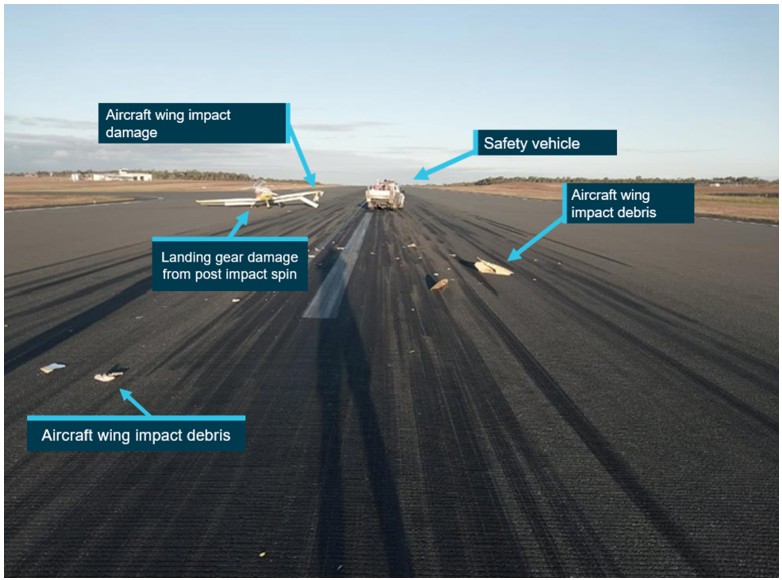
During the landing, the pilot recalled that the safety vehicle did not vacate the runway. Sensing that a collision was imminent, the pilot manoeuvred to the right. At 1714 local time, the aircraft’s left wing collided with the left side of the safety vehicle. The safety vehicle sustained minor damage to the bull bar. The aircraft sustained substantial damage to the wing, strut and landing gear (Figure 1).
Figure 1: Post-impact damage
Aerodrome frequency response unit (AFRU)
The AFRU system automatically monitors the designated local radio frequency—typically on CTAF. When a pilot makes a normal radio transmission that lasts longer than 2 seconds (such as an inbound or taxi call), the AFRU detects it and instantly sends an automated response back over the frequency.
Depending on recent traffic, the AFRU replies in one of 2 ways:
- Voice identification: if no other aircraft have transmitted on that frequency within the last 5 minutes, the unit will broadcast a pre-recorded voice message stating the name of the aerodrome and the frequency (e.g., "Proserpine CTAF").
- Tone burst (beep-back): if there has been radio activity within the previous 5 minutes, the unit will simply reply with a short, 300-millisecond beep.
Further information relating to the AFRU is available on the CASA website.
Operator’s comments
The aerodrome operator reviewed CTAF recordings and CCTV footage and advised the following:
- The only radio broadcast captured on the CTAF recording was the ARO broadcast prior to entering runway 11.
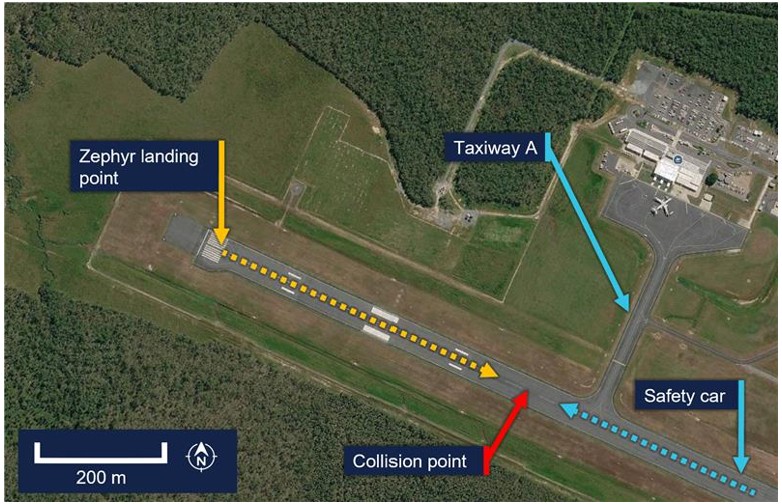
- CCTV footage showed the safety vehicle in motion prior to the collision. The impact occurred at about 90 metres west of taxiway A, about 500 metres from the runway 11 threshold, where the aircraft landed (Figure 2).
- At the time of the collision, the ARO was focused on another aircraft parked on the apron (to the right of the vehicle). They were looking for that aircraft’s safety beacon to determine if the safety vehicle was required to vacate the runway. The driver estimated that during the time they were looking to the right, the vehicle would have travelled about 20 metres. The driver did not observe the aircraft prior to the collision.
Figure 2: Proserpine/Whitsunday Coast Airport
Safety message
Non-towered aerodromes are a central component of the Australian airspace system with most aerodromes not having an air traffic control presence. While see and avoid principles are critical, it is enhanced with effective radio communication.
To achieve radio alerted see-and-avoid, pilots must ensure they have a serviceable radio connected to the correct CTAF frequency for the aerodrome and always make the standard positional broadcasts within 10 NM of a non-towered aerodrome and respond to others as appropriate. CASA advisory circular, AC 91-10 v1.7, Operations in the vicinity of non-controlled aerodromes provides guidance on the procedures that, when followed, will improve situational awareness and safety at and in the vicinity of, non‑controlled aerodromes.
Through training and experience, AROs also develop situational awareness in relation to operating on the aerodrome and active runways, however safety at an aerodrome is a shared responsibility that relies on both ground personnel and pilots broadcasting their intentions clearly and concisely. Should uncertainty exist, the safest course of action is to make an additional broadcast to confirm aircraft or vehicle positions.
It is a known phenomenon that 2 objects on a collision course can appear stationary relative to one another. One limitation of see and avoid detection is that the eye relies on contrast to detect movement and the collision risk may not be detected. It is important that pilots maintain an adequate visual scan process to increase the likelihood of detecting a conflict.
Should an aircraft, vehicle or other potential hazard be present on the runway, pilots should always conduct a missed approach.

The ATSB SafetyWatch highlights the broad safety concerns that come out of our investigation findings and from the occurrence data reported to us by industry. One of the safety concerns is Reducing the collision risk around non-towered airports | ATSB.
About this report
Decisions regarding whether to conduct an investigation, and the scope of an investigation, are based on many factors, including the level of safety benefit likely to be obtained from an investigation. For this occurrence, no investigation has been conducted and the ATSB did not verify the accuracy of the information. A brief description has been written using information supplied in the notification and any follow-up information in order to produce a short summary report, and allow for greater industry awareness of potential safety issues and possible safety actions.
Occurrence summary
| Mode of transport | Aviation |
|---|---|
| Occurrence ID | AB-2026-044 |
| Occurrence date | 08/08/2026 |
| Location | Proserpine/Whitsunday Coast Airport |
| State | Queensland |
| Occurrence class | Accident |
| Aviation occurrence category | Air-ground-air, Collision, Runway incursion |
| Highest injury level | None |
| Brief release date | 27/11/2026 |
Aircraft details
| Manufacturer | Atec |
|---|---|
| Model | Zephyr |
| Sector | Sport and recreational |
| Operation type | Part 103 Sport and recreational aircraft |
| Activity | General aviation / Recreational – Sport and pleasure flying – Pleasure and personal transport |
| Departure point | Lakeside Airpark Aircraft Landing Area, Queensland |
| Destination | Proserpine/Whitsunday Coast Airport, Queensland |
| Injuries | None |
| Damage | Substantial |