

| Occurrence Briefs are concise reports that detail the facts surrounding a transport safety occurrence, as received in the initial notification and any follow-up enquiries. They provide an opportunity to share safety messages in the absence of an investigation. Because occurrence briefs are not investigations under the Transport Safety Investigation Act 2003, the information in them is de-identified. |
What happened
On the afternoon of 28 September 2026, the pilot of a Cessna Aircraft Company 172S (aircraft A) was conducting a solo training flight from Moorabbin Airport, Victoria. After take-off, the flight progressed around the east and south of Port Phillip Bay, before tracking west to Lake Burn and then north‑east towards Point Cook Airport, with the intention of overflying the airport on the return to Moorabbin via Williamstown.
As the aircraft was approaching Point Cook, the crew of another Cessna 172S (aircraft B) that had been conducting dual instructional circuits from runway 17, was climbing to depart the Point Cook circuit area and track south‑west at 2,500 ft AMSL.
The pilot of aircraft A, approaching from the south‑west, was also maintaining 2,500 ft as they neared the airport, when they observed aircraft B ahead and on a reciprocal track – slightly to the left and climbing. Ensuring they maintained separation from the approaching aircraft, the pilot flew to the south of the airport before resuming the planned track towards Williamstown.
The instructor, who was pilot in command of aircraft B, reported that as they were approaching 2,500 ft on the south‑west track, they saw aircraft A directly ahead and in close proximity. Reducing power, they commenced an immediate descending right turn away from the closing aircraft.
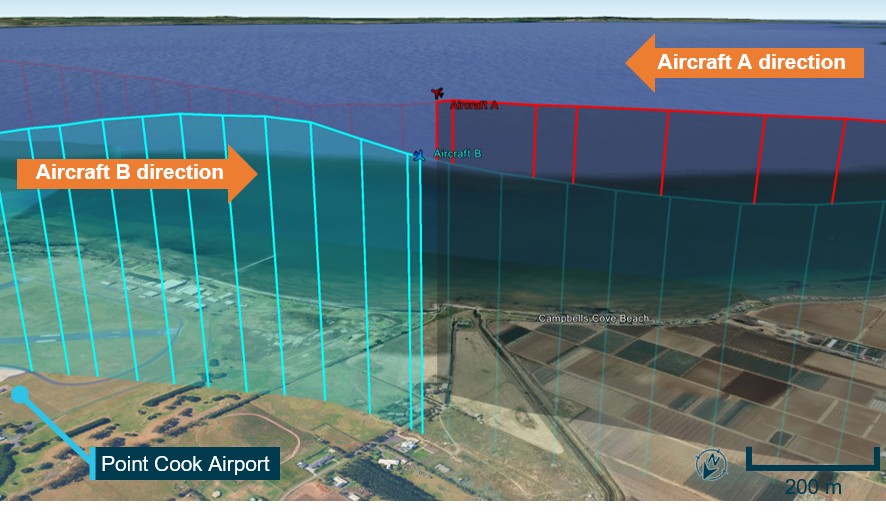
An analysis of recorded ADS-B aircraft track data showed separation between both aircraft reduced to about 165 metres horizontally and 250 ft vertically at the closest passing point (Figure 1).
Radio calls
The operating crew of aircraft B stated they made a call on the Point Cook CTAF when they were overhead the airport on climb and heard no responses from other aircraft. Following the sighting and manoeuvre to avoid aircraft A, they reported attempting to establish direct radio contact with the aircraft but were unsuccessful.
The pilot of aircraft A stated that they had made a radio call on the Point Cook CTAF at 10 nautical miles (18.5 km) inbound and had heard several aircraft reporting their departure from the airport. After the close proximity event with aircraft B, they reported making another call overhead Point Cook and then to coastal traffic as they tracked towards Williamstown.
Figure 1: Depiction of relative flight paths
Safety message
Pilots of aircraft operating under the visual flight rules are directly responsible for ensuring their separation from other air traffic. While the traditional ‘see-and-avoid’ principle remains valid, publications such as the Civil Aviation Safety Authority’s AC 91‑14 advisory circular Pilots’ responsibility for collision avoidance note that:
In modern aviation, see-and-avoid is the last line of defence, but usually not the only mechanism for avoiding a collision or an Airprox event.
Alerted see-and-avoid principles can significantly enhance pilots’ situational awareness in detecting and avoiding potential conflicts. In addition to the use of effective radio communication procedures, pilots and aircraft operators should strongly consider utilising technologies such as ADS-B1, ACAS2 and Electronic Flight Bag (EFB) applications to supplement their visual lookout – particularly in higher visually-separated traffic areas such as uncontrolled aerodromes.

The ATSB SafetyWatch highlights the broad safety concerns that come out of our investigation findings and from the occurrence data reported to us by industry. One of the safety concerns is Reducing the collision risk around non-towered airports.
About this report
Decisions regarding whether to conduct an investigation, and the scope of an investigation, are based on many factors, including the level of safety benefit likely to be obtained from an investigation. For this occurrence, no investigation has been conducted and the ATSB did not verify the accuracy of the information. A brief description has been written using information supplied in the notification and any follow-up information in order to produce a short summary report, and allow for greater industry awareness of potential safety issues and possible safety actions.
- ^ Automatic dependent surveillance‑broadcast – a means by which aircraft, aerodrome vehicles and other objects can automatically transmit and/or receive data such as identification, position, and additional data, as appropriate, in a broadcast mode via a data link.
- ^ Airborne collision avoidance system – an electronic system for detecting and alerting flight crew to the presence of other aircraft on potentially conflicting flight paths.
Occurrence summary
| Mode of transport | Aviation |
|---|---|
| Occurrence ID | AB-2026-056 |
| Occurrence date | 28/09/2026 |
| Location | Near Point Cook Airport |
| State | Victoria |
| Occurrence class | Serious Incident |
| Aviation occurrence category | Near collision |
| Highest injury level | None |
Aircraft details
| Manufacturer | Cessna Aircraft Company |
|---|---|
| Model | 172S |
| Sector | Piston |
| Operation type | Part 91 General operating and flight rules |
| Activity | General aviation / Recreational - Instructional flying - Instructional flying - solo |
| Departure point | Moorabbin Airport, Victoria |
| Destination | Moorabbin Airport, Victoria |
| Injuries | None |
| Damage | Nil |
Aircraft details
| Manufacturer | Cessna Aircraft Company |
|---|---|
| Model | 172S |
| Sector | Piston |
| Operation type | Part 91 General operating and flight rules |
| Activity | General aviation / Recreational - Instructional flying - Instructional flying - dual |
| Departure point | Point Cook Airport, Victoria |
| Destination | Point Cook Airport, Victoria |
| Injuries | None |
| Damage | Nil |