

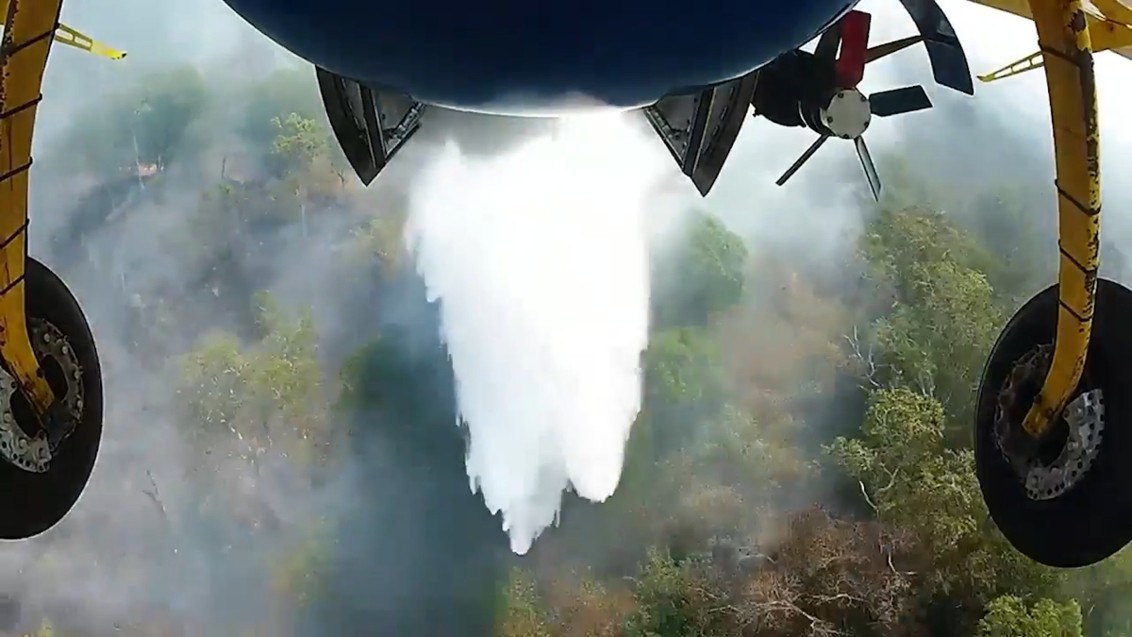
A survey of Australia’s aerial firefighting pilots has registered positive sentiment around tasking and communication within the sector, but some concern around safety and reporting culture.
Pilots were surveyed as part of the ATSB’s ongoing aerial firefighting safety study, which aims to identify systemic safety issues and other learnings to help enhance safety in aerial firefighting.
The survey, taken by 149 pilots registered with the National Aerial Firefighting Centre (NAFC), asked for opinions and experiences covering four key focus areas: tasking, communication, reporting culture and safety culture.
“Respondents were largely positive on the topic of tasking, with the exception being just over half did not consider decision-makers directing aircraft had sufficient aviation training and experience,” ATSB Director of Transport Safety Dr Stuart Godley outlined.
“Sentiment was also majority positive about communication within Australia’s aerial firefighting operations.
“But more negative sentiment was recorded on questions relating to reporting culture, and safety culture.”
Specifically, survey respondents were most critical over a perceived lack of adequate response when incidents were reported to a tasking agency.
There was also a statistically significant gap between respondents who said they had experienced an incident (61%) and those who said they had reported one (35%) in the sample timeframe.
The survey data has been published as Part B of the ATSB’s safety study.
Part A, released earlier this year, was an analysis of interviews conducted by the ATSB with 11 Australian fire agency representatives, and 9 aircraft operators involved in firefighting operations.
Part C of the study will expand upon prior ATSB analysis to identify key trends in occurrence data from aerial firefighting operations.
“These three reports will then be considered as we develop findings and make any recommendations in a final report,” Dr Godley said.
The Part B report notes several safety actions have already been taken, or are underway, as the safety study progresses.
The New South Wales Rural Fire Service has reported several initiatives since the time of the pilot survey, including the development and implementation of an Aviation Safety Management System.
Further, the NAFC’s Strategic Committee has committed to facilitate several safety actions, including aiding the development of nationally consistent standards, and strategies that identify and manage risk in aerial firefighting.
NAFC has also established the national fire and emergency Aviation Safety Group to reflect a stronger focus on aviation safety.
Read the Safety Report: Analysis of aerial firefighting pilots' survey responses regarding aviation safety
Image credit: XO Aviation