

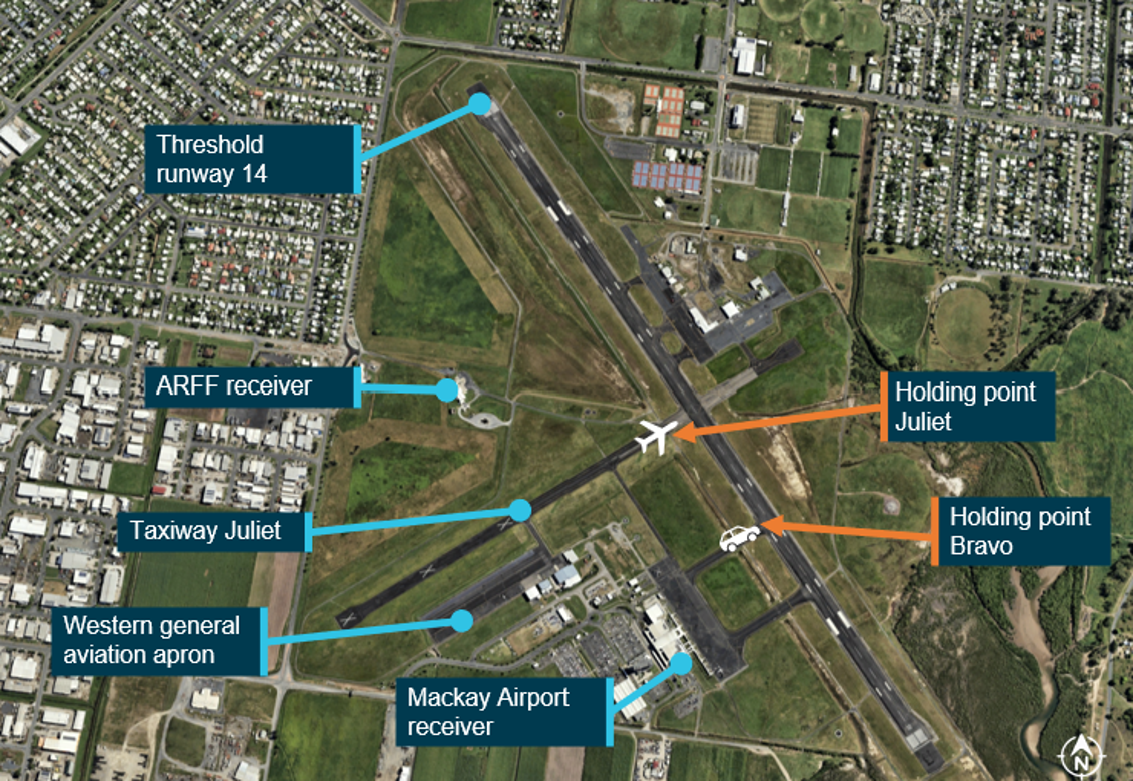
Poor quality radio transmissions and incomplete visual scanning contributed to a runway incursion and near collision involving a Metro freighter aircraft and an airport safety car at Mackay Airport, an ATSB investigation has found.
On 12 November 2025, the Sharp Airlines operated twin-turboprop aircraft was rolling for take-off for a freight flight from Mackay to Brisbane, the investigation’s final report details.
The take-off occurred outside Mackay Airport's tower hours, so the aerodrome was uncontrolled. Under these conditions, pilots and other aerodrome users are responsible for maintaining separation via communications on the Common Traffic Advisory Frequency (CTAF).
As the Metro approached rotation speed the pilot observed a car exiting the runway via taxiway Juliet, ahead of them. About 5 seconds later the aircraft rotated and took off, adjacent to the taxiway.
The investigation found radio transmissions from the aircraft on the CTAF were of poor quality.
This was due to a combination of the pilot’s rapid speech and use of non-standard phraseology, as well as interference associated with the use of the aircraft’s VHF COM 2 radio, which uses an antenna on the underside of the aircraft.
Additionally, the Metro pilot did not hear a broadcast made by the driver of the safety car as they entered the runway, likely due to reduced radio reception strength, and a concurrent broadcast on another frequency.
The investigation also found the airport safety officer did not scan for aircraft ground movements or keep a constant radio listening watch prior to entering the occupied runway, possibly due to being distracted while using a company-issued electronic flight bag (tablet) and not expecting the aircraft at that time.
“This serious incident reiterates how important it is for pilots and drivers operating at non-controlled airports to actively listen to the CTAF and always maintain a vigilant lookout,” ATSB Chief Commissioner Angus Mitchell said.
“It is crucial for broadcasts on the CTAF to be clear, concise, and accurate, including by pausing at the beginning and end of a transmission to avoid ‘clipping’, using standard phraseology, and speaking slowly and clearly.”
Mr Mitchell noted that the investigation identified Sharp Airlines had not formally risk-assessed identified hazards at non-controlled aerodromes, as required by its safety management system.
The operator has subsequently introduced a procedure to ensure any discussions around the identification and assessment of hazards are documented in safety meetings. It also conducted a formal assessment of the placement of antennas on its aircraft, and pilot radio selection at non-controlled aerodromes.
“Hazard identification and risk mitigation should be a continuous and ongoing activity for operators,” Mr Mitchell said.
“Safety performance needs to be monitored and reassessed to ensure the effectiveness of any risk control.”
In addition, the investigation also found Mackay Airport did not have specific guidance for the use of company-issued iPads in its safety cars.
Mackay Airport has subsequently updated and reinforced existing human factors training, and supplemented existing guidance on electronic flight bag use for operational demands.
Read the final report: Runway incursion and near collision involving Fairchild SA227-DC, VH-HPE, and an airport safety vehicle, at Mackay Airport, Queensland, on 12 November 2025