

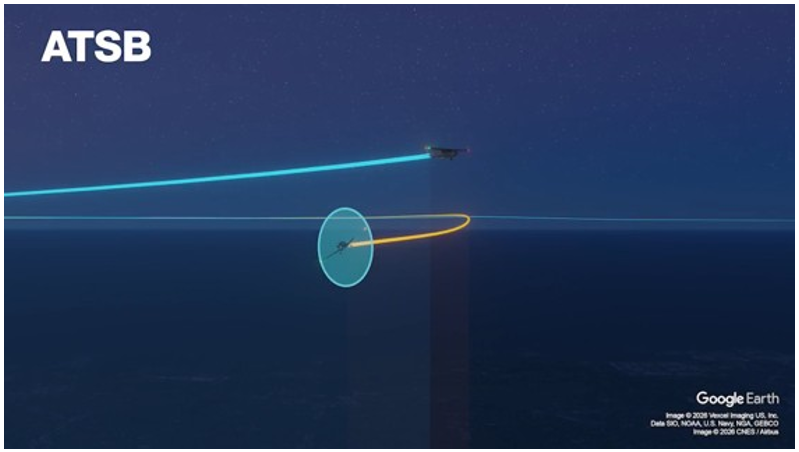
The pilots of two light aircraft were forced to take avoiding action to prevent a midair collision over Melbourne’s CBD when one of the pilots did not maintain adequate spacing to the slower preceding aircraft, an ATSB investigation report details.
The two aircraft, a Cessna 172 with a flight instructor and student pilot on board, and a Cirrus SR22 with a pilot and three passengers, had both been cleared to conduct an orbit over Melbourne’s CBD at an altitude of 2,100 ft on the evening of 22 January 2026, the report details. Both were operating under the night visual flight rules.
“In issuing a clearance for the orbit, air traffic control instructed the Cirrus pilot to follow the slower preceding Cessna,” explained ATSB Director Transport Safety Dr Stuart Godley.
“The Cirrus pilot advised ATC they had the Cessna sighted and would slow down. However, the Cirrus remained faster than the Cessna, resulting in a sustained reduction of lateral separation between the two aircraft.”
‘Shortly after the Cessna departed the orbit, the Cirrus was continuing turning through a westerly heading with a groundspeed of 146 kt when it encroached on the Cessna, which had a groundspeed of 86 kt.
The student and instructor in the Cessna sighted the Cirrus behind the left-wing strut heading directly towards the aircraft. The student recalled their initial reaction was to turn to the right. However, the instructor assumed control of the aircraft and recalled waiting to observe the avoiding action from the pilot of the Cirrus.
Around this time, the pilot of the Cirrus recalled that the Cessna became stationary in their windshield and assessed that the aircraft were on a collision course.
The Cirrus pilot pitched the aircraft down and descended from 2,100 ft shortly after. Having observed the Cirrus descend, the instructor in the Cessna then initiated a brief climb while maintaining a relatively consistent heading and airspeed.
The Cirrus passed 46 m behind and 99 ft below the Cessna.
No radio communication between the two aircraft took place following the encounter, nor was the incident advised to ATC.
“The investigation found the Cirrus pilot did not maintain adequate spacing to the preceding, slower Cessna,” said Dr Godley.
“Although the pilot of the Cirrus was provided traffic information for the Cessna by ATC, and their aircraft’s traffic advisory system, they did not reduce the aircraft’s indicated airspeed sufficiently to maintain adequate spacing.”
The report details that as the airspace over the Melbourne CBD is designated as controlled, clearance from ATC was required to undertake the orbits, but as they were operating under the visual flight rules, separation remained the responsibility of the pilot in command of each aircraft.
“Air traffic control sequencing is critical to the safe separation of aircraft operating within the same airspace, and pilots must accurately interpret and adhere to ATC clearances,” Dr Godley concluded.
“Pilots should continuously assess the relative proximity of nearby aircraft using all available sources of information.
“And where the developing traffic situation no longer matches the anticipated scenario, the timely reassessment and implementation of an alternative course of action is essential to restoring adequate separation and reducing the risk of collision.”
Read the final report: Near collision involving Cessna 172S, VH-KOJ, and Cirrus SR22, VH-XC5, about 21 km south‑south‑east of Melbourne Airport, Victoria, on 22 January 2026