

Report release date: 28/08/2026
| Occurrence Briefs are concise reports that detail the facts surrounding a transport safety occurrence, as received in the initial notification and any follow-up enquiries. They provide an opportunity to share safety messages in the absence of an investigation. Because occurrence briefs are not investigations under the Transport Safety Investigation Act 2003, the information in them is de-identified. |
What happened
On the morning of 12 July 2026, the pilot of a Cameron Balloons Sport‑90 hot air balloon took off from Rainbow, Victoria, for an extended solo recreational cross-country flight. The prevailing conditions following launch carried the balloon in a north-easterly direction and across the Victoria–New South Wales border at an average ground speed of 37 kt (67 km/h). After around 4 hours flight and a ground track of about 149 NM (268 km), the pilot descended for a landing in an open and uncultivated agricultural area near Hay, New South Wales.
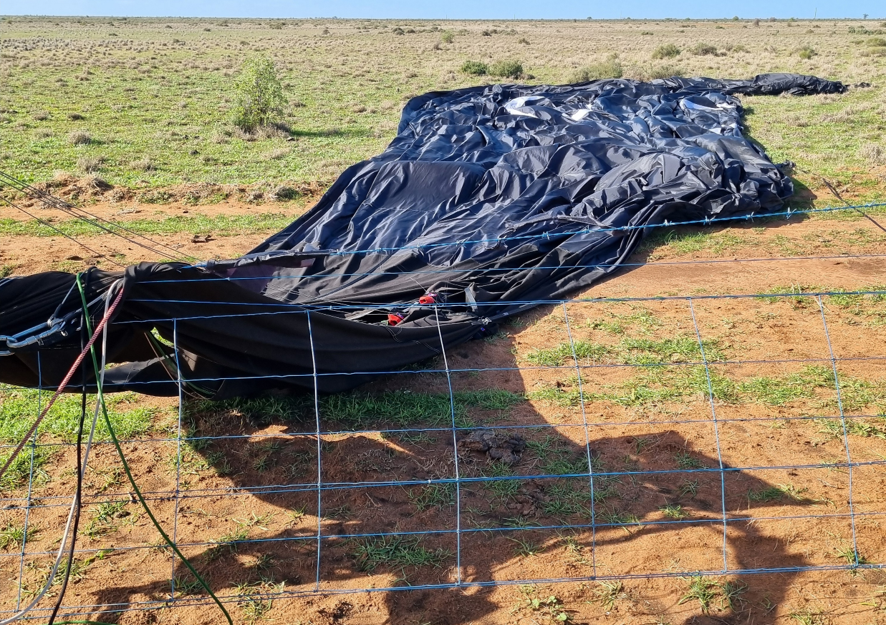
The pilot reported that the wind speed (and thus the balloon speed) was around 13 kt (23 km/h) on contact with the ground, with the basket laying over and dragging for some distance as the remaining buoyancy was vented and the envelope deflated. The pilot noted that during the landing, the dragging phase continued for longer than anticipated, resulting in the balloon overrunning the intended area and the envelope being pulled across a barbed wire fence (Figure 1). The envelope sustained substantial damage, with large tears/holes in 27 fabric panels and small holes in 2 panels. The envelope’s polyester load tapes, basket, burners and equipment were undamaged.
The pilot dislocated a finger of one hand during the landing but was otherwise uninjured.
Figure 1: Balloon envelope at rest across the barbed wire fence
Safety message
Hot air balloon landings that result in a basket lay-over and dragging phase are common with elevated windspeeds at ground level. Such landings require special precautions that begin with the selection of landing sites that have an extended clear and unobstructed surface in the direction of travel. Allowance should be made for an appreciable landing overshoot, should higher than anticipated speeds at ground level or delays in the envelope deflation prolong the dragging phase.
When operating with elevated windspeeds, landings should be planned early to allow for the safe discontinuation of multiple landing approaches, should the initially selected area/s not fully provide the needed obstacle-free pathway for the expected landing drag plus an allowable margin.
About this report
Decisions regarding whether to conduct an investigation, and the scope of an investigation, are based on many factors, including the level of safety benefit likely to be obtained from an investigation. For this occurrence, no investigation has been conducted and the ATSB did not verify the accuracy of the information. A brief description has been written using information supplied in the notification and any follow-up information in order to produce a short summary report, and allow for greater industry awareness of potential safety issues and possible safety actions.
Occurrence summary
| Mode of transport | Aviation |
|---|---|
| Occurrence ID | AB-2026-042 |
| Occurrence date | 12/07/2026 |
| Location | Near Hay |
| State | New South Wales |
| Occurrence class | Accident |
| Aviation occurrence category | Collision with terrain |
| Highest injury level | Minor |
| Brief release date | 28/08/2026 |
Aircraft details
| Manufacturer | Cameron Balloons Ltd |
|---|---|
| Model | Sport-90 |
| Sector | Balloon |
| Operation type | Part 133 Air transport operations - rotorcraft |
| Activity | General aviation / Recreational - Sport and pleasure flying - Pleasure and personal transport |
| Departure point | Rainbow, Victoria |
| Injuries | Crew – 1 (minor) |
| Damage | Substantial |