

Discontinuation notice
Report release date: 22/09/2026
| Section 21 (2) of the Transport Safety Investigation Act 2003 (TSI Act) empowers the ATSB to discontinue an investigation into a transport safety matter at any time. Section 21 (3) of the TSI Act requires the ATSB to publish a statement setting out the reasons for discontinuing an investigation. The statement is published as a report in accordance with section 25 of the TSI Act, capturing information from the investigation up to the time of discontinuance. |
What happened
On the evening of 10 August 2026, a Jetstar Airways Airbus A321-251NX (A321neo), registered VH‑OFS, was operating passenger transport flight JQ987 from Perth, Western Australia, to Sydney, New South Wales.
As the aircraft approached Sydney, it descended in dark night conditions with autopilot 2 and autothrust engaged. During the descent, westerly winds between 40–50 kt were recorded by the aircraft’s digital flight data recorder and the flight crew described turbulence experienced during the descent as moderate.1 At 2214 local time, air traffic control provided clearance for the crew to descend to 3,000 ft above mean sea level (AMSL) and make a left turn to join an approach for runway 34 left.
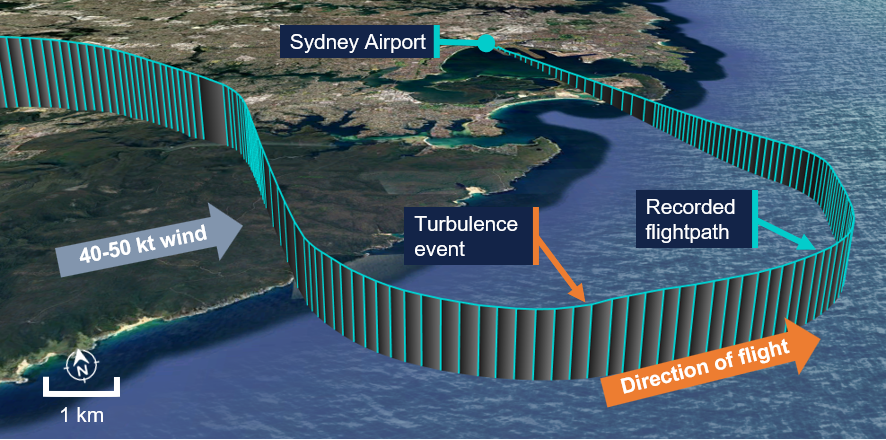
While in the turn and descending below 3,640 ft AMSL (Figure 1), the first officer, acting as pilot flying,2 asked the captain, acting as pilot monitoring, to select flaps 1. At about the same time that the captain selected flaps 1, the flight crew felt a larger turbulence encounter, the aircraft’s flight envelope angle of attack protection activated, and the autopilot disconnected (see the section titled Flight envelope protection). The aircraft pitch also increased from 7.7° nose-up to a maximum of 17.1° nose-up and the aircraft began to climb (see the section titled Recorded data). The autothrust system remained engaged and increased engine thrust to maintain airspeed.
Figure 1: Overview of turbulence event
As the aircraft climbed, the first officer attempted to reengage the autopilot, but turbulence once again caused the angle of attack protection to activate, and the autopilot disengaged again after 1 second. At the same time, the captain took control and manually lowered the nose to reduce the pitch angle and the angle of attack protection deactivated. The aircraft reached a maximum recorded altitude of 4,110 ft AMSL.
After reducing the pitch angle and reestablishing the descent, the captain then engaged autopilot 1. The autopilot engaged and the aircraft returned to the desired descent profile. The descent continued and the aircraft landed on runway 34 left at 2223 without further incident.
Aircraft information
The Airbus A321-251NX (A321neo) is a modern, fully digital, fly-by-wire aircraft. The flight controls are electronically actuated with the pilots using sidesticks to manoeuvre the aircraft in pitch and roll during manual flight.
Flight envelope protection
The A321neo flight control computers feature flight envelope protection that includes high angle of attack protection to guard against aerodynamic stall.
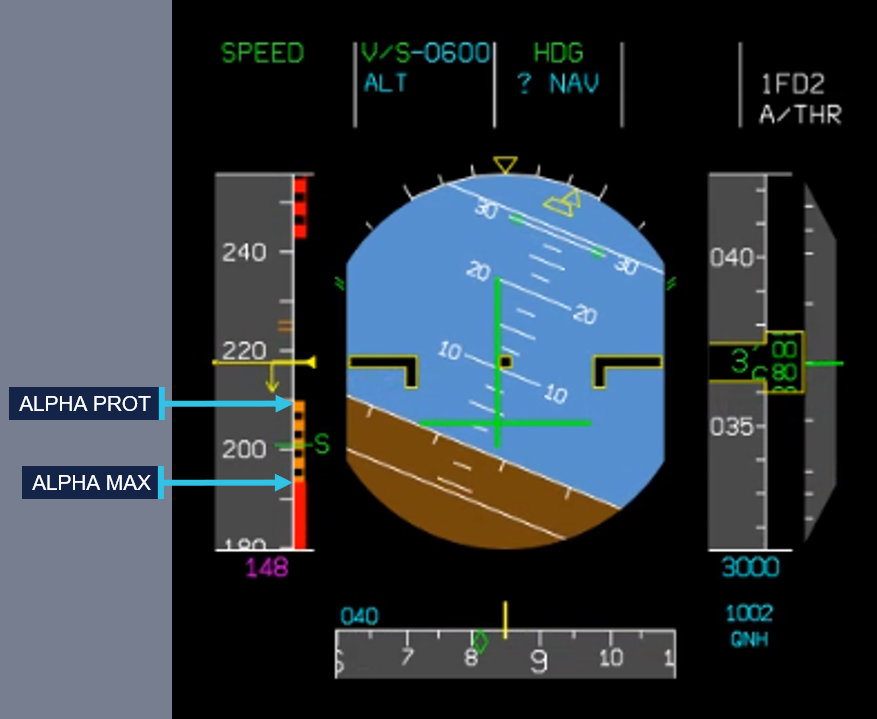
When the angle of attack3 increases above the protection angle (ALPHA PROT) (indicated by an amber and black strip on the primary flight display speed indication – Figure 2), the high angle of attack protection activates. When activated, the autopilot disengages (autothrust is not disengaged) and the flight control computer maintains an angle of attack equal to ALPHA PROT without flight crew input. The angle of attack can be further increased beyond ALPHA PROT by flight crew side stick input up to a maximum angle of attack slightly below the stall angle of attack (ALPHA MAX) (indicated by red on the primary flight display speed indication – Figure 2).
Figure 2: Representation of primary flight display during the turbulence event
Source: Supplied, annotated by the ATSB
The speeds that correspond to ALPHA PROT and ALPHA MAX are computer-calculated and vary with aircraft configuration, weight and load factor.4 Between ALPHA PROT and ALPHA MAX, a further flight envelope protection function, ALPHA FLOOR, may automatically set go-around thrust.
Regarding activation of alpha protection, the A321neo Flight crew operating manual stated:
If the flight crew flies into alpha protection, they should leave it as soon as other considerations allow. This is achieved by easing forward on the sidestick to reduce angle of attack below the alpha protection angle.
Post‑flight report and inspections
The post‑flight report recorded the automatic autopilot disengagement at 2217. No aircraft system fault was recorded during the flight.
Following the flight, an inspection of the angle of attack sensors and a test of the autoflight system were completed with no faults identified.
Recorded data
Jetstar provided the ATSB with the aircraft’s combined digital flight data and cockpit voice recorder that was downloaded in the ATSB laboratory.
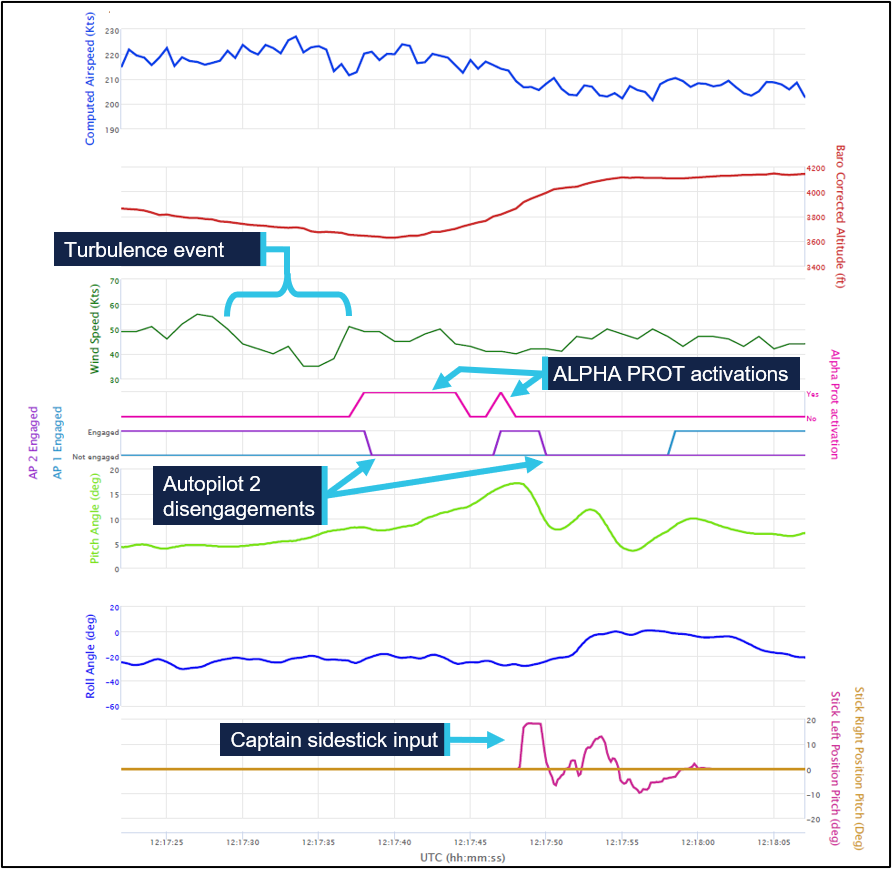
This data captured the turbulent conditions during the descent and the turbulence event at 2217:37 that led to the ALPHA PROT activation and autopilot deactivation 1 second later (Figure 3). At 2217:47, autopilot 2 was recorded as being reengaged but then disengaged 1 second later. Autopilot 1 was then engaged at 2217:59 and remained engaged until the aircraft was established on the approach for runway 34 left.
Figure 3: Graphical representation of recorded flight data
Source: ATSB
The maximum recorded pitch angle was 17.1° nose up at 2217:49 as the captain applied a manual nose down sidestick input.
No stall warning activation was recorded, nor did the ALPHA FLOOR flight envelope protection activate.
Manufacturer analysis
The aircraft manufacturer analysed the recorded flight data and found that the aircraft encountered a wind downdraft of about 2,300 ft per minute at about 2217:29. In response, the autopilot started to increase pitch to counteract the downdraft. Seven seconds later, the aircraft encountered a wind updraft of about 2,200 ft per minute and vertical speed began to increase from a 1,000 ft per minute descent eventually reaching a 3,500 ft per minute climb.
Two seconds later, the angle of attack reached ALPHA PROT and the angle of attack protection activated, disengaging the autopilot. At that time, no side stick input was recorded and the flight computer maintained ALPHA PROT. Eleven seconds later, at 2217:47 the captain applied full sidestick forward to reduce the angle of attack below ALPHA PROT. At about the same time, a second ALPHA PROT activation occurred that automatically disengaged the autopilot.
Reasons for the discontinuation
The ATSB strives to use its limited resources for maximum safety benefit and noted that in this case, the aircraft flight envelope protections worked as designed and the flight crew responded promptly and appropriately to reestablish the descent profile. Therefore, the ATSB considered it was unlikely that further investigation would identify any systemic safety issues or important safety lessons. Consequently, the ATSB has discontinued this investigation.
- ^ Moderate turbulence: changes in aircraft altitude and/or attitude occur, but the aircraft remains in positive control at all times. It usually causes variations in indicated airspeed.
- ^ Pilot flying (PF) and pilot monitoring (PM): procedurally assigned roles with specifically assigned duties at specific stages of a flight. The PF does most of the flying, except in defined circumstances such as planning for descent, approach, and landing. The PM carries out support duties and monitors the PF’s actions and the aircraft’s flight path.
- ^ Angle of attack: the acute angle between the chord line of the aerofoil and the direction of the relative airflow.
- ^ Load factor: the ratio of the lift of an aircraft to its weight and is also referred to as the G load.
Occurrence summary
| Investigation number | AO-2026-089 |
|---|---|
| Occurrence date | 10/08/2026 |
| Occurrence time and timezone | 2223 Australian Eastern Standard Time |
| Location | 27 km south of Sydney Airport |
| State | New South Wales |
| Report release date | 22/09/2026 |
| Report status | Discontinued |
| Investigation level | Short |
| Investigation type | Occurrence Investigation |
| Investigation status | Discontinued |
| Mode of transport | Aviation |
| Aviation occurrence category | Turbulence/windshear/microburst |
| Occurrence class | Incident |
| Highest injury level | None |
Aircraft details
| Manufacturer | Airbus |
|---|---|
| Model | A321-251NX |
| Registration | VH-OFS |
| Serial number | 11229 |
| Aircraft operator | Jetstar Airways Pty Limited |
| Sector | Jet |
| Operation type | Part 121 Air transport operations - larger aeroplanes |
| Activity | Commercial air transport-Scheduled-Domestic |
| Departure point | Perth Airport, Western Australia |
| Destination | Sydney Airport, New South Wales |
| Injuries | None |
| Damage | Nil |