

Preliminary report
Report release date: 30/09/2026
| The ATSB has released this preliminary report to provide a timely update on evidence gathered and investigation activities to date. It outlines areas of further investigation but does not contain analysis or findings, which will be detailed in a final report at the conclusion of the investigation. The information in this report is released in accordance with section 25 of the Transport Safety Investigation Act 2003. |
Summary video
The occurrence
On 9 August 2026, at 0716:36 local time, a Menzies Aviation Bliss-Fox F1-500-D ground support tractor (tug), callsign ‘Silver Victor’, began ground towing operations of a Qatar Airways Boeing 777-300ER (B777) aircraft, registered A7-BEU, from the international terminal 5, bay 32 at Sydney Airport, New South Wales, to remote bay 122 for daily storage (Figure 1, Figure 2, A). On board the B777 was an engineer (in the cockpit) and 5 cabin service agents (cleaners), while the tug had the driver and a head-setter1 monitoring the tow.
Figure 1: Planned taxi route for tug in tow with B777
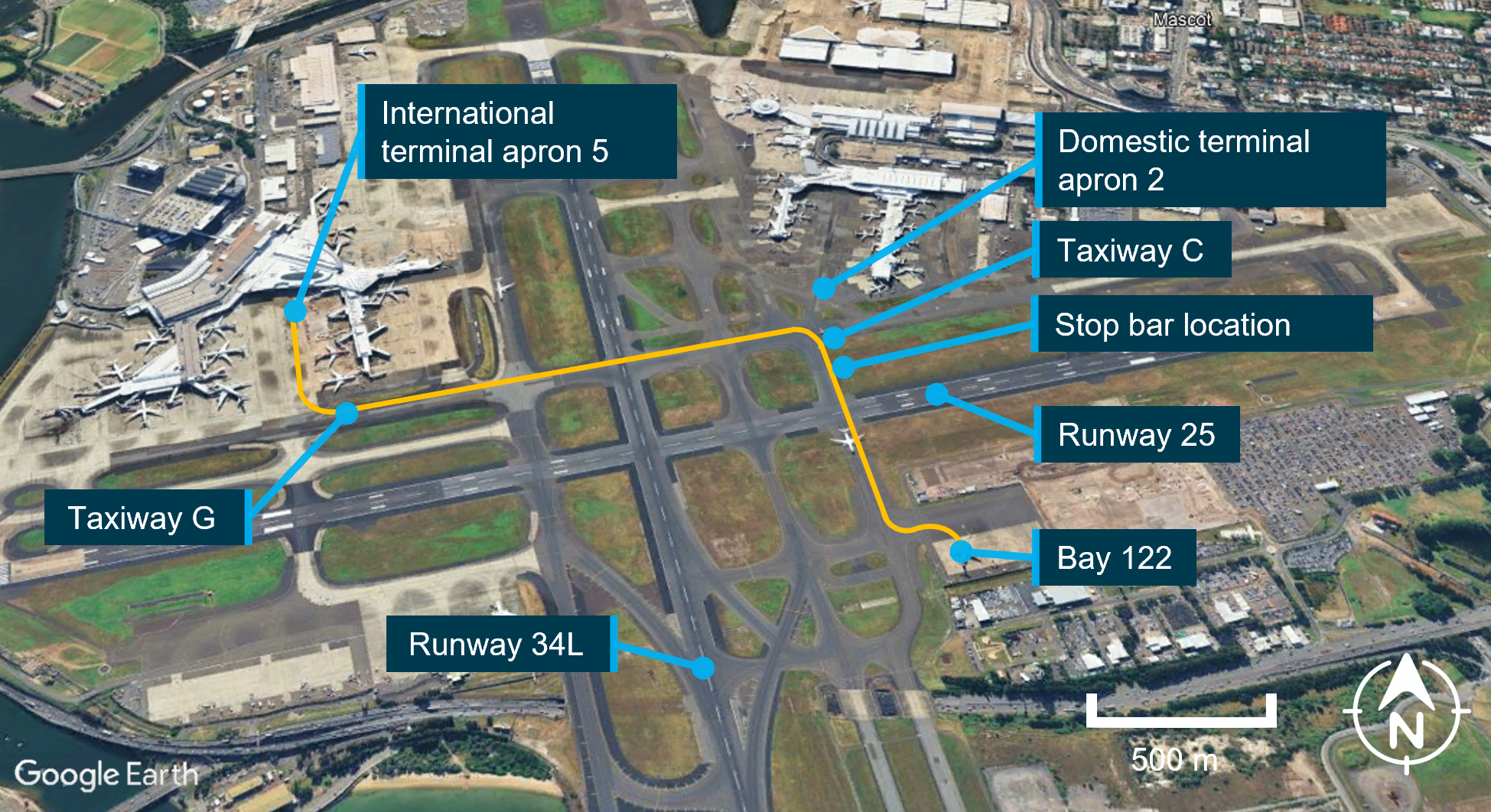
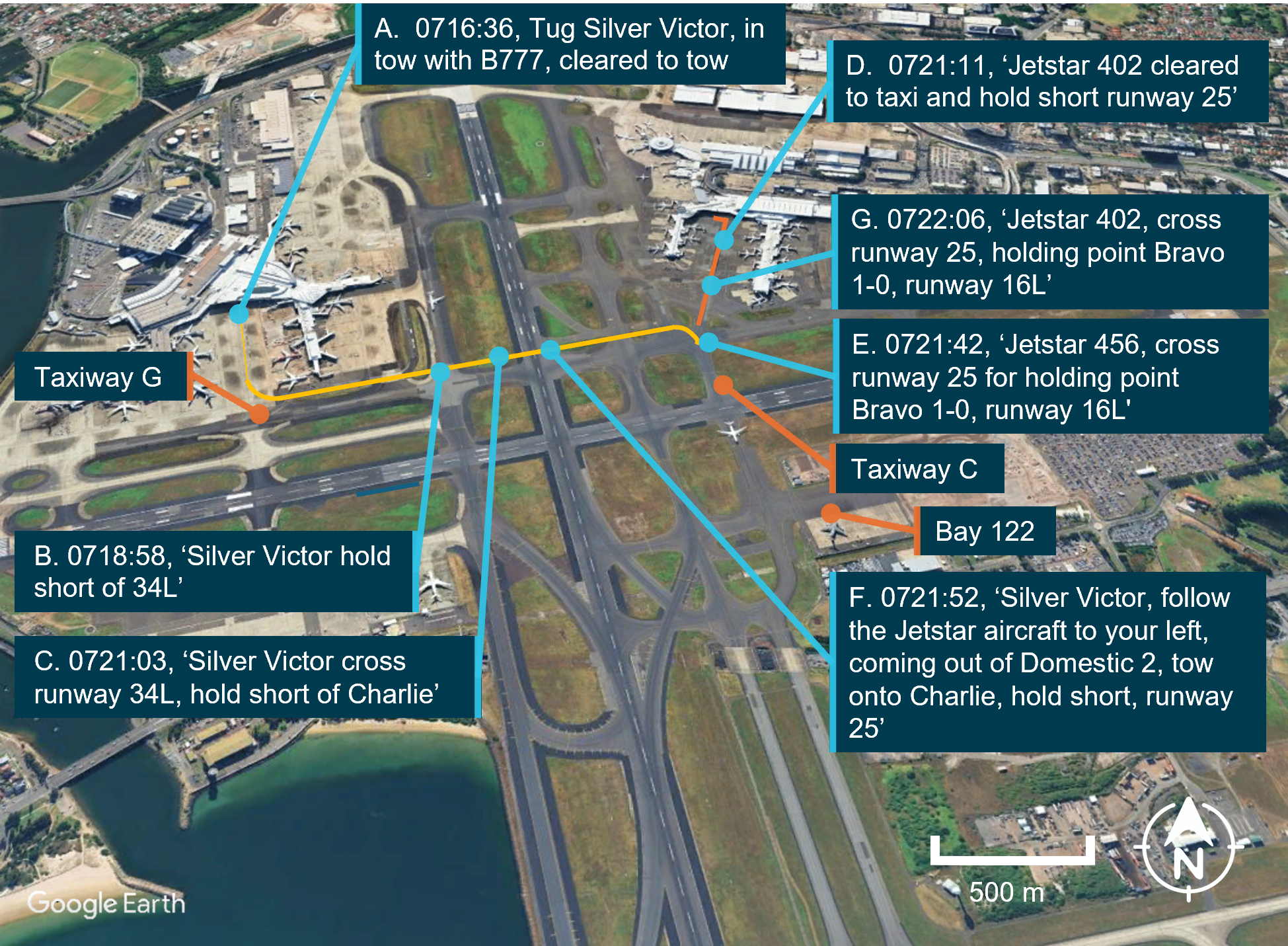
After departing international terminal apron 5, the tug turned onto taxiway Golf (G) and proceeded eastbound, before the tug driver was instructed by the air traffic surface movement controller (SMC) to hold short2 of runway 34 left (L)3 for traffic at 0718:58 (Figure 2, B). At 0721:03, Silver Victor was cleared by the SMC to cross runway 34L heading east on taxiway G, with an instruction to hold short of taxiway Charlie (C) (Figure 2, C).
Three seconds later, a Jetstar Airways Airbus A320-232 (A320) aircraft, registered VH‑VQJ (callsign Jetstar 402), with 180 passengers and 6 crew on board, was cleared by the SMC to taxi from domestic terminal apron 2 for a passenger transport flight to the Gold Coast, Queensland. The instructions given to the flight crew were to taxi via taxiway C, follow a preceding Jetstar Airways A320 (callsign Jetstar 456) and hold short of runway 25 (Figure 2, D). At 0721:30, Jetstar 402 began to move.
At 0721:37, Jetstar 456 crossed the intersection of taxiway C and G as tug Silver Victor crossed the centreline of runway 34L.
At 0721:42, the SMC cleared Jetstar 456 to cross runway 25 (Figure 2, E). Six seconds after that transmission, before finishing crossing runway 34L with the B777 in tow, Silver Victor was cleared to follow a ‘Jetstar aircraft’ to their left coming out of domestic apron 2, ‘tow onto taxiway Charlie and hold short of runway 25’ (Figure 2, F). The tow driver responded that they would ‘follow the Jetstar, tow onto Charlie and hold short of runway 25’.
The tug driver recalled visually identifying a Jetstar A320 aircraft that had just crossed from their left to right and proceeded to follow that aircraft onto taxiway C. However, the aircraft they identified was the A320 operating as Jetstar 456, and the driver had not yet identified that there was a second Jetstar A320 (Jetstar 402) leaving the domestic 2 apron.
As Jetstar 456 approached the holding point to begin its cross of runway 25, Jetstar 402 departed the domestic terminal apron and tracked towards taxiway C. At 0722:06, Jetstar 402 was given clearance by the SMC to cross runway 25 (Figure 2, G). The captain, who was the pilot flying,4 recalled proceeding along taxiway C towards the runway at about 15 kt.
Figure 2: Aircraft and tow vehicle movements and clearances at Sydney Airport
The driver of Silver Victor then recalled identifying another Jetstar aircraft approaching from their left. The engineer on board the B777 also recalled identifying the second Jetstar aircraft approaching from the left at about the same time. However, both the driver and engineer were expecting the approaching Jetstar aircraft to stop to allow them passage.
The first officer (FO) of Jetstar 402, who was the pilot monitoring, reported that, while approaching the intersection of taxiway C and G, they could not proceed in accordance with their clearance to cross runway 25 due to the stop bar lights being illuminated (see Stop bars). The FO focused their attention on the stop bar lights and transmitted a call to the SMC to advise ‘stop bar’. Directly after this, the captain of Jetstar 402, while conducting a visual scan left to right on taxiway G, identified the approaching B777 under tow on taxiway G and initiated an emergency stop.
The tug driver, who had slowed and begun the turn onto taxiway C, identified the Jetstar aircraft (Jetstar 402) in close proximity and initiated an emergency stop about 3 seconds after Jetstar 402 had stopped. The head-setter of the tug vehicle made a brake command to the engineer on board the B777 and they initiated braking, bringing the B777 to a stop about 3 seconds later.
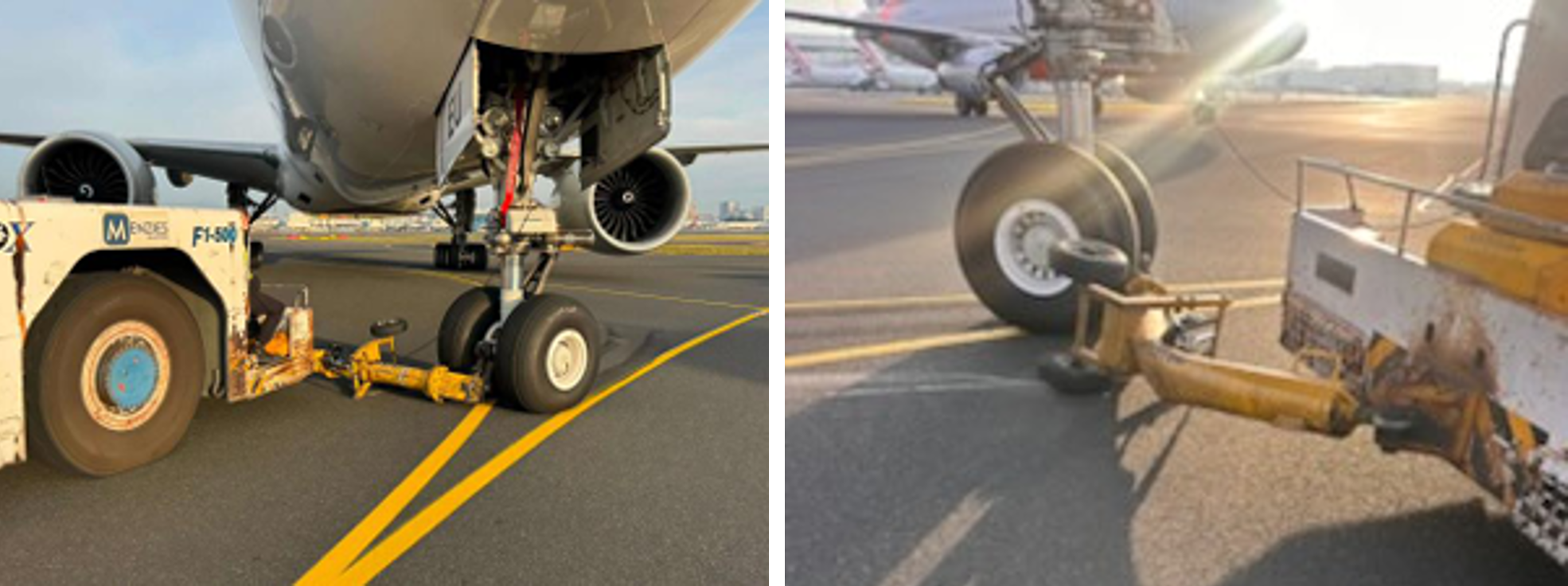
However, during the initial emergency stop performed by the tug driver, the tow bar, compressed under the heavy braking pressure and aircraft momentum, deformed and obstructed the B777 nosewheels, which prevented further rotation and caused minor damage (Figure 3). There were no injuries to those on the tug or in the B777.
Figure 3: Damage to the aircraft tow bar
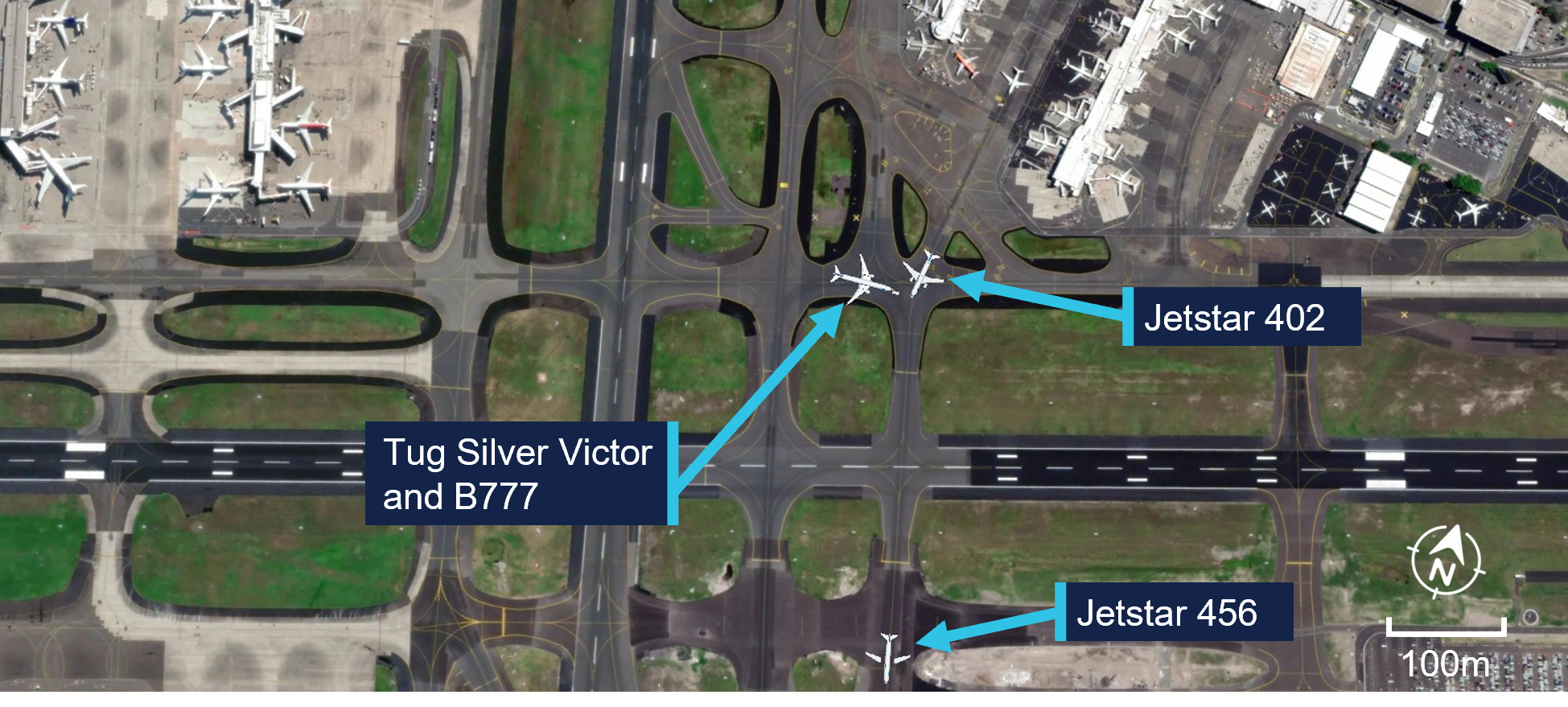
The tug in tow with the B777 and Jetstar 402 came to a stop with less than 30 m separation (Figure 4). Further manoeuvring by the tug vehicle was not possible due to the failure of the tow bar.
Figure 4: Proximity of tug and aircraft post-event
The Jetstar 402 flight crew then received reports that a cabin crew member had sustained a broken wrist due to a fall after the emergency application of brakes. The cabin crew member was treated on board, and Jetstar 402 was returned to the gate to provide further medical assistance to the injured crew member.
Context
Personnel information
Jetstar 402 flight crew
The captain held an Air Transport Pilot Licence (ATPL) (Aeroplane), a valid class 1 aviation medical certificate, and had a total flying time of 16,633 hours of which 12,082 hours were on the A320 aircraft. The captain indicated they were familiar with Sydney Airport and operated daily from there as their local port. They reported having been on duty for about 2.2 hours and awake for 3.2 hours prior to the occurrence, had slept about 8 hours the night before and were feeling very lively, responsive, but not at peak (Samn-Perelli scale 2).5
The FO held a Commercial Pilot Licence (Aeroplane), a valid class 1 aviation medical certificate, and had a total flying time of about 2,360 hours, of which about 750 hours were on the A320 aircraft. The FO was also familiar with Sydney Airport having regularly operated multiple times a week for the past year from that location. The FO reported that they had been on duty for about 2 hours and awake for 3 hours prior to the occurrence, had slept about 6 hours the night before and were feeling very lively, responsive, but not at peak.
Towing personnel
Menzies Aviation tug vehicle driver
The tug driver held a category 4 airside driving certificate and had worked for Menzies Aviation for about 3 years as a baggage handler, aircraft loader and tug driver. They reported having about 9 months experience towing aircraft at Sydney Airport and conducted the operations 2–3 times daily. The tug driver stated that they had been on duty for about 1.5 hours and awake for 2.5 hours prior to the occurrence and had slept about 8.5 hours the night before.
Qatar B777 engineer
The engineer on board the aircraft conducted tow operations as part of their normal duties as the aircraft brake operator6 (brake-rider) on board towed aircraft for Qatar. They had worked for the organisation for about 10 years, 3 of these were at Sydney Airport as an engineer, and they conducted brake-riding operations 2–3 times a week. They had 26 years previous experience working on a variety of other commercial aircraft types for another international airline. The engineer indicated that they had been on duty for about 2 hours and awake for 2.5 hours prior to the occurrence and had 8.5 hours of good sleep the night before.
Surface movement controller
The SMC was correctly endorsed for their role and reported that they were fully endorsed on all air traffic control roles at Sydney Airport, apart from the tower shift manager position. They had over 8 years experience and had been working at Sydney Airport for about 5 years.
The controller began their shift at 0550 and had returned from a scheduled rest period of about 20 minutes just prior to the occurrence. They reported feeling very lively, responsive, but not at peak. They indicated that aircraft movements were not excessive in the period leading up to the occurrence.
The controller did not have an elevated predicted fatigue level based on their previous roster (see Fatigue Management). The controller reported having about 7 hours of average quality sleep the night before the occurrence, 7.5 hours of average sleep the day prior and 9 hours the 2 nights before.
Aircraft information
Jetstar A320, VH-VQJ (Jetstar 402)
The Airbus Industrie A320 aircraft, registered VH-VQJ, was a modern, low-wing passenger transport aircraft, powered by 2 V2527-A5 turbofan engines, manufactured in France in 2006 with serial number 2703 and first registered in Australia on 2 March 2006. The aircraft was configured with 180 passenger, 4 cabin crew and 2 flight crew seats.
Qatar Airways Boeing 777, A7-BEU
The Boeing 777-3DZER aircraft, registered A7-BEU, was a modern, low-wing passenger transport aircraft, powered by 2 GE90-115B turbofan engines, manufactured in the United States in 2018 with serial number 65302.
Meteorological information
The Bureau of Meteorology reported that the visibility at Sydney Airport at the time of the occurrence was greater than 10 km. Cloud was observed to be few7 at 4,000 ft, with no other cloud observed below 5,000 ft in the vicinity of the airport. The wind was about 6 kt from the north-west, the temperature was about 10°C with a dewpoint8 of 7°C.
Witnesses on the A320 (Jetstar 402), B777 and the tug all indicated that there was no adverse weather that would have affected operations, and that visibility was good on the ground at Sydney Airport.
Air traffic services information
Roles
At Sydney Airport, air traffic services were provided by Airservices Australia. Sydney tower had 7 control positions, which included the aerodrome controller east and west, SMC east and west, clearance delivery, coordinator, and tower shift manager (TSM).
The aerodrome controller east was responsible for movements on runway 34R/16L, and the west controller was responsible for movements on runway 34L/16R.
The SMC east was responsible for vehicles and aircraft using taxiways east of runway 34L/16R, and SMC west was responsible for vehicles and aircraft using taxiways west of runway 34L/16R. As the aircraft movements were not excessive in the period leading up to the occurrence, the SMC east and west positions were combined and were staffed by one controller. The SMC was then responsible for controlling all aircraft and vehicle movements on the airport aprons, non-operational runways and other manoeuvring areas.
The clearance delivery controller was responsible for obtaining and providing airways clearances9 to aircraft in preparation for their departure.
The coordinator was responsible for keeping the automatic terminal information service10 updated and working with external stakeholders on departure times. The position helped control the flow of departures and keep aircraft engine run times to a minimum. The coordinator role supported the SMC by providing sequencing of ground movements and deconfliction of ground traffic.
The TSM role was to provide general supervision of operational staff to ensure a safe and efficient air traffic service and to provide overall responsibility for the provision of the tower’s air traffic service.
At the time of the occurrence, the TSM position was combined with the Sydney coordinator position due to a staff absence in the roster. It was reported that the combined TSM and coordinator role could introduce greater administrative requirements to the coordinator role.
None of the controllers in the combined positions were undertaking training at the time.
Fatigue management
Regulatory information
The Civil Aviation Safety Regulations Part 172 (Air Traffic Service Providers) Amendment (Fatigue Rules) Manual of Standards 2023 required Airservices to have a fatigue risk management system (FRMS) that was approved by the Civil Aviation Safety Authority (CASA) for implementation by 1 September 2024. Airservices had submitted a draft FRMS to CASA, however, the FRMS had not yet been approved. Airservices had been operating under a CASA exemption since 1 September 2024, which permitted operations without an approved FRMS.
CASA reported that, while the exemption was in place, Airservices continued to operate under existing fatigue risk management arrangements and was required to meet a number of additional conditions. This included providing CASA with regular reports on fatigue risk management and progress towards the development of an FRMS.
The current exemption commenced on 1 September 2026 and was due to expire on 28 February 2027. CASA expects Airservices to have an approved FRMS in place by the expiry of the exemption.
Fatigue risk management process
The Airservices fatigue risk management process focused on 2 controls: work scheduling, and education and awareness. Managing fatigue-related risk involved developing planned rosters/work cycles via a strategic roster planning process (which contained 12 strategic roster planning rules) and application of the tactical roster management process (risk identification, assessment and control) when changes to planned rosters/work cycles were required.
A controller could be allocated to a shift if their predicted fatigue level was ‘medium’ or ‘high’. However, a formal risk assessment was required. The risk assessment considered the expected operational situation for the shift (for example, the time of day and traffic volume) and applicable controls. The outcome of the risk assessment required acceptance by a supervisor or manager, dependent on the risk level.
Fatigue level predictions did not indicate that a controller was fatigued, but rather, that they were at risk of fatigue based on their roster. In addition to the organisational fatigue monitoring, Airservices Australia required all controllers to advise their manager if they felt they were not fit for duty.
Airservices provided a list of risk controls that could be implemented to mitigate the impact of fatigue, which was managed by the TSM. Some of those risk controls included extra breaks for controllers at risk, change of duties during the shift, and releasing the controllers from their duties earlier than their scheduled finish time.
At the time of the occurrence, Sydney Tower was operating with high predicted fatigue levels for the TSM, a medium level for one aerodrome controller and a low level for the clearance delivery controller. The SMC coordinating both east and west ground movements was not identified as having an increased risk of fatigue.
Roster information
The rostered duty times for the SMC and TSM during the period 3 to 8 August 2026 are depicted in Table 1.
Table 1: Controller rostered duty times 3 August to 9 August
| Controller | 3 Aug 2026 | 4 Aug 2026 | 5 Aug 2026 | 6 Aug 2026 | 7 Aug 2026 | 8 Aug 2026 | 9 Aug 2026 |
| SMC | 2015-0545 | 2145-0545 | Off | Off | Off | 0550-1330 | 0550-1330 |
| TSM | 0515-1145 | 0550-1330 | 1330-2130 | 2145-0545 | 15:30-00:00 | 1330-2130 | 0515-1145 |
Source: Airservices Australia
Towing operations
General
Aircraft tow operations occur multiple times a day at Sydney Airport. Aircraft are moved from the terminal parking bays to storage bays around the airport to facilitate the effective usage and prioritisation of arriving and departing traffic and passengers at the airport. If an arriving aircraft is not being utilised for a period, the aircraft is towed to a remote storage bay until it is required.
Tow vehicle
The Bliss-Fox F1-500-D tug was a widebody, pushback, tow vehicle manufactured in 2008 as serial number F1-500-04 and had a total time of about 5,640 hours of operation at the time of the occurrence. The tug was fitted with an inline 6-cylinder, 600 horsepower diesel engine, capable of towing aircraft up to 592 tonnes (Airbus A380) and was fitted with hydraulically‑controlled brakes.
The tug was fitted with an ICOM IC-A110 very high frequency air band radio transceiver. The driver would hear radio transmissions through a speaker in the cab and made transmissions by the use of a handheld microphone. The tug driver used this radio to request and readback operational clearances to air traffic control to coordinate safe towing passage across the airport.
Towbar
The towbar connecting the B777 to the tow vehicle was a Clyde Machines CLY‑15F3300, manufactured in 2023 as serial number 108521. It was a heavy-duty aircraft towbar designed to connect a tug to aircraft nose landing gear and was compatible with all Boeing 777 models. The towbar transferred towing and braking forces through a reinforced towbar with shear pins in place to reduce the risk of damage to the aircraft during abnormal loading. The towbar was fitted with a heavier shear pin for towing Boeing 777 and 787 aircraft.
Communications with towed aircraft
The Menzies Aviation head-setter, seated at the rear of the tug, wore an aviation headset with an extension cord that plugged into the side of the B777 for direct communications with the engineer in the cockpit to coordinate the tow and to communicate braking requirements. The head-setter faced backwards towards the aircraft, without any direct line of sight to the tug driver, to watch the tow bar linkage and report issues to the driver.
The tug driver was able to see behind them through rear vision mirrors and a video screen in the tug through a rear facing camera. While they could see the head-setter in the frame, they could only communicate through hand signals, due to no direct means of verbal communication due to the noise of the tug during towing.
Recorded information
VH-VQJ (Jetstar 402)
Recorded information for Jetstar 402 was obtained from the operator through the provision of the flight data recorder (FDR) and cockpit voice recorder (CVR). The FDR contained about 26.5 hours of data, including the occurrence. The CVR operated on an endless loop principle and contained 3 individual 30-minute recordings of each crew channel, 2 hours of the crew channels combined into a single file, and 2 hours from the cockpit area microphone. The occurrence was captured on the 2-hour recordings, but the individual channels had been recorded over prior to the CVR being quarantined for the investigation.
Analysis of the FDR and CVR data pertaining to the occurrence will be provided in the ATSB’s final investigation report.
A7-BEU
FDR and CVR data were not available for the ground tow operations of the Boeing 777 as they were not recording as the aircraft was not intended to be operated for flight.
Airservices Australia data
Airservices provided a number of recordings from the advanced surface movement guidance and control system (A-SMGCS). This system uses many distributed radio frequency sensors and surface movement radar to detect vehicles and aircraft on the airport surface. Aircraft and ground vehicles are fitted with a transponder, which transmits a signal to a receiver at the airport. Used at major airports, A-SMGCS shows the position of aircraft and ground vehicles on a screen in front of the SMC in the tower (Figure 5). This provided the SMC with control of routing, guidance and surveillance of aircraft and ground vehicle movements at Sydney Airport.
Air traffic control very high frequency audio and coordination recordings were also provided as part of the investigation.
Figure 5: Advanced surface movement guidance and control system showing the positions of Jetstar 402 (‘JST402’) and the tug/B777 (‘SILV’)
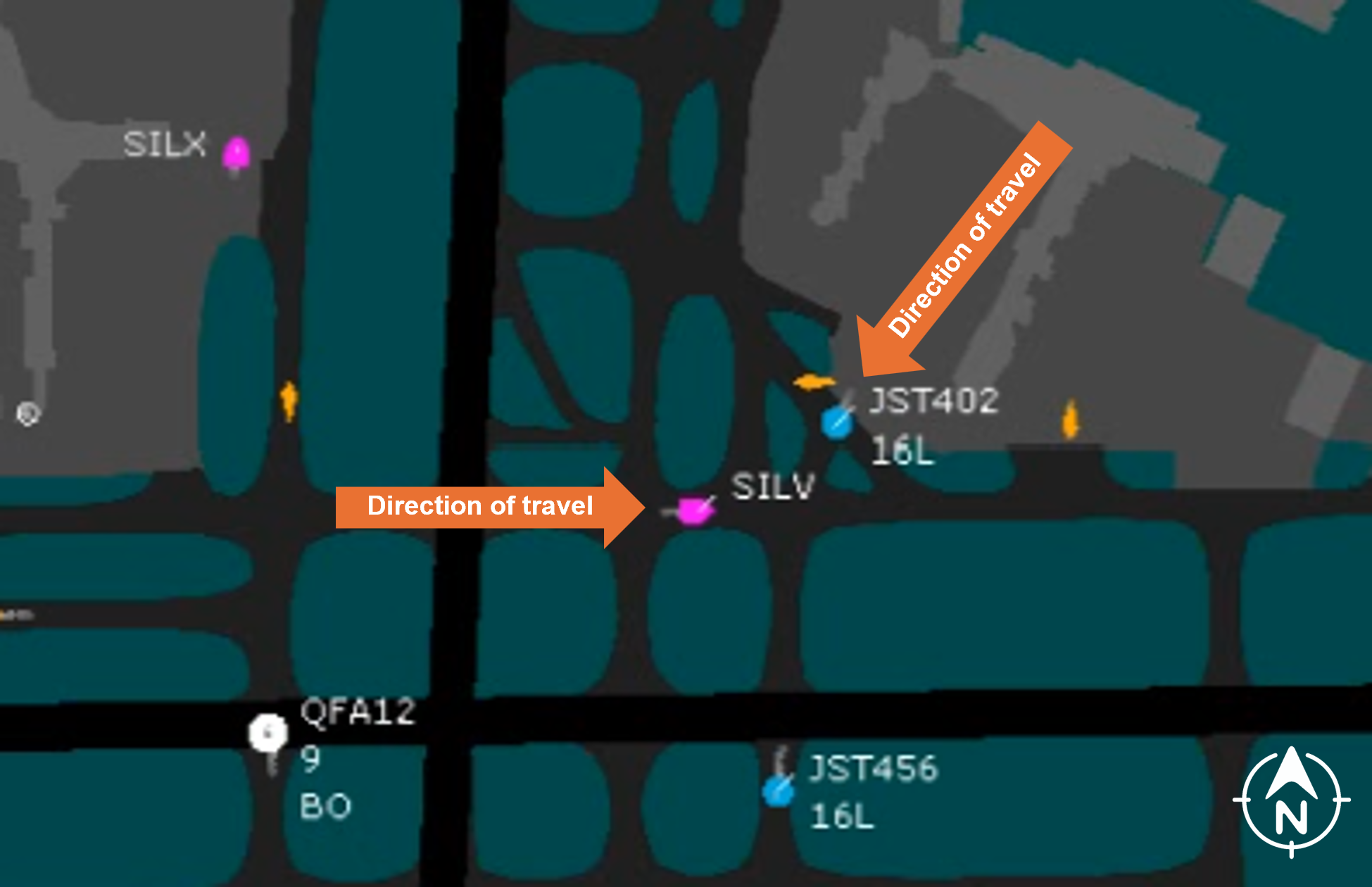
Source: Airservices Australia, annotated by the ATSB
Data relating to the towing operation, Jetstar 402 and Jetstar 456 was provided and details of this analysis will be available in the final report.
Sydney Airport video footage
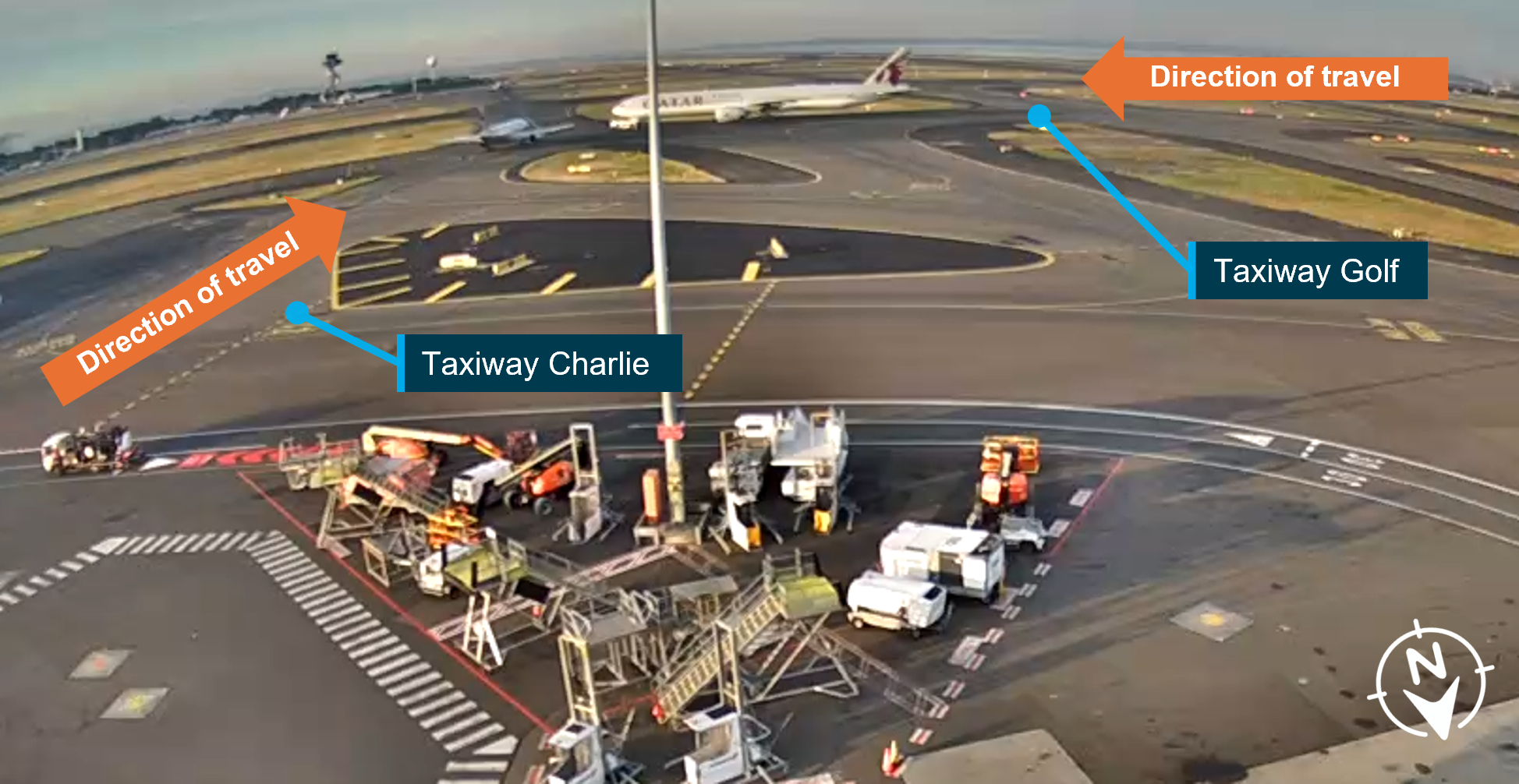
Closed-circuit television footage was provided by Sydney Airport directed towards the intersection of taxiway C and G. The footage shows the approach of both the B777 under tow on taxiway G and Jetstar 402 during taxi on C (Figure 6).
Figure 6: Closed-circuit television footage of intersection
Stop bars
Stop bars were intended to provide additional protection of runway/taxiway intersections to prevent aircraft inadvertently entering the runway without an air traffic control clearance. They were a series of unidirectional lights at right angles to a taxiway centreline. The lights were spaced 3 m apart and located 0.3 m before a holding point. Stop bars showed red in the direction of approach to the stop bar. In order to extinguish the stop bar on the non-duty runway (applicable to runway 25 at the time of the occurrence), the SMC was required to wait until the stop bar reset timeframe had elapsed after any preceding aircraft had passed clear of the stop bar intersection.
The flight crew was required to stop and hold their aircraft at all illuminated stop bars. Flight crew could only proceed to taxi an aircraft once a clearance to enter or cross a runway had been received and the stop bar lights had been switched off by air traffic control.
Further investigation
To date, the ATSB has:
- received and commenced analysis of the Airservices Australia advanced surface movement guidance and control system and air traffic control audio recordings
- downloaded the CVR and FDR for Jetstar 402
- interviewed the Menzies Aviation tug driver and head-setter, the Qatar engineer onboard the aircraft, the flight crew of Jetstar 402, and the SMC
- obtained closed-circuit television footage.
The investigation is continuing and will include:
- further review, examination and analysis of the supplied closed-circuit television footage
- analysis of recorded aircraft and air traffic control data and recordings
- review of flight crew and tug driver decision‑making
- review of operational procedures relating to aircraft towing, use of stop bars and radio phraseology.
- review of Airservices fatigue management and rostering.
Should a critical safety issue be identified during the course of the investigation, the ATSB will immediately notify relevant parties so appropriate and timely safety action can be taken.
A final report will be released at the conclusion of the investigation.
Purpose of safety investigationsThe objective of an ATSB safety investigation is to improve transport safety through:
In accordance with the TSI Act, the ATSB does not investigate for the purpose of taking administrative, regulatory or criminal action, and cannot apportion blame, assist in determining liability, or, as a general rule, assist in court proceedings. About ATSB reportsATSB safety investigation reports are developed in accordance with ATSB procedures and guidelines, and with regard to applicable international standards and instruments. Reports must include factual material of sufficient weight to support the investigation’s analysis and findings. At all times the ATSB endeavours to balance the use of material that could imply adverse comment with the need to properly explain what happened, and why, in a fair and unbiased manner. An explanation of terminology used in ATSB investigation reports is available here. Publishing informationReleased in accordance with section 25 of the Transport Safety Investigation Act 2003 Published by: Australian Transport Safety Bureau © Commonwealth of Australia 2026 Ownership of intellectual property rights in this publication Unless otherwise noted, copyright (and any other intellectual property rights, if any) in this report publication is owned by the Commonwealth of Australia. Creative Commons licence 
With the exception of the Commonwealth Coat of Arms, ATSB logo, and photos and graphics in which a third party holds copyright, this report is licensed under a Creative Commons Attribution 4.0 International licence. The CC BY 4.0 licence enables you to distribute, remix, adapt, and build upon our material in any medium or format, so long as attribution is given to the Australian Transport Safety Bureau. Copyright in material obtained from other agencies, private individuals or organisations, belongs to those agencies, individuals or organisations. Where you wish to use their material, you will need to contact them directly. |
- ^ A crewman at the rear of the tow vehicle that monitors the tow linkage to the aircraft and provides braking guidance to the aircraft by wearing a headset.
- ^ Instruction to require the aircraft to stop at the marked runway holding point and that no part of the aircraft extends onto the runway.
- ^ Runway number: the number represents the magnetic heading of the runway (for example, runway 34 is oriented 340° magnetic). The runway identification may include L, R or C as required for left, right or centre.
- ^ Pilot flying (PF) and pilot monitoring (PM): procedurally assigned roles with specifically assigned duties at specific stages of a flight. The PF does most of the flying, except in defined circumstances; such as planning for descent, approach and landing. The PM carries out support duties and monitors the PF’s actions and the aircraft’s flight path.
- ^ The Samn-Perelli scale for self-evaluating fatigue ranges from 1 (fully alert) to 7 (completely exhausted). A rating of 2 indicated ‘very lively, responsive, but not at peak.
- ^ The aircraft brake operator rides with an aircraft during a tow. They operate the aircraft systems as required, including the aircraft brakes. This role is also referred to as the brake rider.
- ^ Cloud cover: in aviation, cloud cover is reported using words that denote the extent of the cover – ‘few’ indicates that up to a quarter of the sky is covered.
- ^ Dewpoint: the temperature at which water vapour in the air starts to condense as the air cools. It is used, among other things, to monitor the risk of aircraft carburettor icing or the likelihood of fog.
- ^ Airways clearance: in controlled airspace such as Sydney, aircraft are required to obtain a cleared route from air traffic control which, they are required to follow.
- ^ Automatic terminal information service (ATIS): an automated pre-recorded transmission indicating the prevailing weather conditions at the aerodrome and other relevant operational information for arriving and departing aircraft.
Occurrence summary
| Investigation number | AO-2026-087 |
|---|---|
| Occurrence date | 09/08/2026 |
| Occurrence time and timezone | 0720 Australian Eastern Standard Time |
| Location | Sydney Airport |
| State | New South Wales |
| Report release date | 30/09/2026 |
| Report status | Preliminary |
| Anticipated completion | Q1 2027 |
| Investigation level | Short |
| Investigation type | Occurrence Investigation |
| Investigation phase | Examination and analysis |
| Investigation status | Active |
| Mode of transport | Aviation |
| Aviation occurrence category | Ground handling, Taxiing collision/near collision |
| Occurrence class | Accident |
| Highest injury level | Serious |
Aircraft details
| Manufacturer | Airbus |
|---|---|
| Model | A320-232 |
| Registration | VH-VQJ |
| Serial number | 2703 |
| Aircraft operator | Jetstar Airways Pty Limited |
| Sector | Jet |
| Operation type | Part 121 Air transport operations - larger aeroplanes |
| Activity | Commercial air transport-Scheduled-Domestic |
| Departure point | Sydney Airport, New South Waless |
| Destination | Gold Coast Airport, Queensland |
| Injuries | Crew – 1 (serious) |
| Damage | Nil |
Aircraft details
| Manufacturer | The Boeing Company |
|---|---|
| Model | 777 |
| Registration | A7-BEU |
| Serial number | 65302 LN:1552 |
| Aircraft operator | Qatar Airways |
| Sector | Jet |
| Operation type | Part 129 Foreign air transport operators |
| Activity | Ground operations |
| Departure point | Sydney Airport, New South Wales |
| Destination | Sydney Airport, New South Wales |
| Injuries | None |
| Damage | Minor |