

Report release date: 23/07/2026
| Occurrence Briefs are concise reports that detail the facts surrounding a transport safety occurrence, as received in the initial notification and any follow-up enquiries. They provide an opportunity to share safety messages in the absence of an investigation. Because occurrence briefs are not investigations under the Transport Safety Investigation Act 2003, the information in them is de-identified. |
What happened
On the morning of 26 June 2026, a pilot was landing a Robinson R22 helicopter in a paddock about 9 km north-west of Moree Airport, New South Wales.
The pilot reported being ‘rushed’ due to operational needs. During the landing, the helicopter's skid contacted a tuft of grass with a small amount of sideways movement while the collective was in a raised position. This resulted in a roll to the right.
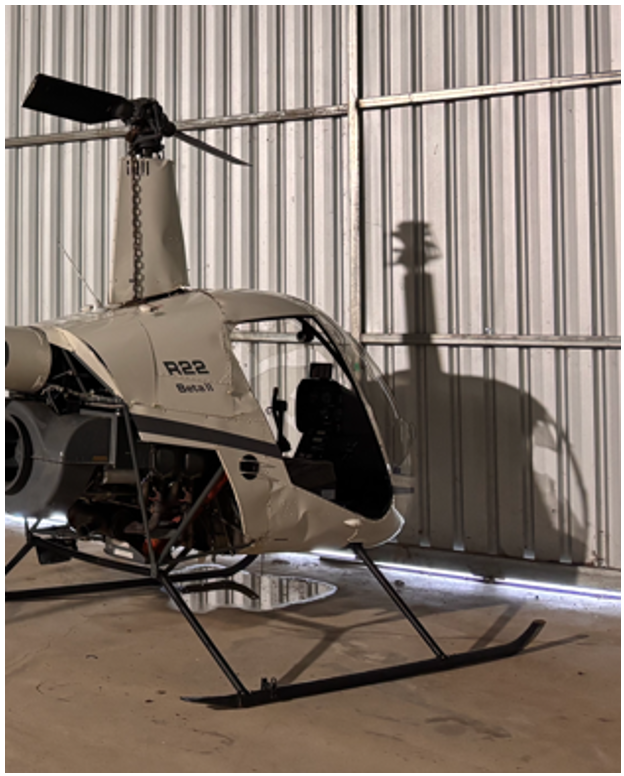
With the helicopter’s skid still in contact with the ground, the main rotor blades impacted the ground. The helicopter came to rest on its right side and was substantially damaged (Figure 1). The pilot was uninjured.
Figure 1: Damaged helicopter in hangar post‑occurrence
Helicopter dynamic rollover
For dynamic rollover to occur, some factor must first cause the helicopter to roll or pivot around a skid or landing gear wheel, until its critical rollover angle is reached (Figure 2). The angle at which dynamic rollover occurs will vary based on helicopter type but is usually in the order of 15°. Beyond this point, main rotor thrust (and sometimes tail rotor thrust) continues the roll and recovery becomes impossible.
Figure 2: Dynamic rollover
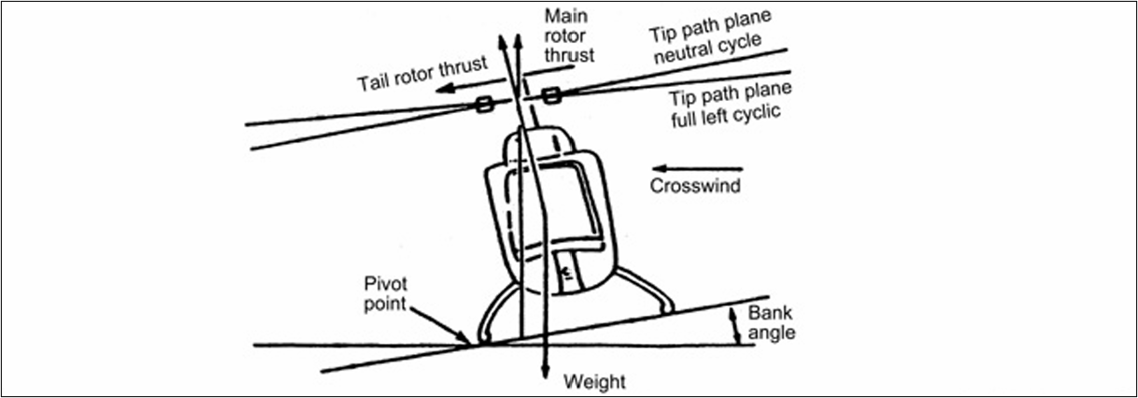
Recovery from dynamic rollover prior to this point can be achieved by smoothly lowering the collective lever while controlling any tendency to roll in the opposite direction with cyclic to re-establish the helicopter’s weight evenly on the ground. In general, the application of smooth collective inputs is more effective in avoiding rollover issues than using the cyclic control.
Safety message
While bush landing sites and paddocks can be suitable landing areas, they are also prone to concealed hazards. Pilots need to make a conscious effort to operate in a slow and methodical manner so they can assess the environment and minimise sideways movement at touchdown.
Pilots should have a thorough understanding of the principles and contributing factors of dynamic rollover, as well as the recovery methods. This knowledge is essential to conduct safe helicopter operations, especially landing in unprepared areas.
About this report
Decisions regarding whether to conduct an investigation, and the scope of an investigation, are based on many factors, including the level of safety benefit likely to be obtained from an investigation. For this occurrence, no investigation has been conducted and the ATSB did not verify the accuracy of the information. A brief description has been written using information supplied in the notification and any follow-up information in order to produce a short summary report, and allow for greater industry awareness of potential safety issues and possible safety actions.
Occurrence summary
| Mode of transport | Aviation |
|---|---|
| Occurrence ID | AB-2026-039 |
| Occurrence date | 26/06/2026 |
| Location | 9 km north-west of Moree Airport |
| State | New South Wales |
| Occurrence class | Accident |
| Aviation occurrence category | Collision with terrain, Loss of control |
| Highest injury level | None |
| Brief release date | 23/07/2026 |
Aircraft details
| Manufacturer | Robinson Helicopter Co |
|---|---|
| Model | R22 |
| Sector | Helicopter |
| Operation type | Part 91 General operating and flight rules |
| Activity | General aviation / Recreational-Other general aviation flying-Ferry flights |
| Departure point | Near Moree, New South Wales |
| Destination | Near Moree, New South Wales |
| Injuries | None |
| Damage | Substantial |