

A freight train passing through Oonoomurra, near Cloncurry in western Queensland, collided with the rear wagons of a second, stationary freight train that had stopped over 300 m short of a block limit sign which meant its rear wagons obstructed the track, an ATSB investigation final report details.
The two trains were operating on the single bidirectional Mount Isa rail line, managed by Queensland Rail under the direct traffic control safeworking system (where only one rail traffic movement is authorised on any one block – or section of track – at any one time).
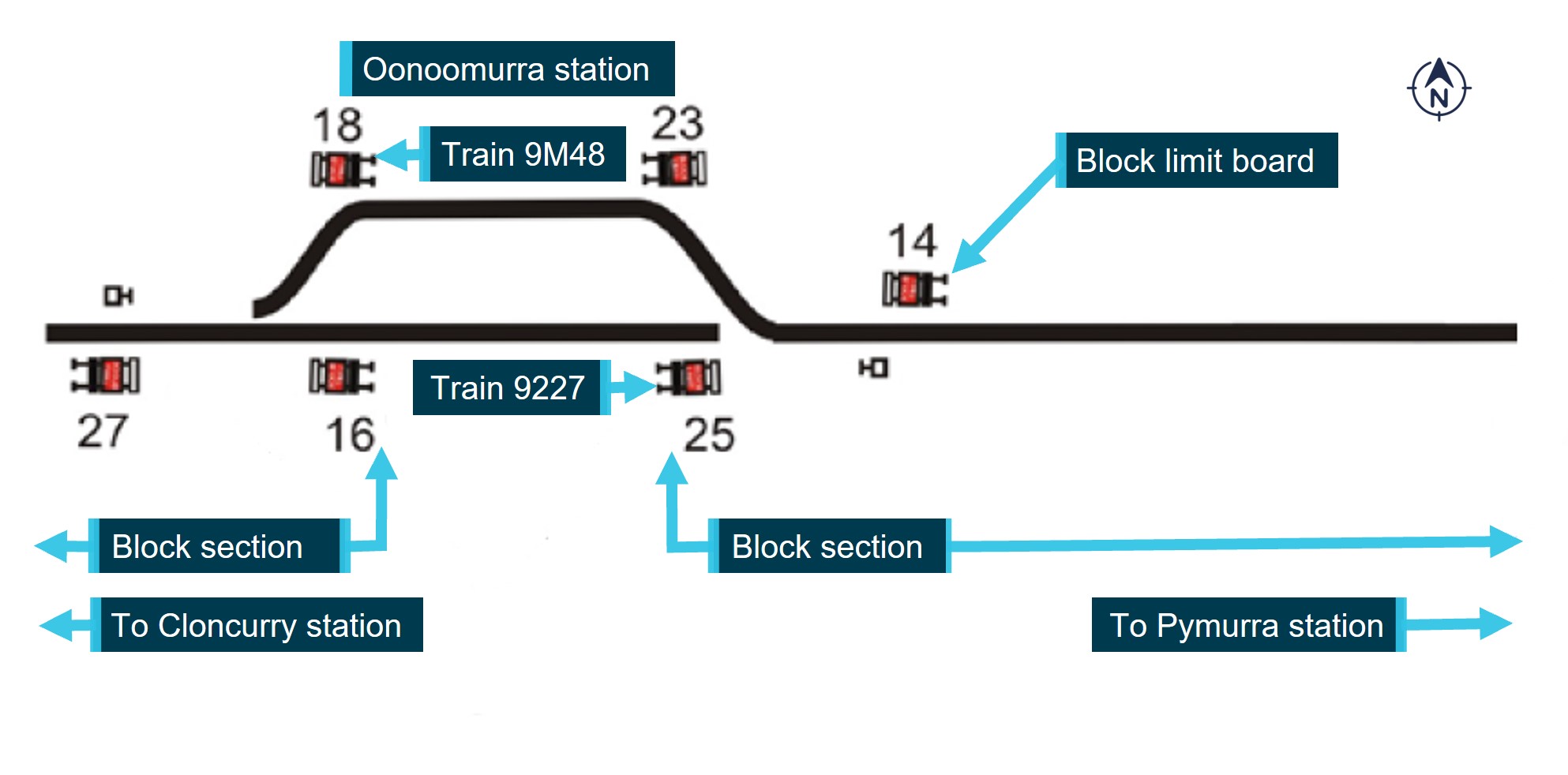
The trains were planned to cross at Oonoomurra, a directional travel station with a second line that extends for 1,033 m allowing trains to cross (with points set to divert approaching trains to the right-side track alignment in their direction of travel), before sunrise in the early hours of 17 August 2022.
A Qube-operated freight train (train 9227), with two locomotives hauling a consist of iron ore wagons, and with a length of 824 m, had passed through Cloncurry and was travelling east before stopping at Oonoomurra before block limit board (sign) OA 25, their limit of authority (see diagram below).
This was to allow an Aurizon-operated freight train (train 9M48), with a consist of empty ore wagons bound for Mount Isa, to pass in the opposite direction on the adjacent section of track.
Once the driver of the Qube train advised network control that they had stopped and were clear of the block section between Cloncurry and Oonoomurra, the network control officer authorised the Aurizon train to continue to travel west through Oonoomurra and continue towards Cloncurry.
“As the Aurizon train rounded a sweeping left curve at the western end of the Oonoomurra station, travelling at about 23 km/h, the driver saw several wagons from the rear of the Qube train obstructing the track ahead,” ATSB Director Transport Safety Kerri Hughes said.
“The driver made an emergency brake application but was unable to avoid a collision, during which their locomotive derailed, uncoupled from the trailing locomotive, and rolled onto its side.”
Two bystanders who were stopped in a vehicle at the nearby Landsborough Highway level crossing witnessed the collision and assisted the driver, who was in darkness and unable to readily locate safety equipment or make an emergency radio call to network control, to exit the locomotive cab.
Several wagons on the Qube train were damaged, and zinc concentrate spilled onto the track. The driver and assistant driver of the Qube train were uninjured.
“The ATSB found that the lead loco of the Qube train had stopped about 317 m from the trackside location board marking the limit of authority for the eastern end of Oonoomurra, and so the rear of the train blocked the track where the two lines converged,” said Ms Hughes.
In turn, the investigation found that Qube’s competency procedures had not ensured the driver was familiar with the operation of the different types of on-board electronic measurement devices fitted to its locomotives.
“The driver, unsure of the operation of their locomotive’s on-board electronic measurement device, did not use it to check the locomotive had travelled a sufficient distance when stopped at Oonoomurra,” Ms Hughes said.
When they had stopped, the driver could not see the end of the train in the locomotive mirrors due to track alignment and vegetation, but they could see road traffic travelling through the Landsborough Highway level crossing.
However, although the driver believed sighting the road traffic supported their conclusion that the train was in-clear, the level crossing was located approximately 200 m from the western end of the Oonoomurra station.
“This, combined with their belief that their train was shorter than usual, likely influenced the driver’s decision to not move the train closer to their typical stopping point within a station, around 50 m from the limit of authority.”
Other investigation findings concerned network control and train survivability considerations
“There were limited means available to the network control officer to independently verify the physical availability of a block section before issuing an authority, in this case, the extension of authority to the Aurizon train,” Ms Hughes said.
“With an extension of authority, increased reliance was placed on the second train crew detecting the section was obstructed at a distance sufficient to avoid a collision, which may not be achievable in all situations.”
Read the report: Collision between Aurizon train 9M48 and Qube train 9277, at Oonoomurra, Queensland, on 17 August 2022