

Report release date: 05/06/2026
| Occurrence Briefs are concise reports that detail the facts surrounding a transport safety occurrence, as received in the initial notification and any follow-up enquiries. They provide an opportunity to share safety messages in the absence of an investigation. Because occurrence briefs are not investigations under the Transport Safety Investigation Act 2003, the information in them is de-identified. |
What happened
On 10 May 2026, a Robinson R44 helicopter was conducting a scenic flight from Hamilton Island to nearby Whitehaven Beach, Queensland. The flight was conducted in conjunction with a second R44 helicopter. Both helicopters had a pilot and 2 passengers on board from the same group.
At about 0910 local time, both helicopters made an approach to land on Whitehaven Beach from the north. The pilots had planned to land so the helicopters would be nose to nose on the beach, the pilot of the first helicopter had planned to land in the downwind direction. The pilot of the first helicopter accelerated to increase the distance from the second helicopter and reduce any effects of their downwash on the second helicopter’s landing.
Having identified the landing area, the pilot of the first helicopter initiated a left crosswind turn and had intended to bring the helicopter to a hover crosswind at the landing area before conducting a hover turn 90° to the left to land downwind.
The pilot reported they inadvertently overflew the landing area which resulted in them conducting a downwind approach to land. As the aircraft slowed and lost translational lift,1 the pilot applied additional power, however, the helicopter settled into the soft sand with the right skid low. With a high power setting applied and the right skid anchored by the soft sand, the helicopter quickly rolled onto its right side, impacting the main rotor blades onto the sand before coming to a stop.
The pilot then shut off the fuel supply to the engine and switched the battery off before they assisted the passengers to egress from the back seats. One passenger suffered a minor injury to their leg and was treated by the pilot from the onboard first-aid kit. The helicopter was substantially damaged.
Figure 1: Occurrence R44 helicopter
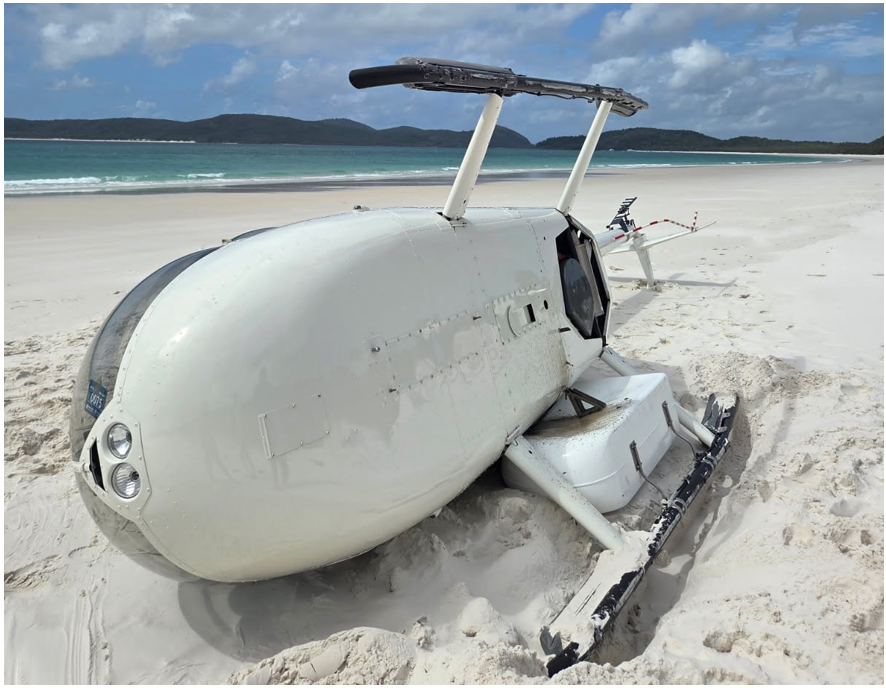
* Note – The main rotor blades had been removed for transport. Source: Operator, adjusted by the ATSB
Wind conditions recorded 12 km away at Hamilton Island, at 0900, indicated an east‑south‑easterly wind at 24 kt.
Safety action
The operator of both helicopters advised that the pilot’s actions were not in accordance with company standard operating procedures and the pilot should have aborted the approach to landing after misjudging the landing area.
Following the occurrence the operator advised they intended to implement a pilot decision‑making course into their pilot training syllabus.
Safety message
Helicopters operate more efficiently at a particular airspeed. At 55 kt, the R44 helicopter uses the least amount of power to maintain height and as airspeed increases or decreases from 55 kt an increase in power is required to maintain the intended flight path.
After misjudging the landing area, the pilot’s decision to continue to land via a downwind approach reduced their airspeed and therefore increased the power required to maintain the desired rate of descent, and consequently was unable to arrest the descent with the power available.
The Robinson R44 pilot operating handbook safety tip number 10 warns pilots on the risks of conducting take-offs and landings downwind:
Never make takeoffs or landings downwind, especially at high altitude. The resulting loss of translational lift can cause the aircraft to settle into the ground or obstacles.
The misjudgement of the intended landing area in aviation is common, and sound pilot decision‑making following the misjudgement is critical to the continued safety of flight. Often the safest outcome is to abort the landing and allow time to reassess the planned approach.
About this report
Decisions regarding whether to conduct an investigation, and the scope of an investigation, are based on many factors, including the level of safety benefit likely to be obtained from an investigation. For this occurrence, no investigation has been conducted and the ATSB did not verify the accuracy of the information. A brief description has been written using information supplied in the notification and any follow-up information in order to produce a short summary report, and allow for greater industry awareness of potential safety issues and possible safety actions.
- ^ Translational lift occurs when clear, undisturbed air flows through the rotor system, either from wind or directional flight improving rotor efficiency
Occurrence summary
| Mode of transport | Aviation |
|---|---|
| Occurrence ID | AB-2026-029 |
| Occurrence date | 10/05/2026 |
| Location | Whitehaven Beach |
| State | Queensland |
| Occurrence class | Accident |
| Aviation occurrence category | Collision with terrain, Loss of control |
| Highest injury level | Minor |
| Brief release date | 05/06/2026 |
Aircraft details
| Manufacturer | Robinson Helicopter Co |
|---|---|
| Model | R44 |
| Sector | Helicopter |
| Operation type | Part 133 Air transport operations - rotorcraft |
| Activity | Commercial air transport-Non-scheduled-Joyflights / sightseeing charters |
| Departure point | Hamilton Island Airport, Queensland |
| Destination | Whitehaven Aircraft Landing Area, Queensland |
| Injuries | Crew - none; Passengers - 1 (minor) |
| Damage | Substantial |