

Report release date: 05/06/2026
| Occurrence Briefs are concise reports that detail the facts surrounding a transport safety occurrence, as received in the initial notification and any follow-up enquiries. They provide an opportunity to share safety messages in the absence of an investigation. Because occurrence briefs are not investigations under the Transport Safety Investigation Act 2003, the information in them is de-identified. |
What happened
On the afternoon of 3 February 2026, an Airbus A350-9 aircraft was in the early stages of baggage loading prior to departure from Sydney, New South Wales, for an international flight.
Prior to the commencement of passenger boarding, the crew received a fire indication for the cargo hold. At the same time, airport ground staff reported observing a small fire in the rear cargo hold and notified emergency services. The 13 crew members on board evacuated from the aircraft and all ground staff were removed from the area. Emergency services then arrived and confirmed the fire had self-extinguished, with only a residual burning smell remaining. No water or fire suppressant was required.
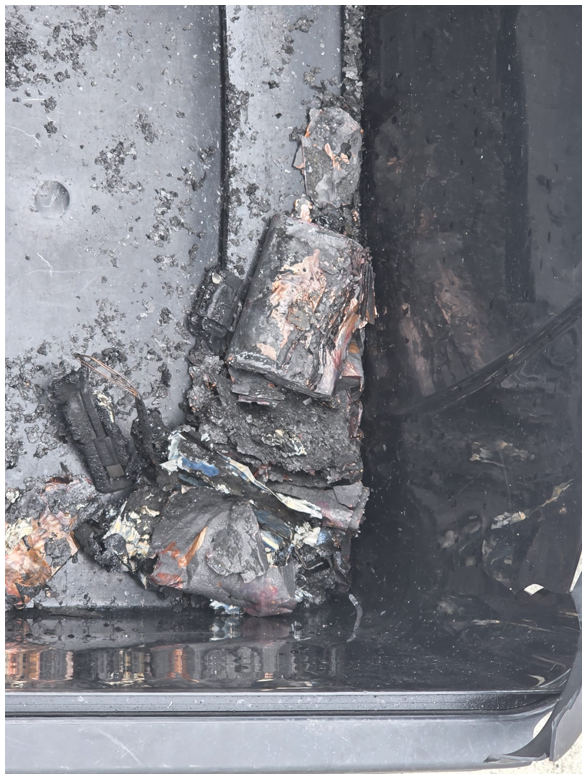
The source of the fire and fumes was traced to a lithium-ion battery power bank which was attached to another personal electronic device that had caught fire (Figure 1). The devices were removed and air quality testing was conducted within the cargo hold.
Figure 1: Power bank and personal electronic device debris
Source: Maintenance provider
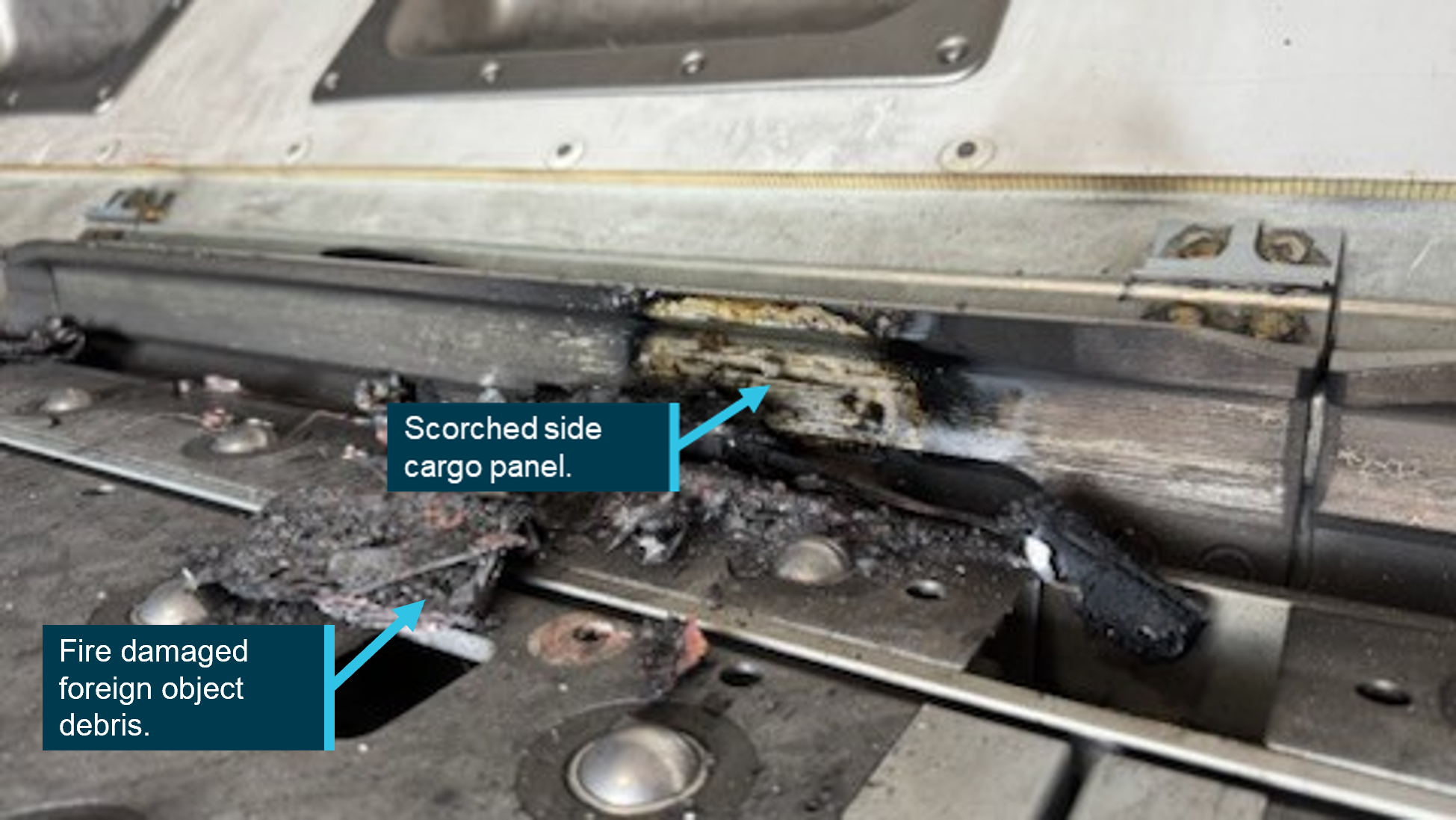
During inspection of the cargo hold by aircraft engineers, minor scorch damage was observed to the cargo floor (Figure 2). Post-occurrence, it was reported that the smoke detectors were found to be in working order and the internal fire extinguisher had not (yet) discharged.
Figure 2: Damage to the cargo compartment floor
Source: Maintenance provider
Operator and ground handling agent investigations
The aircraft operator and the ground handling agency conducted internal investigations, with both being inconclusive as to how the power bank and personal electronic device entered the cargo hold. Only one PMC cargo pallet had been loaded into the rear cargo hold when the fire occurred, and that pallet did not contain any dangerous goods. It was also confirmed that all declared dangerous goods on the cargo manifest were properly documented.
The ground handling agency’s lower deck loader (LDL) operator was interviewed post‑occurrence and stated that they were responsible for both the arrival and departing service, and they did not have or take a power bank into the cargo hold. It was also determined during interview that no other person was in the cargo hold during either service. The LDL operator reported that the fire began immediately after the PMC pallet was loaded, as the rollers were used to transfer the pallet into its position. They are of the belief that this pallet crushed the power bank at this time, resulting in thermal runaway and ignition.
The ground handling agency’s investigation noted that the power bank and personal electronic device could not be linked to any specific passenger baggage, cargo shipment, service provider or ground handling activity. Therefore, the source of introduction into the aircraft environment was unable to be conclusively established.
The aircraft operator’s investigation included a review of CCTV footage at the previous international port prior to the flight to Sydney, with no abnormal handling or suspicious activity observed during cargo loading at that location. It was also noted that ground handlers at that location are prohibited from carrying personal electronic devices airside, and the cargo containment method used was overwrap, as opposed to netting. As a result, the operator determined that the power bank was not introduced at the previous port.
Safety message
Hazards can enter the aircraft environment through multiple sources. Ground handlers should always conduct thorough checks of aircraft cargo holds for loose items or foreign objects both before and during the loading process, and never assume that an unknown item is harmless. It is important that ground handlers act immediately if fire, smoke or fumes are detected to prevent further incident.
Devices containing lithium-ion batteries such as power banks and mobile phones can short circuit and result in fire. A recent ATSB investigation, In-flight fire involving Boeing 737, VH-YFY, 56 km north-north-east of Hobart Airport, Tasmania, on 21 July 2025 (AO‑2025-043) notes that a thermal runaway of a lithium-ion battery can be difficult to manage, particularly when the aircraft is airborne, and presents a risk of in-flight fires. While this incident occurred while the aircraft was being loaded for flight, it serves as a valuable reminder of the risks presented by lithium-ion batteries.
About this report
Decisions regarding whether to conduct an investigation, and the scope of an investigation, are based on many factors, including the level of safety benefit likely to be obtained from an investigation. For this occurrence, no investigation has been conducted and the ATSB did not verify the accuracy of the information. A brief description has been written using information supplied in the notification and any follow-up information in order to produce a short summary report, and allow for greater industry awareness of potential safety issues and possible safety actions.
Occurrence summary
| Mode of transport | Aviation |
|---|---|
| Occurrence ID | AB-2026-012 |
| Occurrence date | 03/02/2026 |
| Location | Sydney Airport |
| State | New South Wales |
| Occurrence class | Serious Incident |
| Aviation occurrence category | Fire, Smoke, Warning devices |
| Highest injury level | None |
| Brief release date | 05/06/2026 |
Aircraft details
| Manufacturer | Airbus |
|---|---|
| Model | A350-9 |
| Sector | Jet |
| Operation type | Part 129 Foreign air transport operators |
| Activity | Commercial air transport - Scheduled - International |
| Departure point | Sydney Airport, New South Wales |
| Destination | International location |
| Injuries | None |
| Damage | Minor |