

Report release date: 03/06/2026
| Occurrence Briefs are concise reports that detail the facts surrounding a transport safety occurrence, as received in the initial notification and any follow-up enquiries. They provide an opportunity to share safety messages in the absence of an investigation. Because occurrence briefs are not investigations under the Transport Safety Investigation Act 2003, the information in them is de-identified. |
What happened
On 23 April 2026, the pilot of a Cessna 402C aircraft was conducting a passenger transport operation from Jandakot to Laverton, Western Australia, with 5 passengers on board. Prior to departure the pilot used the aircraft heater to defrost the windshield for approximately 7 minutes and recalled turning the heater off at approximately 0640.
Following the aircraft’s departure, while in the initial cruise phase of the flight, the pilot noticed a moderate oil leak from the left engine cowling vents. The pilot monitored aircraft performance, observed no abnormal indications, and determined the leak was likely from residual oil. The flight continued as planned at this stage, while the pilot continued to monitor the situation.
At approximately 0731, the pilot began to feel lightheaded and ‘zoned out’ momentarily. They then observed the carbon monoxide (CO) detection placard on the instrument panel had changed colour, indicating that CO was present (Figure 1). The pilot immediately opened all available air vents, opened the cabin air controls, and confirmed the cabin heater was off.
Figure 1: The aircraft’s carbon monoxide (CO) detection placard and exemplar
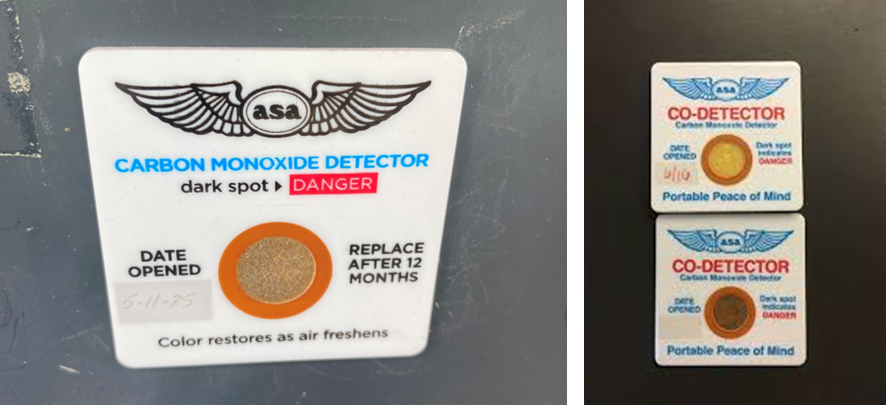
Note: Slight darkening indicating some CO was present (left), an example placard showing no detection (top right), and a placard showing detection (bottom right). Source: Operator (left), Civil Aviation Safety Authority (right)
Approximately 2 minutes later, observing no change to the CO indication, the pilot contacted air traffic control (ATC), requested traffic information, and amended their destination to Merredin. The pilot then commenced descent, communicated the change of plan to the nearest passenger, and asked the passenger to instruct all other passengers to open the air vents above their seats.
The pilot continued to self-monitor during descent, and determined their condition was not deteriorating. The wellbeing of the passengers was also confirmed, with none reporting ill effects of CO.
Once established in the circuit at Merredin, the pilot opened the aircraft’s storm window1 and observed no change to the CO indicator and the aircraft landed safely.
Once on the ground, the pilot observed the oil leaks on the left engine. An engine inspection showed numerous components and hoses were covered in oil and a shallow pool of oil had formed at the bottom of the cowling. The upper cowling also showed signs of oil splatter on the inside forward of the vents.
Engineering inspection
The aircraft was subsequently inspected by an engineer flown out to Merredin with the replacement aircraft. No obvious correlation could be made between the oil leak and the CO detector. Ground runs were performed with no abnormal indications or subsequent oil leaks (beyond residual streaks).
As a further precaution, the operator removed the aircraft from service to conduct further engineering assessments. The heater was operated on the ground with the aircraft windows closed, and the engines not running. CO ingress was measured with a handheld CO monitor around the glareshield/demister and excessive CO was observed to ingress into the cabin.
The heater was subsequently removed for closer inspection. A loose item, that looked like a silver crush washer, was discovered inside the heater once the combustion liner cap was removed, and the cap was also found to be dented. The inspection determined the aircraft heater was defective, damaged, and potentially incorrectly reinstalled during servicing.
Safety action
The operator removed the heater from operation and returned the aircraft to service.
Safety message
Carbon monoxide is a colourless and odourless gas that is dangerous to humans, and its presence may not be detected until the development of physical symptoms and cognitive effects. However, sometimes these physical and cognitive effects also impair a pilot’s ability to understand that they may be affected by CO, leading to partial or complete incapacitation.
The aircraft was fitted with a disposable CO chemical spot detector. While these type of detectors are commonly used in general aviation aircraft, they have known limitations. They have a limited shelf-life when removed from their original packaging, which may be further affected by factors such as exposure to harsh direct sunlight, cleaning chemicals, and halogens. In addition, they are a passive device, which relies on the pilot regularly monitoring the changing colour of the detector to show elevated levels of CO.
The use of an attention‑attracting carbon monoxide detector in the cockpit provides pilots with the best opportunity to detect carbon monoxide exposure before it adversely affects their ability to control the aircraft or become incapacitated. The ATSB safety advisory notice Are you protected from carbon monoxide poisoning? (AO-2017-118-SAN-002) strongly encourages operators and owners of piston-engine aircraft to install a carbon monoxide detector with an active warning to alert pilots to the presence of elevated levels of carbon monoxide in the cabin. If not provided, pilots are encouraged to carry a personal carbon monoxide detection and alerting device.
Should any smell or sensation of illness develop, pilots should check their CO detector, ensure cabin heat has been turned off, open all fresh air vents and windows, make prompt decisions to land as soon as possible, such as in this case, and use all available resources for assistance. Further information on CO poisoning and detectors can be found here: Carbon Monoxide: A Deadly Menace.
About this report
Decisions regarding whether to conduct an investigation, and the scope of an investigation, are based on many factors, including the level of safety benefit likely to be obtained from an investigation. For this occurrence, no investigation has been conducted and the ATSB did not verify the accuracy of the information. A brief description has been written using information supplied in the notification and any follow-up information in order to produce a short summary report, and allow for greater industry awareness of potential safety issues and possible safety actions.
- ^ A small triangular cockpit side window that be opened for ventilation.
Occurrence summary
| Mode of transport | Aviation |
|---|---|
| Occurrence ID | AB-2026-027 |
| Occurrence date | 23/04/2026 |
| Location | 68 km north-east of Cunderdin Aerodrome |
| State | Western Australia |
| Occurrence class | Serious Incident |
| Aviation occurrence category | Diversion/return, Flight crew incapacitation, Warning devices |
| Highest injury level | None |
| Brief release date | 03/06/2026 |
Aircraft details
| Manufacturer | Cessna Aircraft Company |
|---|---|
| Model | 402C |
| Sector | Piston |
| Operation type | Part 135 Air transport operations - smaller aeroplanes |
| Activity | Commercial air transport-Non-scheduled-Passenger transport charters |
| Departure point | Jandakot Aerodrome, Western Australia |
| Destination | Laverton Aerodrome, Western Australia |
| Injuries | None |
| Damage | Nil |