

Final report
Report release date: 14/10/2026
Investigation summary
What happened
On 1 April 2026, a Saab 340 aircraft, registered VH‑VEF and operated by Link Airways, arrived at Melbourne Airport, Victoria, after a flight from Orange, New South Wales. Post‑flight inspection of the aircraft identified that the left, inboard main landing gear tyre had deflated, and a section of the inner wheel rim had fractured and separated while taxiing on the lead-in to the aircraft's parking bay.
Post-occurrence precautionary inspection of the other wheel on the same landing gear leg identified a crack in the inboard, bead seat area, which was in a similar location to the fractured wheel section.
What the ATSB found
In-service fracture of the main landing gear wheel resulted from fatigue cracking in the bead seat area. The fractured wheel and cracked wheel on the same landing gear leg were of a design that was previously established to be susceptible to cracking in the bead seat region. Any additional factors that contributed to the wheel fracture were not able to be determined.
Similar wheel fractures were investigated by the ATSB in 2009 (AO-2009-006) and 2019 (AO-2019-047).
What has been done as a result
The aircraft operator advised the ATSB that, at the time of the occurrence, it had 8 of the main landing gear wheels remaining in service of the design that was susceptible to cracking. While the wheels were permitted to remain in use, the operator removed them from service to mitigate any ongoing safety risk.
Safety message
Aircraft operators and maintainers rely on the best information available from aircraft and component manufacturers to ensure safety and reliability. In this occurrence, a manufacturer has permitted the use of a component with a known susceptibility to cracking, by implementing an increased inspection regime that reduced, but did not completely mitigate, the associated risk. In situations like this, operators should independently assess whether any residual risk is tolerable to their operation and take steps to further reduce or eliminate the risk if practicable.
The occurrence
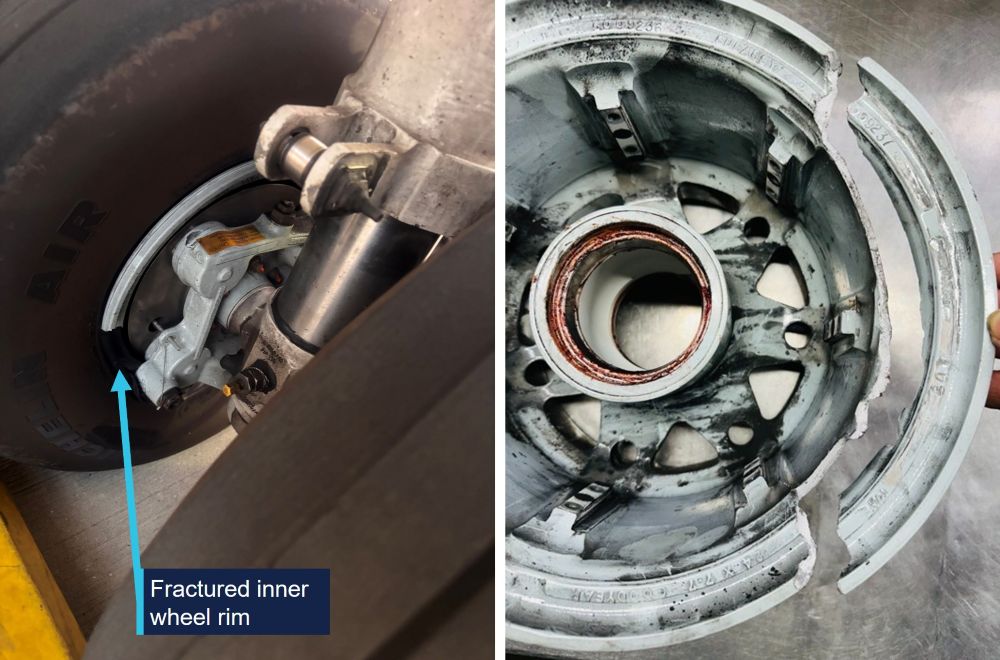
On 1 April 2026 at 1841 local time, a Saab 340 aircraft, registered VH‑VEF and operated by Link Airways, landed at Melbourne Airport, Victoria, after a passenger transport flight from Orange, New South Wales. Routine post‑flight inspection identified that the left main inboard landing gear tyre had deflated and a section of the associated inner wheel rim had fractured and was missing (Figure 1). No other damage was sustained by the aircraft and the flight crew had not noticed anything abnormal about the landing or taxi.
Figure 1: Main landing gear wheel with fractured inner rim section
At approximately 1901, one of the flight crew contacted air traffic control to report that a missing section of a tyre rim may have been lost on landing. Airside safety officers conducted a runway inspection to look for foreign object debris (FOD), while another airside safety officer retraced the aircraft’s taxi route to the bay. During this time, an aircraft diverted from the airport after deeming it not safe to land.
There was no debris identified on the runway and the separated piece was located on the lead-in to the aircraft's parking bay at approximately 1908. The pilot matched the found piece to the missing section and confirmed that it was the only part missing. This was communicated to air traffic control, and the runway inspection was concluded.
The operator subsequently removed the other wheel on the same landing gear leg and subjected it to precautionary, non-destructive inspection, in accordance with the main wheel component maintenance manual.1 A hairline crack was found in the inboard, bead seat area, which was a similar location to that of the fractured wheel.
Context
Aircraft information
The Saab 340B was a twin turboprop aircraft employing a tricycle landing gear with twin wheels on the nose gear and each of the 2 main gear legs. VH-VEF was serial number 340B-457, manufactured in Sweden in 1998 and first registered in Australia in 2018.
At the time of publication, there were currently 71 Saab 340 aircraft on the Australian civil aircraft register and there were estimated to be around 1502 Saab 340 aircraft in operation worldwide in 2025 (Maragkou, 2025).
Incident wheel history
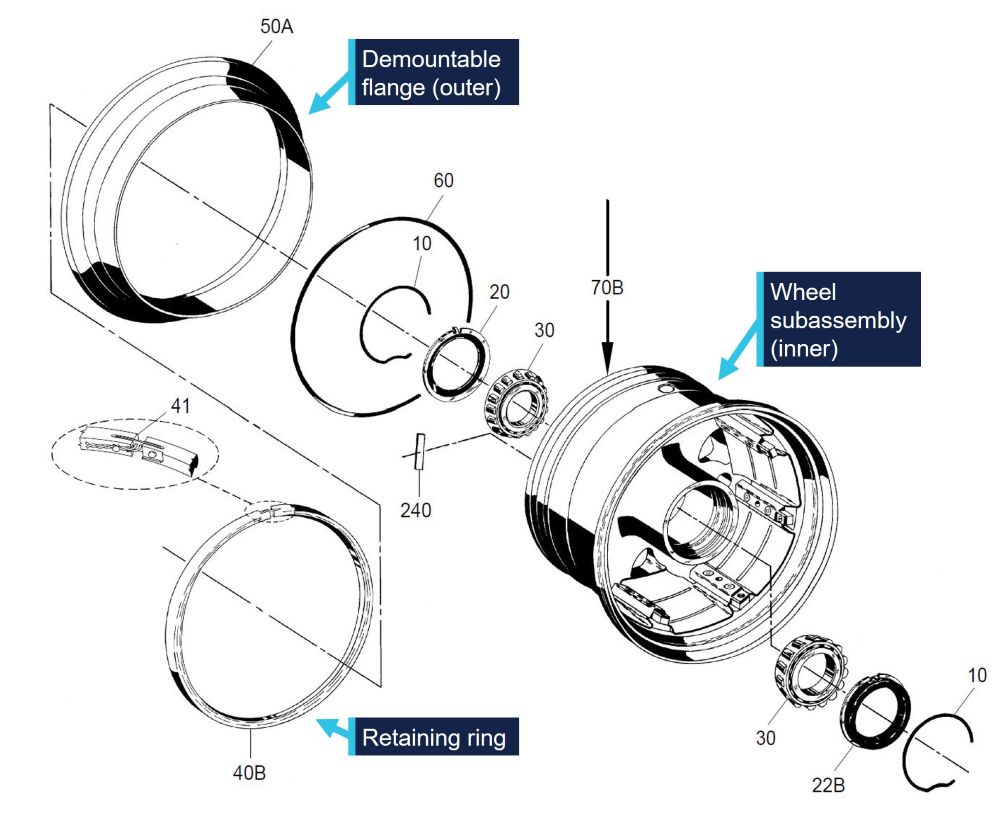
The fractured and cracked wheels were manufactured by the Aircraft Braking Systems Corporation (ABSC), now Meggitt Aircraft Braking Systems (MABS). The fracture and cracking was on the inner subassembly of each wheel (Table 1 and Figure 2).
Table 1: Occurrence wheel details
| Main wheel status | Wheel assembly part number | Inner subassembly part number | Inner subassembly serial number | Flight cycles since overhaul |
| Fractured | 5010488 | 5009237 | Apr 89-0744 | 143 |
| Cracked | 5010488-3 | 5009237 | Aug 90-1435 | 143 |
Neither wheel had previously been fitted to the operator's aircraft. They were received from a supplier in the United States in an overhauled condition and were fitted to the same landing gear leg at the same time. The aircraft operator advised the ATSB that, at the time of the occurrence, it had a further 8 of this original design of wheel (see Service bulletins) in service across its fleet.
The wheels had each accumulated 143 landings since fitment. This was approximately half of the typical number of flight cycles between tyre changes and associated maintenance inspections (see Service bulletins).
The aircraft operator advised the ATSB that it had no reports3 of a hard landing in VH-VEF, and that there were no reports of potholes or damaged runways at any of the airports used by the aircraft since the wheels had been fitted.
Figure 2: Main landing gear wheel assembly
Wheel examination
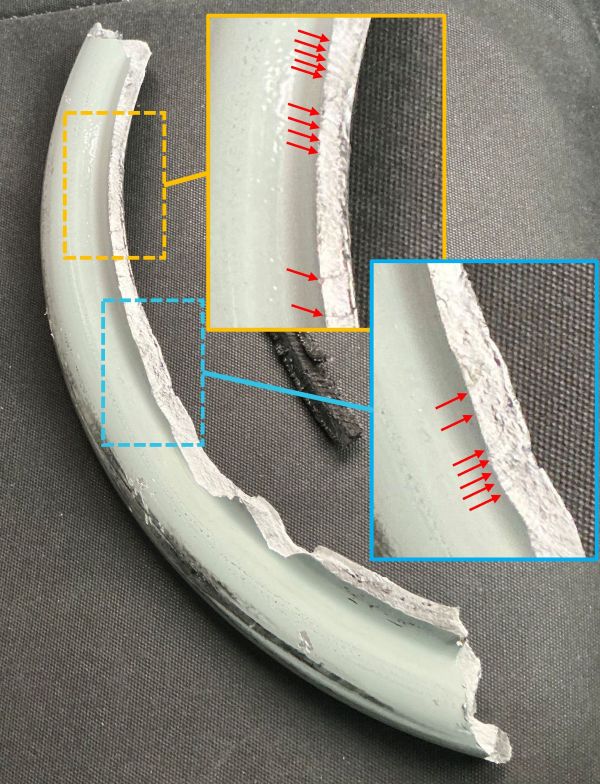
The operator returned the occurrence wheels to the organisation that conducted the most recent overhaul, VSE Aviation, and they were not examined by the ATSB. ATSB examination of images supplied by the operator identified features on the fracture surface consistent with fatigue cracking (Figure 3). The fracture was in a similar location and manner to 2 previous occurrences investigated by the ATSB (see Previous occurrences).
Figure 3: Crack progression features (arrowed) on separated wheel rim section
VSE Aviation advised that it could not identify a cause of the in-service wheel fracture. The organisation anonymously reintroduced the cracked wheel into its non-destructive inspection regime to test its inspection processes. The crack was reportedly successfully detected through this process.
Service bulletins
In April 1994, following a number of other in-service wheel failures worldwide, the wheel manufacturer published service bulletin SF340-32-24, Saab 340 Main Wheel Subassembly 5009237 and 5009237-1 Bead Seat Inspection. The bulletin provided inspection techniques and inspection intervals for the detection of cracking in the bead seat region of the inboard wheel assembly. This included eddy-current inspection4 at each tyre change5 and during overhaul.
In December 1995, the manufacturer released a revised wheel design that reduced the overall stress levels in the bead seat area. The associated service bulletin (SF340-32-41) stated that operators could continue to use the earlier assemblies (serial numbers OCT95-1606 and earlier) until stock depletion, provided that the associated maintenance and inspection standards were maintained.
Inspection efficacy
At the request of the ATSB, VSE Aviation provided a combined list of the assembly number 5010488(0, -1, -2, -3) wheels that it had overhauled between April 2022 and April 2026. There were:
- 676 wheel assemblies inspected during that time
- 26 wheel assemblies (approximately 4%) with inboard subassembly serial numbers from October 1995 or earlier.
No wheel assemblies were rejected due to crack indications in the bead seat area. One was rejected due to (unrelated) cracking in the lock ring groove.
The ATSB searched the Civil Aviation Safety Authority (CASA) Defect Reporting Scheme (DRS) database for reports of Saab 340 main wheel cracks over the past 20 years. There were 30 reports in total, of which 22 were reported between April 2022 and April 2026. There were:
- Three reports of in-service fracture of main landing gear wheels, including the subject occurrence and the 2 occurrences previously investigated by the ATSB (see Previous investigations)
- One report of a bead seat failure of the inner sub assembly while the wheel was undergoing teardown and inspection
- Twenty-six reports of cracked main landing gear wheels.
Of the reports of cracked wheels:
- Two reports indicated this was outside of the routine maintenance inspections.6 One wheel was submitted due to it having suspected cracking and one wheel was submitted for inspection due to the tyre only holding low pressure.
- Five of the reports identified cracking of the inboard wheel rim or bead seat area. The remainder identified cracking elsewhere on the wheel assembly or were not specific.
- Two reports identified cracking on part number 5009237 and 5009237-1 subassembly. The remainder of reports cited a later revision, inboard wheel subassembly (5009237-4), the bead seat area or retaining ring groove in the demountable (outer) wheel flange (5010489), or the parent wheel assembly (5010488).7
Previous investigations
AO-2009-006 – Saab 340B VH-KDQ, Sydney Airport, on 6 February 2009
During the post-flight inspection of a Saab 340B, the left outboard main landing gear wheel was observed to have sustained noticeable damage. There was no prior indication of the failure, as the aircraft had handled normally during the landing and taxiing phase of the flight.
The wheel inner rim had fractured away from the hub for approximately half of the total circumference. This occurred due to initiation and propagation to failure of a circumferential fatigue crack at the bead seat radius. The report found that a juvenile crack was probably present, but not detected, at the time of the most recent inspection, which was 40 flight cycles prior to the occurrence. The report argued that a relatively low number of flight cycles was inconsistent with a fatigue crack initiating and propagating halfway around the wheel rim. The report also noted various factors that could affect the probability of crack detection during non-destructive inspection.
At the time, the design of the fractured wheel was being phased out due to recognised fatigue problems identified at the bead seat area. Both the manufacturer and operator were aware of the increased fatigue susceptibility of the wheel design and had established increased inspection regimes for those wheels remaining in service.
AO-2019-047 – Saab 340B VH-ZLX, Adelaide Airport, on 20 August 2019
During the post-flight inspection of a Saab 340B at Port Lincoln, South Australia, the first officer noted that the left main outboard landing gear tyre was deflated and that a piece of the wheel was missing. Ground support personnel at Adelaide Airport (the departing airport) subsequently located the missing section of wheel on the runway strip. The flight crew reported no issues with aircraft handling during take-off, landing or taxi.
Fatigue cracking had initiated in the bead seat area of the wheel and progressed a short distance around the circumference prior to final fracture. This investigation referenced the previous ATSB investigation, noting that cracking of the bead seat area in this wheel type was a known issue, and maintenance schedules and practices had previously been updated.
It was considered likely that the fatigue crack was present, but not detected, at the most recent maintenance visit, 97 flight cycles prior to the occurrence. Similar to the 2009 investigation, the report cited the low number of flight cycles since the most recent maintenance inspection as having been unlikely to initiate and propagate the crack to the critical size for failure. The report also noted the absence of similar failures over the 10 years since the 2009 occurrence as evidence that the existing inspection regime was generally adequate to identify wheel cracks before they progressed to failure.
Safety analysis
Fracture and separation of the section of inner wheel rim was the result of fatigue cracking. The fracture occurred between routine maintenance inspections, around the inner bead seat area of the wheel subassembly that was previously established to be susceptible to cracking.
Contributing factor Fracture of the main landing gear wheel resulted from fatigue cracking in the bead seat area. |
The susceptible wheel design has now been in service for over 30 years. Therefore, if the design alone was sufficient to result in in-service fracture, between inspections, there would very likely be a significantly higher number of reported wheel failure events than the 2 previously investigated. As noted in the 2019 ATSB investigation report, the existing inspection regime appeared generally adequate to identify wheel cracks before they progressed to failure. Therefore, it is likely that other factors contributed to fracture in the relatively low number of flight cycles since the wheel was overhauled.
The ATSB considered whether an incipient crack might have existed, but not been detected, at the time of the most recent overhaul, as previous investigations found likely. This would extend the number of flight cycles to which the wheel was exposed, to initiate and grow the crack to a critical size under normal loading.
While eddy current is a suitable inspection method for detecting small flaws, it, like all non-destructive inspection methods, is subject to errors or variables that reduce the likelihood of flaw detection. The report of crack detection in the second wheel, after it was reintroduced into the inspection system, provided some confidence in the overhauler’s inspection process, but can’t guarantee that a crack was not missed on another occasion. Additionally, the presence of the large crack in the second wheel might suggest that 2 cracks, in separate wheels, were not detected during overhaul, which would seem less likely for a robust inspection process.
An alternative explanation would involve an abnormal loading event to the landing gear leg to initiate and grow a crack to a critical size within 143 flight cycles. This could also account for the presence of a large crack in the second wheel. While there were no reports of a hard landing or any indication of damage from visited runways, it was still possible that the landing gear leg experienced a higher-than-normal stress event. This could include a firm landing that was still below the hard landing threshold, that was not detected by a flight crew or not considered serious enough to report. Such an event, in combination with the susceptibility of the wheels to cracking, could conceivably result in the cracking or fracture of both wheels between maintenance inspections.
The cracked wheel was not examined by the ATSB and the nature of the crack was not determined. As such, it was also possible that cracking of the second wheel was not due to fatigue and instead resulted from additional loading after being operated with the mating wheel with a deflated tyre.
Ultimately, the factors contributing to the fracture and cracking of the wheels could not be conclusively determined from the available evidence. Nevertheless, the constant factor in this occurrence, and those previously investigated, was the susceptibility of the pre‑redesign wheel subassembly to fracture. For the given set of loading conditions that resulted in the crack initiation, the reduced strength of the bead seat area on the subject wheels would almost certainly have contributed to the extent of cracking and fracture of the wheel in service.
Contributing factor The fractured wheel and cracked wheel on the same landing gear leg were of a design that was previously established to be susceptible to cracking in the bead seat region. |
The 3 wheel fracture occurrences investigated by the ATSB indicated that as long as these specific wheels continue to be operated with the existing inspection regime, there remained an increased likelihood of in-service wheel fracture. However, the susceptible wheel subassemblies appear to make up only a small percentage of those currently in service, based on the records of the overhaul organisation. The likelihood of in-service fracture would therefore be respectively small. Additionally, for each of the 3 wheel fracture events investigated in Australia there have been no significant adverse safety outcomes as a result. As such, the ATSB considers the ongoing safety risk presented by the ongoing use of these wheels to be low.
Findings
ATSB investigation report findings focus on safety factors (that is, events and conditions that increase risk). Safety factors include ‘contributing factors’ and ‘other factors that increased risk’ (that is, factors that did not meet the definition of a contributing factor for this occurrence but were still considered important to include in the report for the purpose of increasing awareness and enhancing safety). In addition ‘other findings’ may be included to provide important information about topics other than safety factors. These findings should not be read as apportioning blame or liability to any particular organisation or individual. |
From the evidence available, the following findings are made with respect to the main landing gear wheel fracture involving Saab 340B, VH-VEF, at Melbourne Airport, Victoria, on 1 April 2026.
Contributing factors
- Fracture of the main landing gear wheel resulted from fatigue cracking in the bead seat area.
- The fractured wheel and cracked wheel on the same landing gear leg were of a design that was previously established to be susceptible to cracking in the bead seat region.
Safety actions
| Whether or not the ATSB identifies safety issues in the course of an investigation, relevant organisations may proactively initiate safety action in order to reduce their safety risk. All of the directly involved parties are invited to provide submissions to this draft report. As part of that process, each organisation is asked to communicate what safety actions, if any, they have carried out to reduce the risk associated with this type of occurrences in the future. The ATSB has so far been advised of the following proactive safety action in response to this occurrence. |
Safety action by Link Airways
The aircraft operator advised the ATSB that, at the time of the occurrence, it had 8 of the main landing gear wheels remaining in service, of the design that was susceptible to cracking. While the wheels were permitted to remain in use, the operator removed them from service to mitigate any ongoing safety risk.
Sources and submissions
Sources of information
The sources of information during the investigation included:
- Link Airways
- VSE Aviation
- Australia Pacific Airports (Melbourne).
References
Maragkou, Eleni (2025). Saab 340A and B – the Tale of Two Lifecycles. [online] Cirium. Available at: https://www.cirium.com/thoughtcloud/ascend-consultancy-saab-340a-and-b-the-tale-of-two-lifecycles/ [Accessed 26 Aug. 2026].
Submissions
Under section 26 of the Transport Safety Investigation Act 2003, the ATSB may provide a draft report, on a confidential basis, to any person whom the ATSB considers appropriate. That section allows a person receiving a draft report to make submissions to the ATSB about the draft report.
A draft of this report was provided to the following directly involved parties:
- Link Airways
- VSE Aviation
- Civil Aviation Safety Authority
- National Transportation Safety Board.
A submission was received from Link Airways. The submission was reviewed and, where considered appropriate, the text of the report was amended accordingly.
Purpose of safety investigationsThe objective of an ATSB safety investigation is to improve transport safety through:
In accordance with the TSI Act, the ATSB does not investigate for the purpose of taking administrative, regulatory or criminal action, and cannot apportion blame, assist in determining liability, or, as a general rule, assist in court proceedings. About ATSB reportsATSB safety investigation reports are developed in accordance with ATSB procedures and guidelines, and with regard to applicable international standards and instruments. Reports must include factual material of sufficient weight to support the investigation’s analysis and findings. At all times the ATSB endeavours to balance the use of material that could imply adverse comment with the need to properly explain what happened, and why, in a fair and unbiased manner. An explanation of terminology used in ATSB investigation reports is available here. Publishing informationReleased in accordance with section 25 of the Transport Safety Investigation Act 2003 Published by: Australian Transport Safety Bureau © Commonwealth of Australia 2026 Ownership of intellectual property rights in this publication Unless otherwise noted, copyright (and any other intellectual property rights, if any) in this report publication is owned by the Commonwealth of Australia. Creative Commons licence 
With the exception of the Commonwealth Coat of Arms, ATSB logo, and photos and graphics in which a third party holds copyright, this report is licensed under a Creative Commons Attribution 4.0 International licence. The CC BY 4.0 licence enables you to distribute, remix, adapt, and build upon our material in any medium or format, so long as attribution is given to the Australian Transport Safety Bureau. Copyright in material obtained from other agencies, private individuals or organisations, belongs to those agencies, individuals or organisations. Where you wish to use their material, you will need to contact them directly. |
- ^ Meggitt Aircraft Braking Systems component maintenance manual 32-41-16 stated: ’When a wheel assembly is operated with a flat or damaged tire on an aircraft that has dual wheels, tandem wheels or dual tandem wheels, the mating wheel assembly must also be examined because this wheel assembly has probably had twice the normal load applied to it.’
- ^ A significant proportion of the Saab 340B fleet were reported as being in storage (not in active service).
- ^ Reports of a hard landing would normally be initiated by flight or cabin crew. The Saab 340 also has a g-switch that would deactivate the flight data recorder in the event of a hard landing.
- ^ A non-destructive inspection method for conductive materials such as metals, using an alternating current probe to induce eddy currents in the test part. The presence of flaws interrupts or alters the current flow, which can then be measured.
- ^ The number of flight cycles before a tyre change is variable, but nominally around 300 cycles.
- ^ The majority of reports cited ‘eddy-current’ as the inspection method. Some reports were not specific. Two wheels had cracks identified visually, one of which had already passed the non-destructive inspection.
- ^ The same, crack-susceptible inboard wheel forging can exist across different wheel assembly and subassembly dash numbers.
Occurrence summary
| Investigation number | AO-2026-071 |
|---|---|
| Occurrence date | 01/04/2026 |
| Occurrence time and timezone | 1845 Australian Eastern Standard Time |
| Location | Melbourne Airport |
| State | Victoria |
| Report release date | 14/10/2026 |
| Report status | Final |
| Investigation level | Short |
| Investigation type | Occurrence Investigation |
| Investigation phase | Final report: Dissemination |
| Investigation status | Completed |
| Mode of transport | Aviation |
| Aviation occurrence category | Landing gear/indication, Objects falling from aircraft |
| Occurrence class | Incident |
| Highest injury level | None |
Aircraft details
| Manufacturer | Saab Aircraft Co. |
|---|---|
| Model | 340B |
| Registration | VH-VEF |
| Serial number | 340B-457 |
| Aircraft operator | Vee H Aviation Pty Ltd |
| Sector | Turboprop |
| Operation type | Part 121 Air transport operations - larger aeroplanes |
| Activity | Commercial air transport-Scheduled-Domestic |
| Departure point | Orange Airport, New South Wales |
| Destination | Melbourne Airport, Victoria |
| Injuries | None |
| Damage | Minor |