

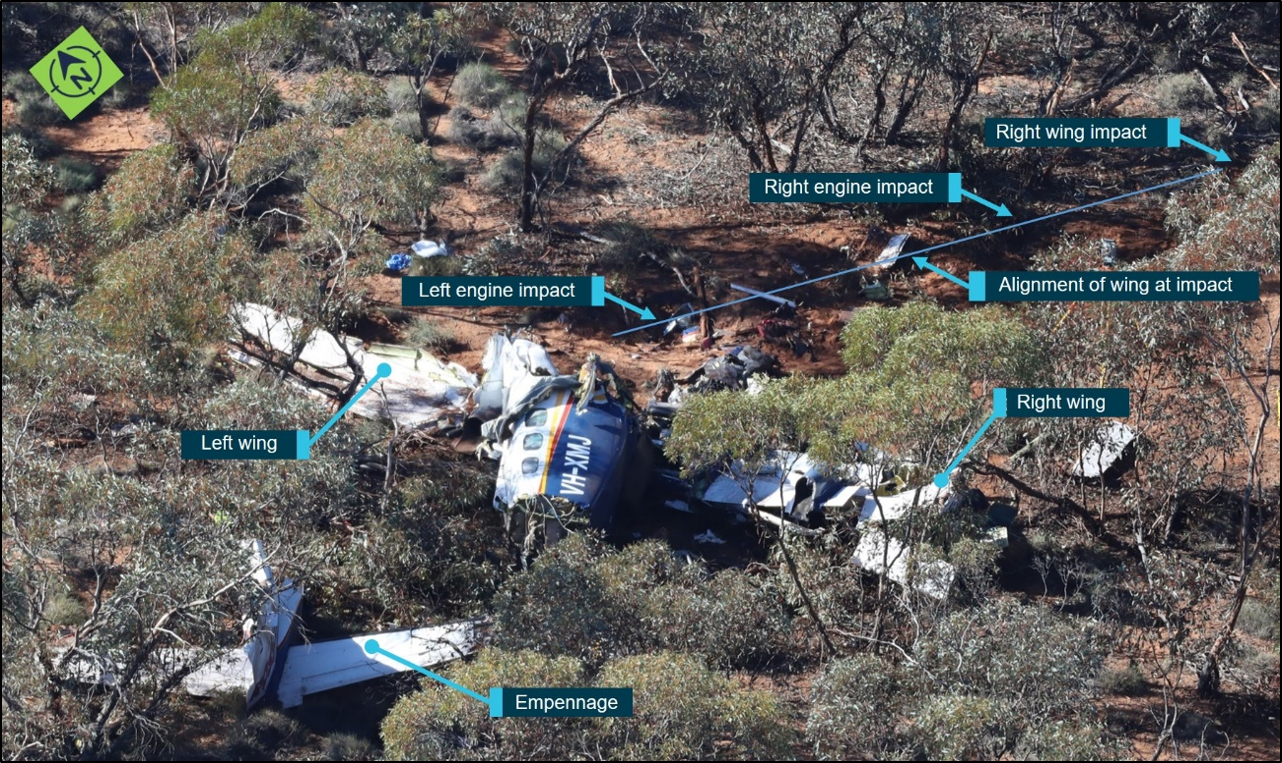
The Australian Transport Safety Bureau (ATSB) is seeking to clarify with operators of the twin-engine Cessna 441 aircraft the recommended procedures for conducting simulated single-engine failure exercises.
The intent of the clarification is to reduce the risk of a repeat occurrence of the fatal loss of control and collision with terrain accident near Renmark Airport, South Australia, on 30 May 2017 involving a Cessna 441. The subsequent ATSB investigation of this accident (AO-2017-057) found that control was lost during a simulated single-engine failure in the take-off configuration exercise that was not conducted in accordance with the Cessna 441 pilot’s operating handbook (POH).
Textron Aviation advised that the POH contains recommended guidance for single engine training, including a recommendation that operations with one engine shut down and VMCA demonstrations be conducted at a minimum of 5,000 ft above ground level (AGL).
Training and checking in single-engine manoeuvres are valid. However, beyond the content in the POH, Textron Aviation does not provide advice or give recommendations on how to conduct flight training, instead suggesting following industry and regulator guidance. As such, Textron Aviation does not provide procedures for simulating an engine failure beyond an actual engine shutdown at a minimum of 5,000 ft AGL, nor is it required to provide such procedures as part of aircraft certification.
Due to the inherent risk, simulation of an engine failure in a multi-engine aircraft needs to be thoroughly assessed and managed in accordance with the operator’s safety management system and exposition. In the case of the Cessna 441, the POH provides manufacturer recommended procedures for practicing a complete engine shut down. A multi-engine training or checking risk assessment should include consideration of how and when an alternate engine failure simulation (zero thrust) is initiated and the potential for unintended reversion to manual fuel metering as the throttle is initially reduced to simulate a power loss.
The Cessna 441 POH recommends that all single engine training procedures should be practiced to enable pilots to master the response to an engine failure/single-engine operation condition and to learn the aircraft’s handling qualities under such circumstances.
Textron Aviation advised the ATSB that Crew Training One Engine Inoperative Procedures, detailed in the POH, specifically allow the pilot to develop their skills and understanding of the aircraft's handling qualities at a minimum speed of VSSE (with a margin above VMCA). The VMCA demonstration is a maximum skill-level manoeuvre which is intended to be explored only after mastery of the other procedures. The manufacturer also recommends, with respect to all procedures and expanded discussions that are specific to training/practice, that pilots should precisely follow steps identified in the POH. The procedures referenced on pages 3–4 and 3–25 are specific to the occurrence of an actual emergency, and not a training scenario.
It is expected that pilots of twin-engine aircraft receive proper training from a qualified instructor with respect to the potential for loss of control and how it is mitigated following an engine failure or when operating single-engine for any reason.
This instruction should include the development of thorough familiarity with the appropriate procedures, proper responses to the commanded steps within a procedure, and training to mastery.
While the focus of this messaging is aimed towards Cessna 441 operators, the ATSB also encourages operators of other twin-engine aircraft types to take this opportunity to review their own simulated engine failure training procedures to ensure that this high-risk activity is conducted safely.
This statement was first published on 6 July 2023 and was updated on 18 August 2026