

Final report
Report release date: 11/11/2026
Investigation summary
What happened
On 13 August 2025, a Cessna 560, registered VH-OHE, was being operated by Avcair on a medical transport flight from Learmonth Airport to Perth Airport, Western Australia, with 2 flight crew and 3 passengers on board.
As the aircraft neared Perth Airport at night, air traffic control cleared the flight crew to descend to 3,000 ft and conduct the instrument landing system (ILS) approach for runway 24. The aircraft was being flown using the autopilot and, while it was still descending to the assigned altitude, the crew agreed to set the approach decision altitude in the altitude selector.
On reaching 3,000 ft, which was also the minimum sector altitude, the aircraft continued descending and did not capture the ILS glideslope. The crew attempted to correct the flight path using the automation system during which time the aircraft continued to descend, the autopilot disconnected, the aircraft entered an uncommanded left bank, and the enhanced ground proximity warning system (EGPWS) issued 2 alerts.
At about 500 ft above ground level, the captain took control and initiated a climb. Shortly after, air traffic control issued a low altitude warning safety alert to the crew. During the recovery, the aircraft reached a bank angle of about 50° and was manoeuvred back towards the ILS approach. In the late stage of the approach, the aircraft’s airspeed increased beyond the operator’s stabilised approach criteria. The flight crew continued the approach, landing a short time later.
What the ATSB found
The ATSB found the flight crew incorrectly set the approach decision altitude in the altitude selector before the autopilot had captured the ILS glideslope. The selection was contrary to the operator’s procedures and, in combination with the selected flight director modes, resulted in the autopilot commanding a continued descent towards terrain.
When the flight crew attempted to arrest the descent, they encountered difficulty locating the required flight director mode button on the first officer’s selector panel. The aircraft’s flight director mode selector panels had a fault that resulted in the intermittent illumination of mode selector buttons. This altered the visual presentation of the row of buttons at night and impacted the flight crew’s ability to locate the desired mode. A similar defect had been observed during a flight in the preceding days, however no endorsement of a defect was recorded in the aircraft’s maintenance release, and no maintenance action had been undertaken.
The flight crew became preoccupied with the flight director mode selection, and their attention was diverted from monitoring the aircraft state. As a result, the aircraft entered an uncommanded descending left turn after the autopilot was disengaged, and the crew did not appropriately respond to the EGPWS alerts.
At 500 ft above ground level, the captain initiated a recovery climb. However, during this time the aircraft exceeded the maximum angle of bank, which resulted in an undesired aircraft state and increased the risk of a loss of control at a low altitude. The flight crew re‑established the aircraft on the approach, but as the aircraft descended through 400 ft the airspeed exceeded the operator’s stabilised approach criteria. However, rather than conducting the required go-around, the flight crew elected to continue the approach and landed the aircraft.
Air traffic control issued a safety alert to the flight crew 35 seconds after the controller received an initial minimum safe altitude warning (MSAW) about the aircraft’s descent. This delay was a missed opportunity to alert the flight crew of the detected terrain proximity at a time when the aircraft was still descending. The delay was likely influenced by the controller’s exposure to previous nuisance MSAWs within the same area. While changes had been implemented to address nuisance MSAW alerts 2 months prior, and communicated to Perth controllers, the controller was not aware of these changes.
What has been done as a result
The operator of VH-OHE advised the ATSB that all company pilots were provided with additional ground-based training relating to the use of aircraft automation and crew resource management. The organisation also communicated to pilots the importance of reporting incidents in accordance with established operator procedures.
Safety message
This incident highlights how an unexpected disruption during an instrument approach can rapidly lead to a significant deviation from the intended flight path and result in an undesired aircraft state. In these scenarios, effective crew resource management, where each crewmember performs their procedurally assigned roles of flying and monitoring, is essential to ensure the continued safety of flight while the disruption is investigated and appropriately managed. If safe flight tolerances cannot be adequately monitored and maintained while the disruption is investigated, discontinuing the approach is the safest response.
The International Civil Aviation Organization’s State of Global Aviation Safety report identified controlled flight into terrain (CFIT) as a global high risk that accounted for 10% of total fatal accidents worldwide by occurrence category in 2024. The adoption of the enhanced ground proximity warning system (EGPWS) has contributed to a reduction in the number of CFIT accidents, however the system serves as a last line of defence by alerting pilots to the hazardous proximity of terrain. Consequently, flight crews should respond immediately and appropriately to EGPWS alerts, as a delay can allow a developing terrain proximity event to result in a CFIT.
Summary video
The occurrence
On the night of 13 August 2025, a Cessna 560, registered VH-OHE, was being operated by Avcair on a medical transport flight under the instrument flight rules1 from Learmonth Airport to Perth Airport, Western Australia (WA). On board was the captain, first officer (FO), 2 medical personnel and a patient. The FO was the pilot flying (PF)2 and the captain was the pilot monitoring (PM).
This was the flight crew’s second sector for the day, having positioned VH-OHE from Karratha Airport, WA, to Learmonth Airport that afternoon for patient retrieval. The aircraft departed Learmonth Airport at 19123 and proceeded to Perth Airport at flight level (FL)4 410.
At 2001, as the aircraft neared Perth Airport, the flight crew received air traffic control (ATC) clearance to conduct the JULIM 6A standard instrument arrival (STAR)5 for runway 24.6 At about 2025, the flight crew initiated a descent using the aircraft’s autopilot, which was coupled to the flight director (FD) with navigation and vertical navigation (VNAV) modes active (see Flight guidance and automation).
At 2037, as the aircraft descended through FL170, the flight crew were transferred to the Perth ATC approach controller (approach controller) who issued further descent and heading clearances.
At 2042:45, VH-OHE was maintaining a heading of 160° when the approach controller advised the flight crew that the aircraft was 3 NM (5.6 km) right of the localiser.7 The flight crew were instructed to turn onto a heading of 210°, descend to 3,000 ft, and were cleared to conduct the instrument landing system (ILS)8 approach for runway 24 (Figure 1). The forward-facing camera installed in VH‑OHE’s cockpit captured video and audio of the flight crew’s actions and cockpit instrumentation. The video from the incident flight recorded the captain acknowledging the clearance while the FO set 3,000 ft in the aircraft’s altitude preselector (ASEL) (see Altitude preselector).
Figure 1: VH-OHE runway 24 approach flight path
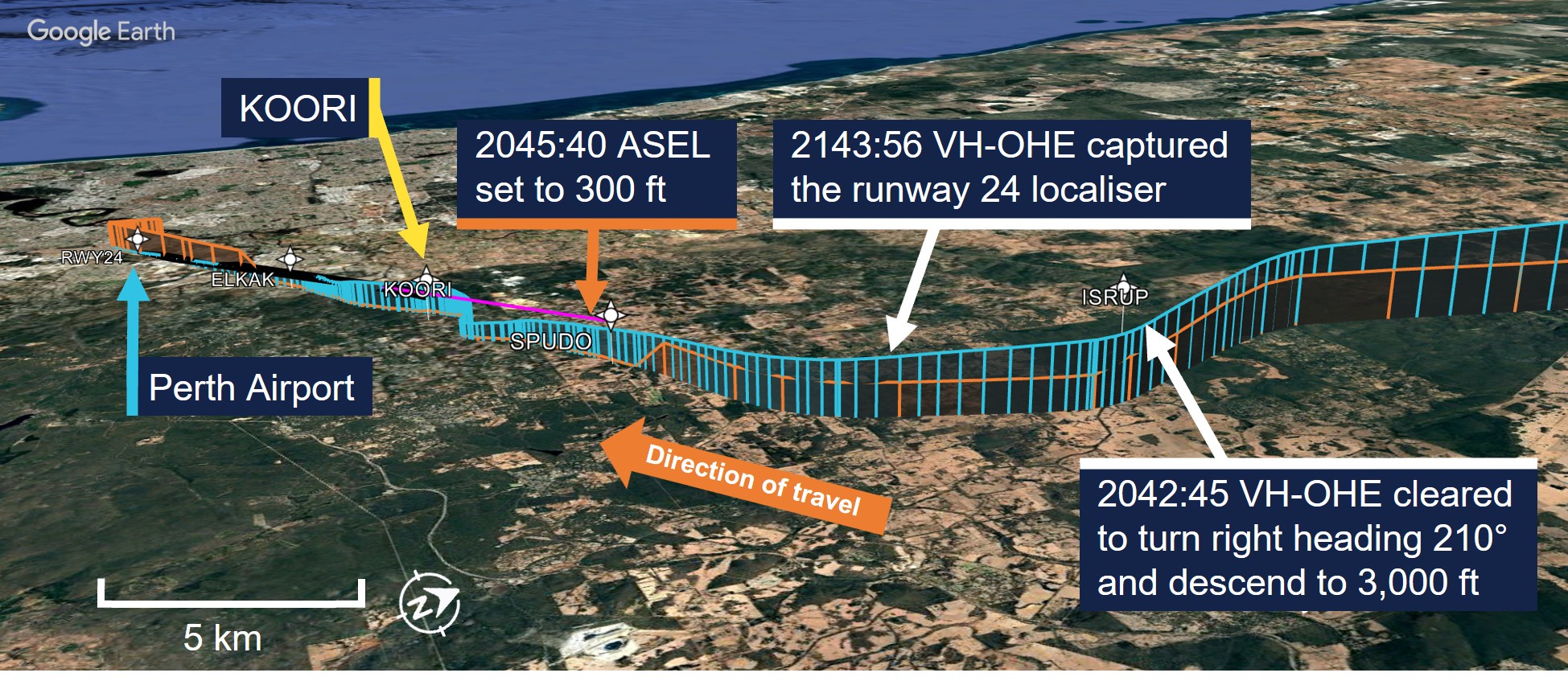
At 2043:56, as the aircraft neared the runway 24 ILS localiser, the FO selected the approach FD mode, which armed the localiser and glideslope (see Flight director mode selector). The FD immediately captured the localiser, and the autopilot initiated a right bank to follow the FD guidance while the aircraft continued descending. The FO then announced, ‘localiser captured.’ At this time, the aircraft was 17 NM (31 km) from the runway threshold and below the ILS glideslope.
At 2044:52, the altitude alert9 activated passing 4,000 ft, and the captain announced ‘1,000 [ft] to go,’10 which was acknowledged by the FO. The captain then asked the FO if they would like to set ‘260 [ft] as the minima’ in the ASEL, which the FO agreed to.
On passing 3,380 ft, the captain extended the landing gear and selected the ‘take off and approach’ flap setting of 15°. At 2045:25, the captain initially set 0 ft, then 300 ft in the ASEL, which they later recalled was the approach decision altitude.11
At 2045:38, the aircraft passed through the assigned altitude of 3,000 ft, which was also the applicable minimum sector altitude (MSA) (see Minimum sector altitude), and the FO enquired why the aircraft had not maintained 3,000 ft or captured the glideslope. The captain responded that the aircraft was below the glideslope, with pitch mode engaged and queried why the aircraft was continuing to descend. The FO responded they were unsure of the reason.
At 2046:11, the Perth Airport approach controller position underwent a shift swap, with the incoming approach controller taking over as VH‑OHE descended through 2,700 ft.
At 2046:15, the captain instructed the FO to engage the vertical speed (VS) FD mode to reduce the aircraft’s rate of descent. At this time the autopilot disconnected, which was accompanied by an audible tone and the ‘AUTOPILOT OFF’ light which illuminated for one second (see Autopilot control panel). This occurred while the FO was attempting to locate and activate the VS mode button on the FD mode selector panel, however, neither pilot recalled disengaging the autopilot at this time. The FO later recalled encountering difficulty locating the desired button due to a fault with their FD mode selector panel back-lighting (see Flight director mode selector panel lighting fault). The captain attempted to assist the FO to locate the VS mode button and, at 2046:20, the aircraft began to bank to the left while the rate of descent increased.
At 2046:28, the aircraft’s rate of descent reached 2,000 fpm as the aircraft descended through 2,150 ft with 20° left angle of bank and 8° nose down pitch attitude (Figure 2 and Figure 3). During this time the captain and FO were still attempting to engage the VS button on the FO side FD mode selector.
Figure 2: Captain’s side primary flight display at 2046:28
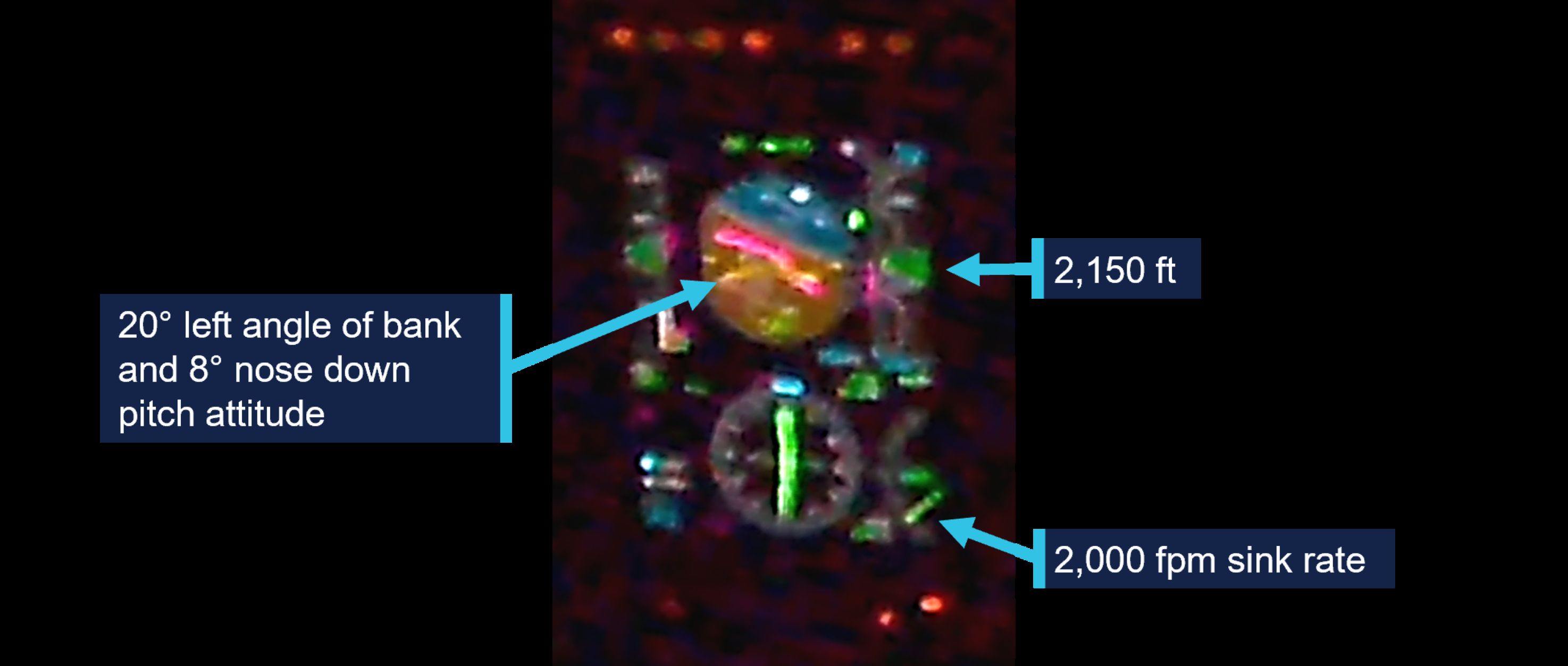
Figure 3: VH-OHE flight path below minimum sector altitude
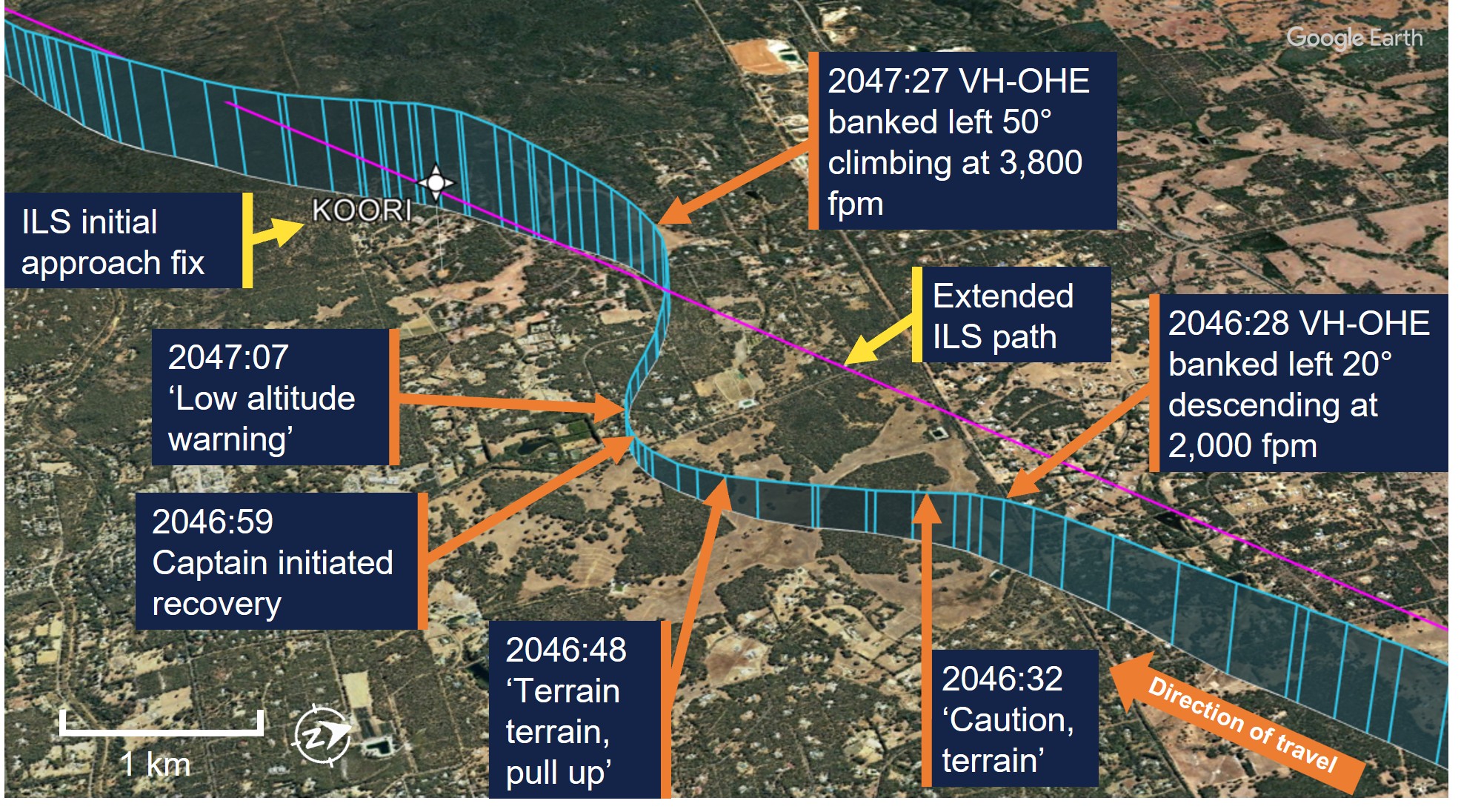
At 2046:32, the aircraft descended through 1,960 ft (1,000 ft above ground level [AGL]) with a rate of descent of about 2,000 fpm and an angle of bank of 22°. At this time, an enhanced ground proximity warning system (EGPWS) alert was generated which presented to the flight crew as a visual alert on their electronic attitude direction indicators (EADI),12 and an accompanying aural ‘caution terrain, caution terrain,’ alert sounded in the cockpit (see Enhanced ground proximity warning system). Neither of the flight crew recalled observing either the visual annunciations or the audible alert.
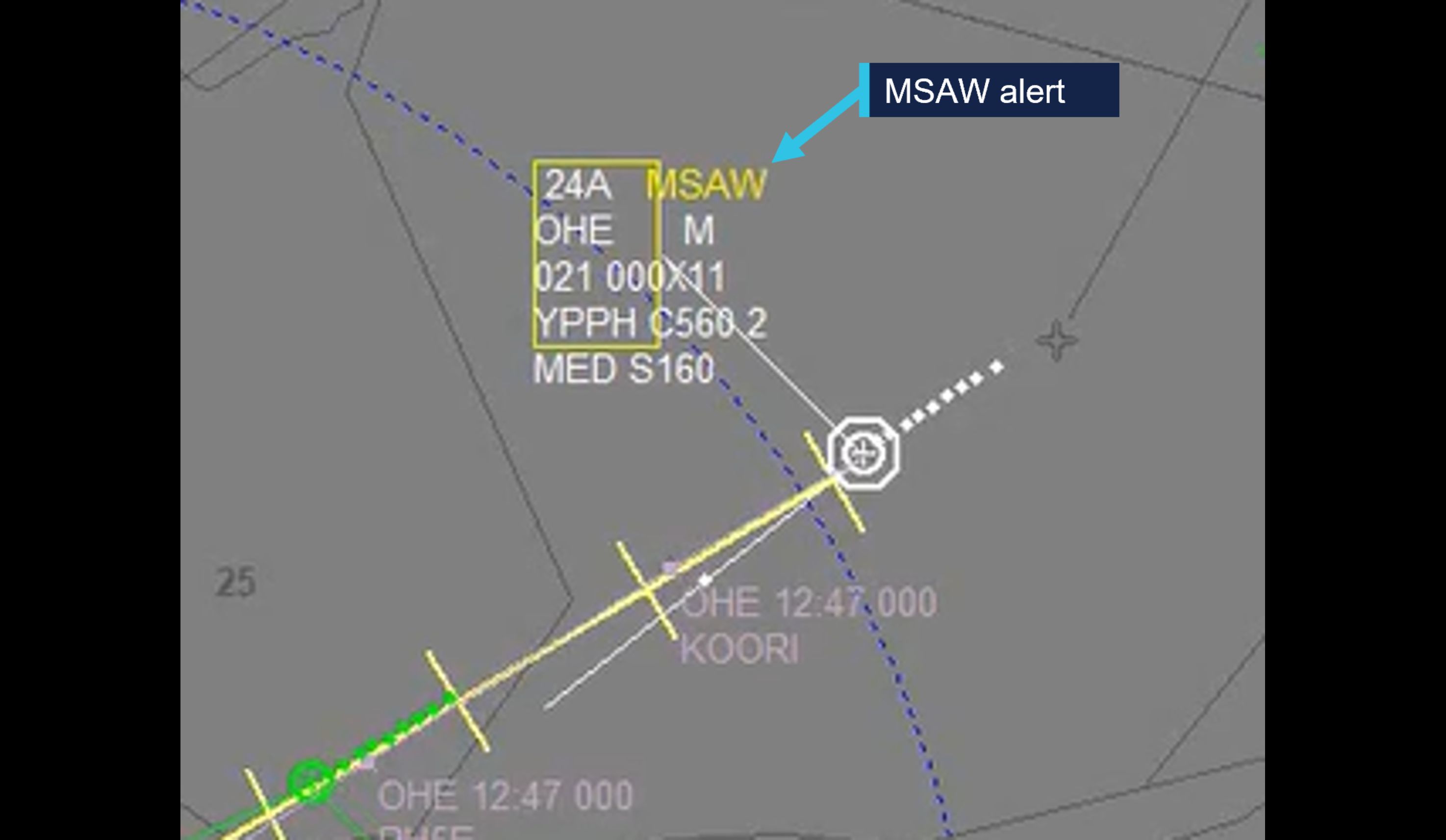
At the same time the flight crew received the EGPWS alert (2046:32), a minimum safe altitude warning (MSAW) alert was triggered for VH‑OHE on the approach controller’s air situation display (see Perth Airport air traffic control). In response, the approach controller assessed that VH‑OHE was above the minimum safe altitude and cancelled the audible alert, however the visual alert remained on the situation display. They later recalled the MSAW alert occurred in an area where they had observed numerous erroneous MSAWs in the year prior to the incident (see Nuisance MSAW alerts).
At 2046:37, the captain re-engaged the autopilot while the FO began experiencing issues with their headset boom microphone that prevented them communicating over the cockpit interphone system. The captain then advised the FO, ‘now the autopilot is engaged,’ which the FO did not recall hearing at the time. The FO persisted attempting to hand-fly the aircraft while it continued descending with the autopilot engaged.
At 2046:48, as the aircraft descended through 1,650 ft (650 ft AGL), an EGPWS alert appeared on the EADI accompanied by a ‘terrain terrain, pull up’ aural alert, which the captain later recalled observing. At this time, the captain was directing the FO to ‘go right to the glideslope.’
At 2046:55, the autopilot disengaged a second time with an accompanied audible tone and ‘AUTOPILOT OFF’ light, which remained illuminated for the remainder of the flight (see Autopilot control panel). This occurred while the FO was still attempting to hand-fly the aircraft. At about 500 ft AGL, the captain announced they were taking control of the aircraft. The FO recalled first observing an EGPWS alert after the captain took over, while neither pilot recalled disengaging the autopilot. Shortly after, the captain advanced both thrust levers and established the aircraft in a climb on a westerly heading at 2047:06.
Around this time, the approach controller recalled observing a second MSAW alert for VH‑OHE, that was triggered at 2046:46, and recalled observing the aircraft was between 1,500–1,700 ft. At 2047:07, the approach controller broadcast, ‘oscar hotel echo, low altitude warning, check your altitude immediately on QNH 1012, lowest safe altitude is 2,800 [ft]’. The FO, who was now PM, initially attempted to acknowledge the warning, but they were still experiencing issues with their headset boom microphone and could not make themselves heard by the controller.
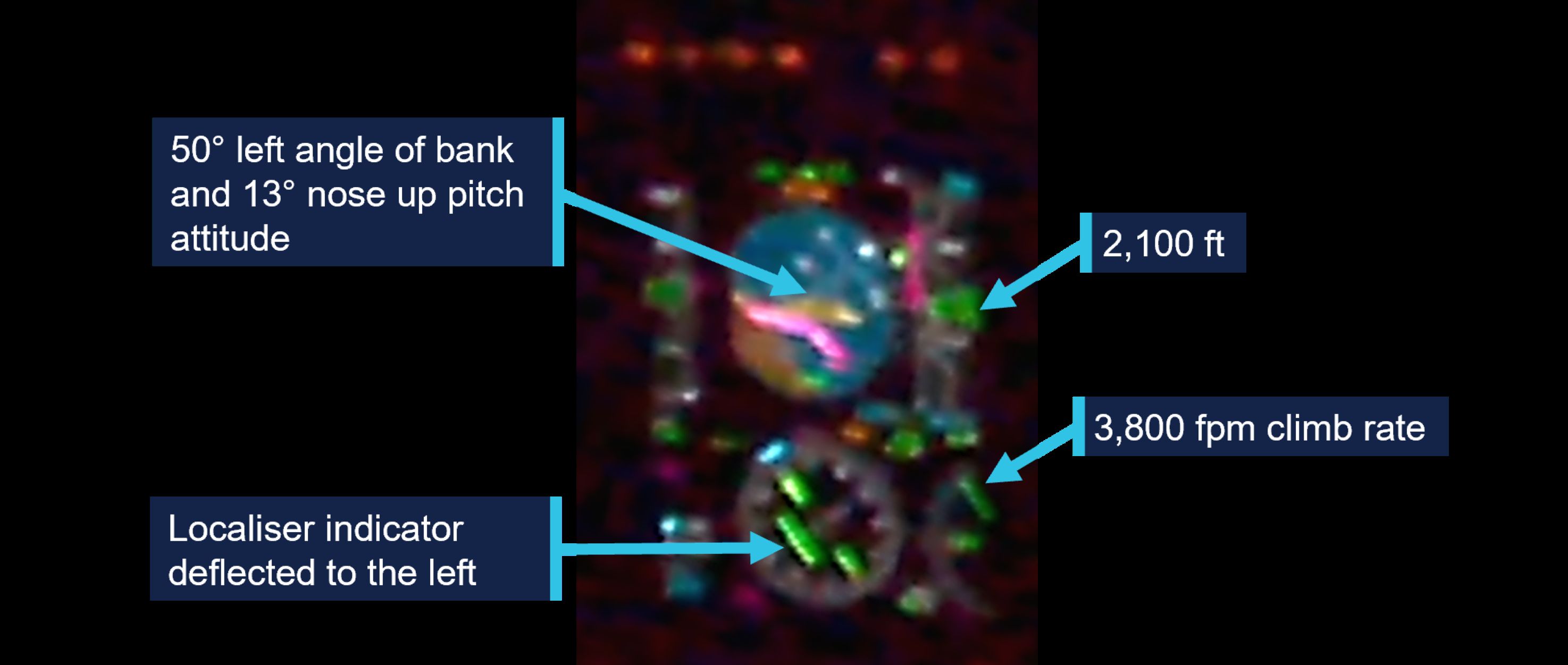
At 2047:24, the aircraft reached a maximum climb rate of 4,000 fpm and was 0.2 NM (0.4 km) right of the runway 24 centreline and below the glideslope. In response, the captain initiated a left turn and progressively increased the angle of bank. In doing so the aircraft reached a maximum angle of bank of 50° and 13° nose up pitch at an altitude of 2,200 ft (1,250 ft AGL) (Figure 4). The angle of bank was not verbalised by either the captain or the FO (see Flight tolerances and approach call outs).
Figure 4: Captain’s side primary flight display at 2047:27
The captain subsequently reduced the angle of bank as the aircraft became established on a south-westerly heading and continued climbing at over 2,000 fpm to regain the desired glidepath. Up to this point, the flight crew had not discussed their intentions following the recovery.
At 2047:37, the FO resolved the issue with their headset and established contact with the approach controller who asked ‘oscar hotel echo, just confirm you’re established on the localiser … we had you a little bit low.’ The FO then advised the approach controller ‘affirm … we corrected that.’ During this time, the aircraft was beyond half‑scale deflection to the right of the localiser abeam the initial approach fix (IAF)13 for the ILS approach.
At 2047:46, the approach controller asked the flight crew if they intended to continue with the approach, to which the FO responded that they would, and they were subsequently transferred to Perth ATC tower controller (tower controller).
At 2048:07, the FO contacted the tower controller and advised that they were ‘established.’14 At this time the aircraft was 7.5 NM (13.9 km) from the runway 24 threshold, established on the localiser and was beyond half-scale deflection above the glideslope. At 2048:39, the captain requested ‘more flap,’15 which was actioned by the FO, followed shortly by the landing checklist.
At 2050:07, the tower controller advised the flight crew that the wind direction at the airport was from 250° with a velocity of 27 kt and cleared VH‑OHE to land on runway 24. As the aircraft passed 1,000 ft, the flight crew acknowledged the altitude with a ‘checked’ call, which coincided with the operator’s stabilisation height during an instrument approach (see Stable approach criteria). Both the captain and FO sighted the runway as the aircraft descended through 800 ft.
At 2051:38, the aircraft descended through 430 ft, and the airspeed increased above the operator’s stable approach criteria, peaking at 133 kt. The airspeed remained above the maximum allowable airspeed until the aircraft passed 200 ft at 2052:09 (see Stable approach criteria). Neither the captain nor the FO verbalised the airspeed exceedance, and they continued with the approach. The aircraft touched down on runway 24 at 2052:28.
Context
Personnel information
Captain
The captain held an Air Transport Pilot Licence (ATPL) (Aeroplane) and a class 1 aviation medical certificate. They had a total of 7,490 hours total flying time, with 470 hours on the Cessna 560 (560). They held a flight examiner rating for the 560 and were employed as a training captain with Avcair. On 5 May 2025, the captain was assessed as competent during an operator proficiency check (OPC) conducted in an approved 560 flight simulator.
First officer
The first officer (FO) held an ATPL (Aeroplane) and a class 1 aviation medical certificate. They had a total time of 9,374 hours, with 50.6 hours on the Cessna 560.
All the FO’s 560 flying time had been accumulated during their initial type rating and subsequent line training with Avcair. For the initial 560 type rating, Avcair engaged a third-party training organisation, which conducted the training in an approved 560 flight simulator. The captain involved in the incident flight had also conducted part of the FO’s subsequent line training in the 560, which accounted for 12.6 hours. After successfully completing their line training, the FO was assessed as competent during an OPC conducted in the 560 on 21 July 2025. The incident operation on 13 August 2025 was the first flying the FO had conducted since completing their line training.
Fatigue
Flight and duty records indicated that both flight crew members had been on standby duties for the preceding 5 days in Karratha, WA, and had signed on for duty at 1423 local time on the day of the incident. Both pilots reported obtaining at least 8 hours of sleep in the 24-hour period preceding the incident. At the time of the incident, the captain reported feeling ‘somewhat fresh,’ while the FO reported feeling ‘responsive but not at peak.’
The ATSB considered that fatigue was unlikely to have affected the flight crew’s performance at the time of the incident.
Aircraft information
General information
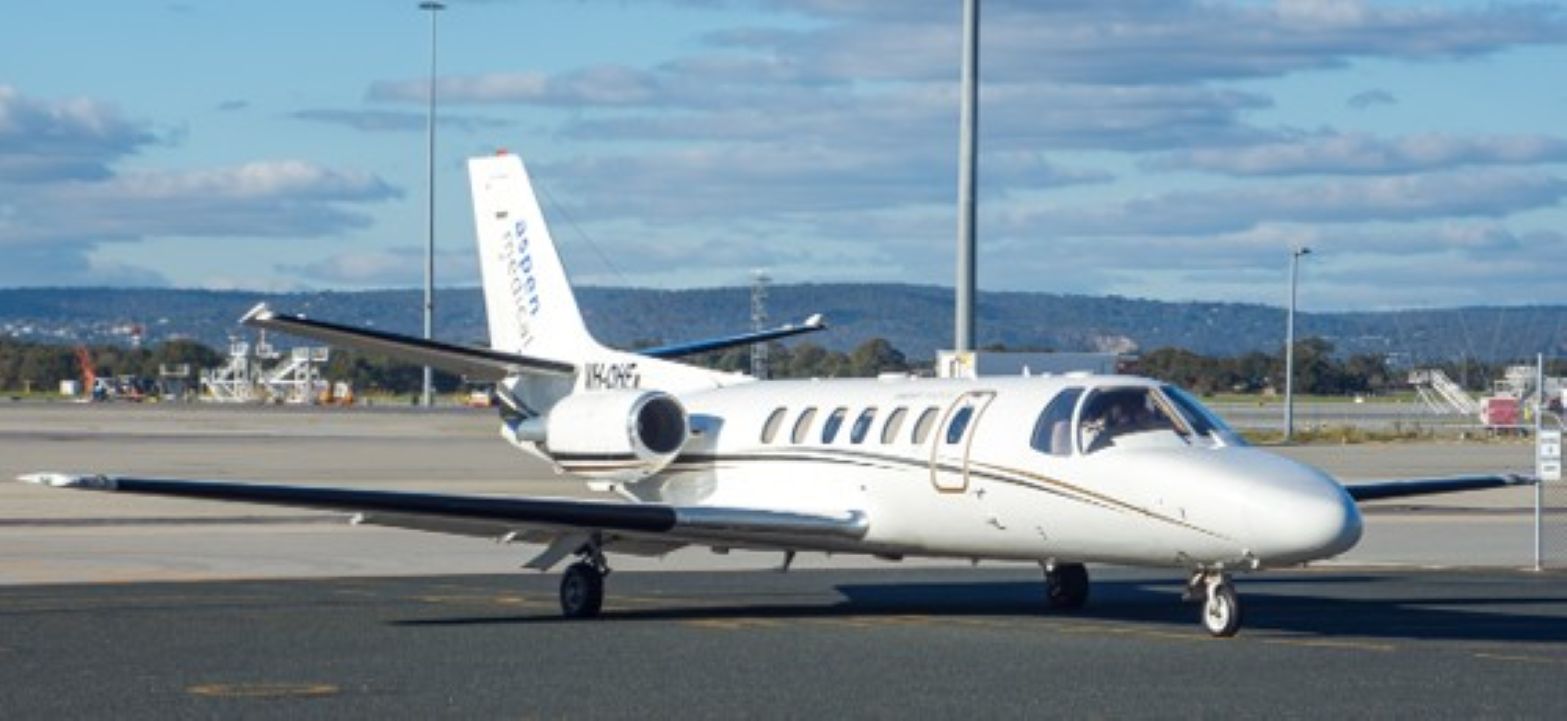
VH-OHE (Figure 5) was a Cessna 560 equipped with 2 Pratt & Whitney Canada turbofan engines. The aircraft was manufactured in 1995 and was first registered in Australia in 1999. Avcair became the registered operator of the aircraft in 2021.
The aircraft was configured for medical transport flights. The last periodic inspection was completed on 14 July 2025. At this time, the aircraft had accumulated 10,589 hours total time in service. At the time of the incident, the aircraft had accumulated an additional 24 hours since the last periodic inspection.
Figure 5: VH-OHE
Operational information
Flight guidance and automation
General information
The Cessna 560 is equipped with a flight director (FD) and autopilot system capable of providing flight guidance and automatic flight control. The aircraft can be flown manually using the guidance provided by the modes selected on the FD. The aircraft may also be flown using the autopilot. When coupled to the flight director, the autopilot will control the aircraft using the commands generated by the FD computer. The autopilot can also be used without any inputs from the FD system, in pitch, roll and heading hold.
Autopilot control panel
The autopilot control panel (ACP), mounted on the cockpit pedestal, provides the means of engaging the autopilot (Figure 6). The push-on/push-off autopilot (AP) button engages the autopilot and yaw damper (YD) simultaneously.
Figure 6: Autopilot control panel
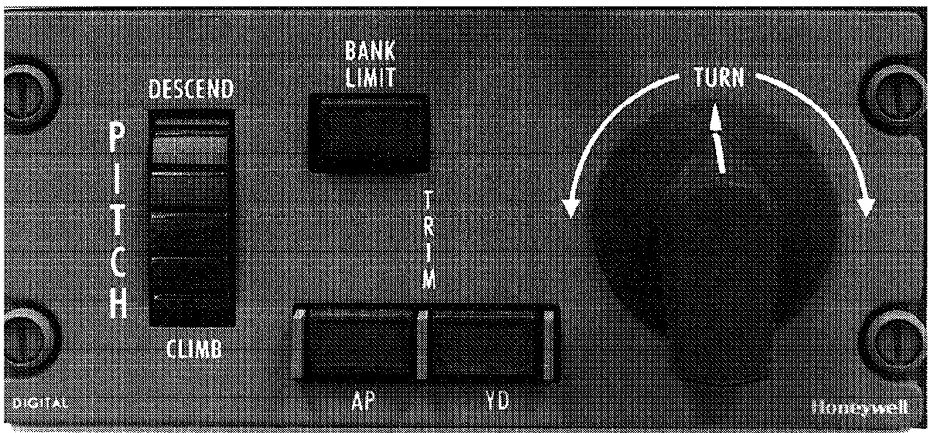
The autopilot is normally disengaged by depressing the AP/TRIM DISC switch on either the captain’s or FO’s yoke, electrically trimming the elevator trim system, or depressing the go-around button on either throttle. In these scenarios, a warning tone will sound for one second and the amber AUTOPILOT OFF light located adjacent to each pilot’s primary flight display (PFD) will illuminate for one second. Any other method of autopilot disconnection, such as pressing the AP button on the ACP, will cause the warning horn to sound for one second and the amber AUTOPILOT OFF light to stay illuminated until extinguished by the flight crew. The autopilot will also disengage if a sustained force is applied to the vertical or horizontal axis.
Flight director mode selector panel
The flight director can be activated by either pilot selecting an FD mode using the FD mode selector panel located above each pilot’s PFD. The panel incorporates 7 push‑on/push-off buttons that engage the selected FD mode(s) (Figure 7).
Figure 7: Flight director mode selector panel
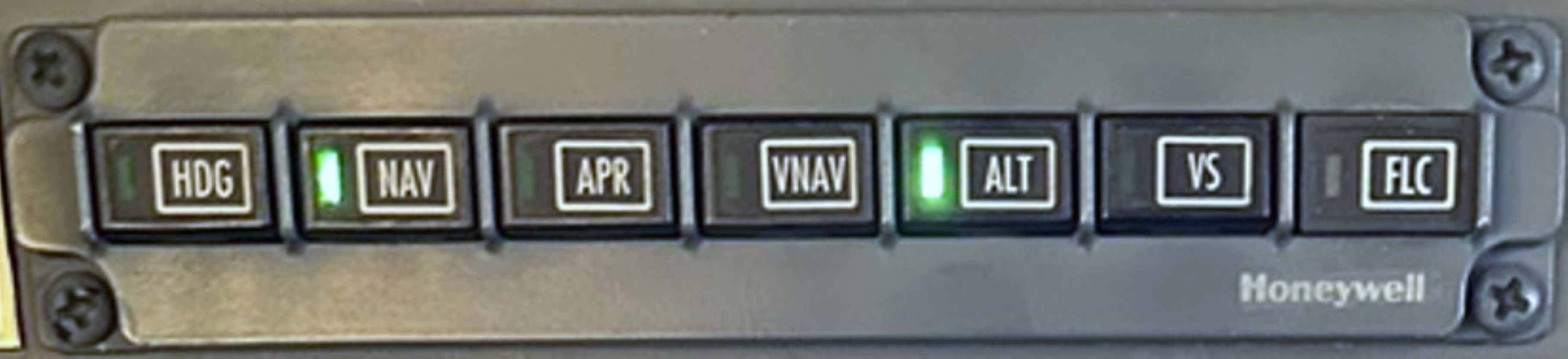
Each button incorporates white background lighting (when selected on) and a green activation light when the corresponding mode is armed or captured. The FD mode status is also annunciated on both pilot’s PFDs, with white text indicating an armed mode and green text indicating a captured or active mode.
Each FD mode button arms or activates a lateral or vertical guidance mode, or both in the case of the approach (APR) mode. The selectable flight director modes relevant to the incident flight are summarised in Table 1.
Table 1: Relevant FD modes and functions
If the autopilot is engaged after FD activation, it is automatically coupled to the FD and follows the FD computer generated flight path. In scenarios where an active vertical FD mode is disengaged, while the autopilot is engaged, the autopilot will hold the pitch attitude of the aircraft at the moment of disengagement.
Altitude preselector
The altitude preselector (ASEL) enables flight crew to set a preselected altitude, in 100 ft increments, in the altitude window at the lower right corner of the multifunction display (MFD).17 The preselected altitude is also presented on the pilot’s PFD.
As the aircraft approaches the preselected altitude, the FD provides pitch commands to the autopilot (when engaged) to level off and maintain the altitude. While in a descent, if a lower altitude is selected before levelling off, the FD will continue descent in the active vertical mode until the aircraft reaches the preselected altitude or captures the glideslope when the APR mode is armed.
As required by the Avcair Operations Manual (AOM), during the descent, the flight crew would use the ASEL to set the desired altitude. When conducting an instrument landing system (ILS) approach the Avcair Aircraft Operating Procedures (AOP) – Approach and Landing Callouts stated:
Once the glide slope has been captured, the altitude pre-selector is set to the missed approach altitude.
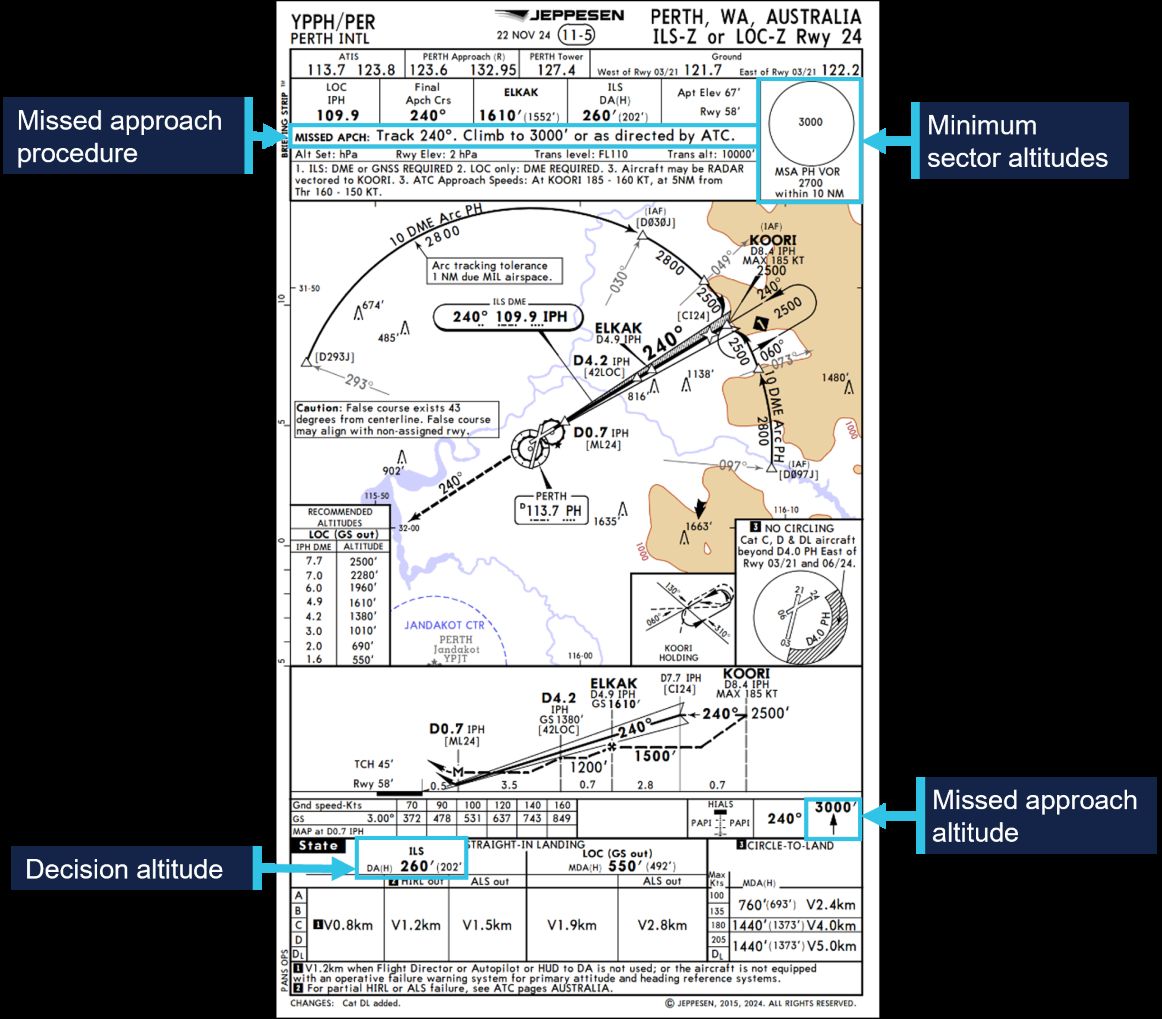
The missed approach altitude for the Perth runway 24 ILS approach is 3,000 ft (see Instrument landing system approach).
A review of the flight crew’s records between 1 April 2025 and the incident indicated the majority of flights conducted were into airports that were only equipped with non‑precision approaches. When conducting a non‑precision approach, the AOP stated:
The crew must set MDA +50 feet as a company DA for any occasion an MDA must be set. The amended minima must be entered in the ASEL.
Flight director mode selector panel lighting fault
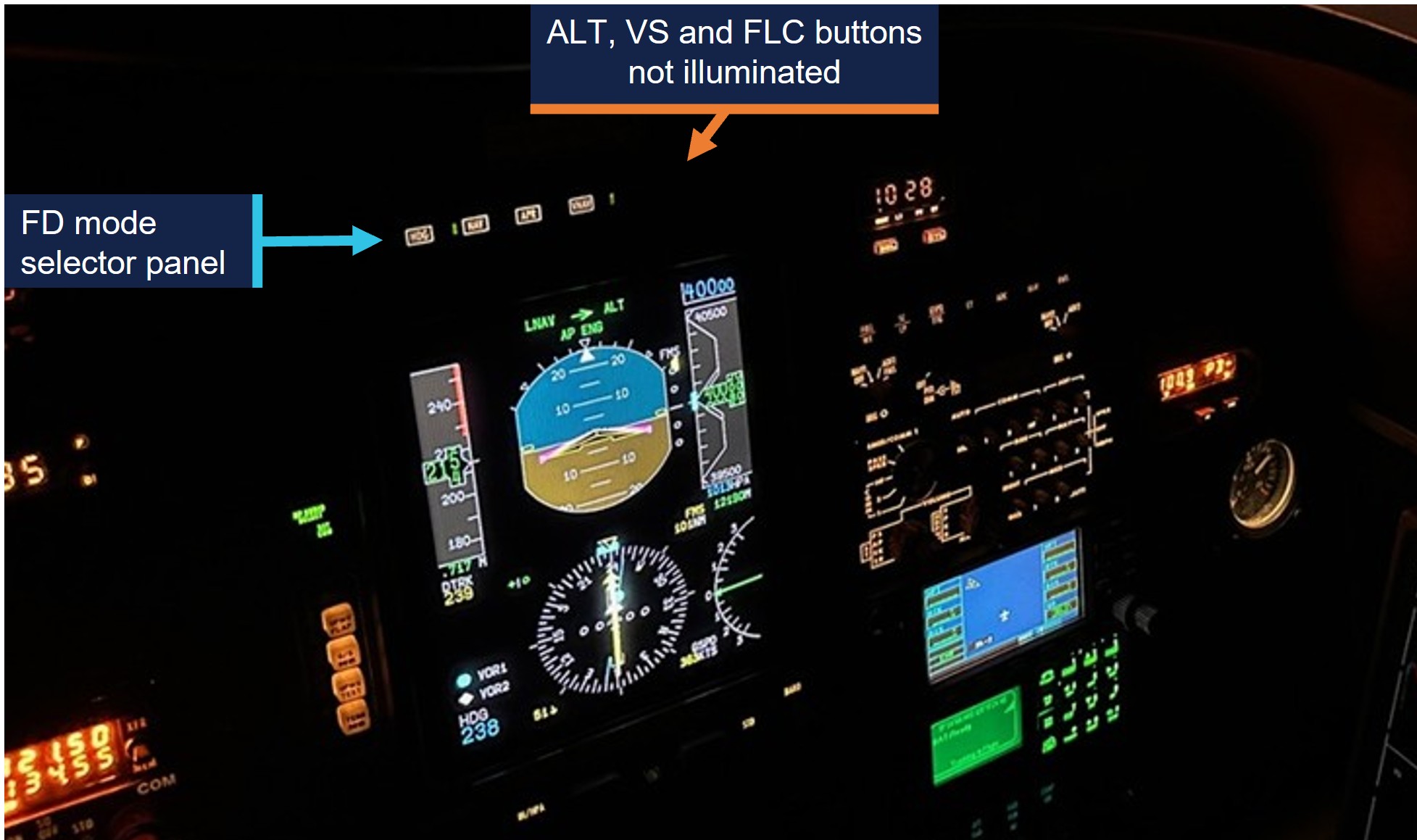
The cockpit video recording of the incident flight indicated that the during the descent and approach, the altitude hold (ALT) FD mode selector panel button on the captain’s side was not illuminated although it was on the FO’s side. Similarly, the FO’s flight level change (FLC) FD mode selector panel button was not illuminated but was on the captain’s side (Figure 8).
Figure 8: FD mode selector panel lighting taken at 2048:57
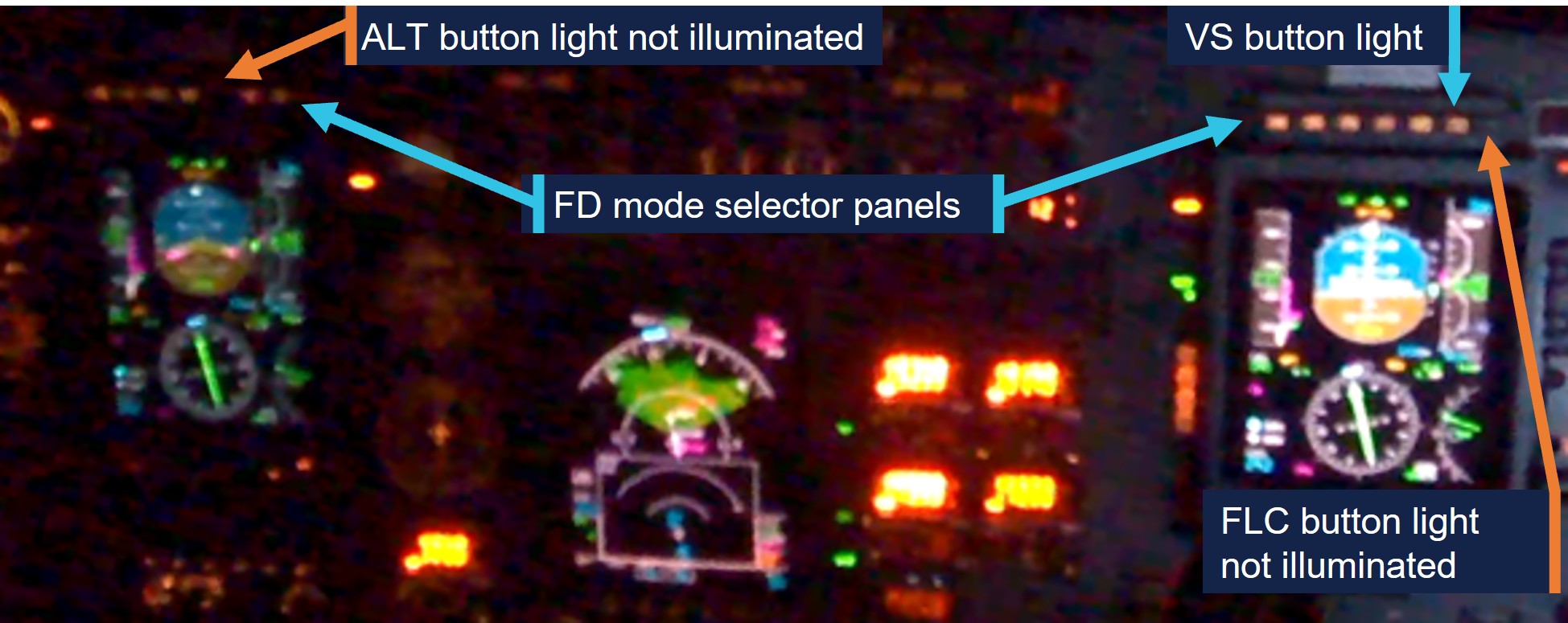
The captain and FO recalled that the backlighting on the FD mode selector panel had operated intermittently prior to the incident flight. Both pilots reported being aware of the practice of rubbing or tapping the affected button to rectify the fault. During the incident flight, the cockpit video recording also captured a similar fault with the FO side APR mode selector button, but it was rectified in flight by the FO when they tapped the button.
An image supplied to the ATSB for a flight in VH-OHE, that took place several days prior to the incident flight, documented the same illumination issue with the ALT, VS and FLC buttons on the FO side FD mode selector panel (Figure 9). ‘Nil defects’ was recorded in the notes section of the corresponding flight log, and no defect had been recorded in the aircraft maintenance release (MR)18 following this flight.
Figure 9: Supplied image of VH-OHE cockpit taken on 7 August 2025
As required by the AOM, in the event that a defect was identified following the completion of a flight, the captain was responsible for recording this in the notes section of the aircraft flight log and reporting the issue to the head of flight operations.
The Avcair Maintenance Control Manual (MCM) described the procedures for reporting of defects which stated:
Defects shall be entered in Part 2 of the Maintenance Release to enable an evaluation and appropriate remedial action by Maintenance Staff and the HAAMC19 and MC.20
The MR document used for VH-OHE was a standard Civil Aviation Safety Authority (CASA) form 918. Part 2 of the MR was used to record defects that occurred during the period of validity. Regulation 50 of the Civil Aviation Regulations 1988 outlined the defects and major damage to be endorsed on the MR and stated:
(1) This regulation applies to each of the following persons:
(a) the holder of the certificate of registration for an Australian aircraft;
(b) the operator of an Australian aircraft;
(c) a flight crew member of an Australian aircraft.
(2) If:
(a) there is a defect in the aircraft; or
(b) the aircraft has suffered major damage;
a person mentioned in subregulation (1), who becomes aware of the defect or damage, must endorse the maintenance release of the aircraft or other document approved for use as an alternative for the purposes of this regulation, setting out the particulars of the defect or damage, as the case may be, and sign the endorsement.
The Avcair internal investigation report into the incident found that the crew did not report the incident to the relevant personnel after landing at Perth, or prior to the subsequent sector in accordance with the AOM procedure for ‘reporting and recording defects and incidents.’ As a result, the aircraft’s cockpit voice recorder was overwritten before the event was reported and so was not available for the ATSB investigation.
The operator also advised the ATSB that no maintenance action had been carried out on the FD mode selector button lighting in the 28-day period prior to the incident. A review of the aircraft MR that was valid for the incident flight did not contain endorsements for defects relating to the flight director mode selector panel lighting.
Enhanced ground proximity warning system
The Cessna 560 is fitted with a Honeywell enhanced ground proximity warning system (EGPWS), which uses the aircraft geographic position, aircraft altitude and a terrain database to predict potential conflicts between the aircraft flight path and terrain. The system provides pilots with aural alert messages, and visual annunciations which are displayed on each pilot’s PFD.
The Aircraft Flight Manual Supplement for the EGPWS prescribed the flight crew’s initial terrain avoidance actions following activation of a visual annunciator or aural terrain alert.
For activation of the aural 'caution, terrain' alert or amber GND PROX annunciator on the PFDs, the initial action for the pilot flying (PF) was to take immediate positive corrective action to adjust the flight path, or correct the aircraft configuration, until the alert ceased.
For activation of the aural 'terrain, terrain, pull up' alert or red PULL UP annunciator on the PFDs, the initial actions for the PF were to disconnect the autopilot, aggressively apply maximum thrust, roll the wings level, and rotate at 3° per second to an initial pitch attitude of 20°.
The Avcair Training and Checking Manual required flight crew undertake initial EGPWS ground training on commencement with the organisation, and recurrent training every 2 years. The captain and first officer last completed the EGPWS ground training on 4 December 2023 and 19 March 2025 respectively.
Flight tolerances and approach call outs
The AOP contained call outs and challenges to be performed by the pilot monitoring (PM) when flight tolerances were exceeded and the required responses by the PF (Table 2).
Table 2: Relevant flight path deviations and standard calls
| Condition / Deviation | Pilot monitoring challenge | Pilot flying |
| Indicated airspeed flight tolerance exceeded | ‘Speed’ |
‘Correcting’ or ‘Go Around’ in circumstances where an acceptable correction cannot be effected |
| Altitude flight tolerance exceeded | ‘Altitude’ | |
| Lateral tracking flight tolerance exceeded (i.e. ½ scale deflection or 5 degrees exceeded) | ‘Tracking’ or ‘Localiser’ | |
| One dot glideslope deviation exceeded | ‘Slope’ | |
| 25 degrees bank angle exceeded | ‘Bank Angle’ | |
| Source: Avcair, tabulated by the ATSB | ||
Standard deviation calls also play an important role in the early identification of a developing undesired aircraft state (UAS). A UAS may result from a pilot induced aircraft position or speed deviations, misapplication of flight controls, or incorrect systems configurations associated with a reduced margin of safety. For safe flight, pilots must quickly recognise and recover from an undesired aircraft state before it leads to a loss of control or uncontrolled flight into terrain (Civil Aviation Safety Authority, 2025).
Stable approach criteria
A stabilised approach is one where an aircraft maintains a constant descent to the runway while other key flight parameters such as airspeed and aircraft configuration are maintained within defined flight tolerances.
The AOM required all approaches conducted in instrument meteorological conditions be stabilised no later than 1,000 ft above ground level (AGL), and 500 ft AGL in visual meteorological conditions. An approach complied with the operator’s stabilised approach criteria when the following conditions were met:
• All briefings completed and checklists have been actioned...
• The landing gear shall be down and locked, and the landing flap should be selected.
• The aircraft speed (excluding momentary excursions defined as a deviation lasting only a few seconds and where every indication is that it will return within the stabilised criteria) is not less than VREF21 and not more than the lower of (Exception 3)
◦ Structural limitations for the configuration; and
◦ Instrument approach handling speeds for the relevant performance category; and
◦ Speed as per below to ensure a controlled and progressive reduction in speed:
- HAT22 + 1000’ at VREF + 60 KTS
- HAT + 900’ at VREF + 50 KTS
- HAT + 800’ at VREF + 40 KTS
- HAT + 700’ at VREF + 30 KTS
- HAT + 600’’ at VREF + 20 KTS
- …HAT + 500’ at VREF + 10 KTS
• The aircraft is on the correct flight path within the approach path tolerances laid down in the AIP [Aeronautical Information Publication] for the type of approach being flown and only minor corrections are required to be made.
• Vertical speed is no more than 1,000 feet per minute.
• Power setting is appropriate for the aircraft configuration.
500’ HAT and Below Stabilised Approach Requirements
At or below 500 ft HAT, if any of the Stable Approach Criteria are no longer met or destabilise (except for momentary excursions of speed), then the PIC in single pilot operations or the PM shall announce “GO AROUND” and an immediate go-around shall be flown.
The AOM also contained the recommended method for calculating the final approach and threshold speeds. It stated:
The Company recommended method of approach speed correction is to add one half of the reported steady headwind component plus the full gust increment above the steady wind to the reference speed. When adjusting for wind velocity, the maximum command speed should not exceed VREF + 20 knots or landing flap placard speed23 minus 5 knots, whichever is lower.
The reported wind component of 250° at 27 kt provided by the Perth tower controller prior to landing likely resulted in a headwind component of 27 kt during the final approach. Based on the operator’s recommended method for calculating the approach speed, the applicable airspeed for the incident approach was 14 kt above the VREF of 103 kt, which equates to 117 kt.
In response to the draft investigation report, the captain advised the ATSB it was their understanding that a wind correction would result in a higher VREF, and assessed that the HAT 500 ft stabilised criteria of VREF + 10 kt during the incident approach equated to 127 kt.
Meteorological information
Automatic traffic information service
The Perth Airport terminal information that was valid during the incident advised the following weather conditions:
- expect instrument landing system approach for runway 24
- whole runway wet
- wind direction 240–320° at 20 kt (maximum crosswind 20 kt)
- 10 km visibility reducing to 3 km
- thunderstorms and associated rain showers
- few24 cloud at 600 ft, broken25 cloud at 1,200 ft and 2,300 ft.
Airport information
Perth Airport
Perth Airport had 2 runway strips oriented 016°/196° and 061°/241° magnetic (03/21 and 06/24). Runway 24 was equipped with a category 126 ILS and provided the typical 3° glideslope to the runway.
Instrument landing system approach
The Perth runway 24 ILS approach commenced at KOORI (initial approach fix) located 8.2 NM (15.2 km) from the runway threshold, which had an elevation of 58 ft. Aircraft conducting the ILS approach could descend to the decision altitude of 260 ft, which was 202 ft above the runway threshold. If a missed approach was required after the approach had commenced, the published procedure was to track 240° and climb to 3,000 ft (Figure 10).
Figure 10: Perth runway 24 ILS approach chart
Minimum sector altitude
The minimum sector altitude (MSA) is the lowest usable altitude that provides at least 300 m (or 1,000 ft) clearance above all objects within a circle or a sector of a circle of radius 46 km (25 NM) or 18.5 km (10 NM) centred on a significant point. If a flight crew encounters an issue that requires immediate terrain avoidance, climbing to the MSA provides safe separation from obstacles within that sector.
The MSA for the Perth runway 24 ILS approach was 3,000 ft within a 46 km (25 NM) radius of the Perth very high frequency omnidirectional range station (VOR).27
Perth Airport air traffic control
General information
The Perth terminal control unit, located at Perth Airport, provided air traffic services, including approach control, for aircraft arriving at Perth Airport. Approach controllers were responsible for adjusting the sequence of arriving aircraft to achieve the correct priority as defined in the Airservices Australia Manual of Air Traffic Services (MATS).28
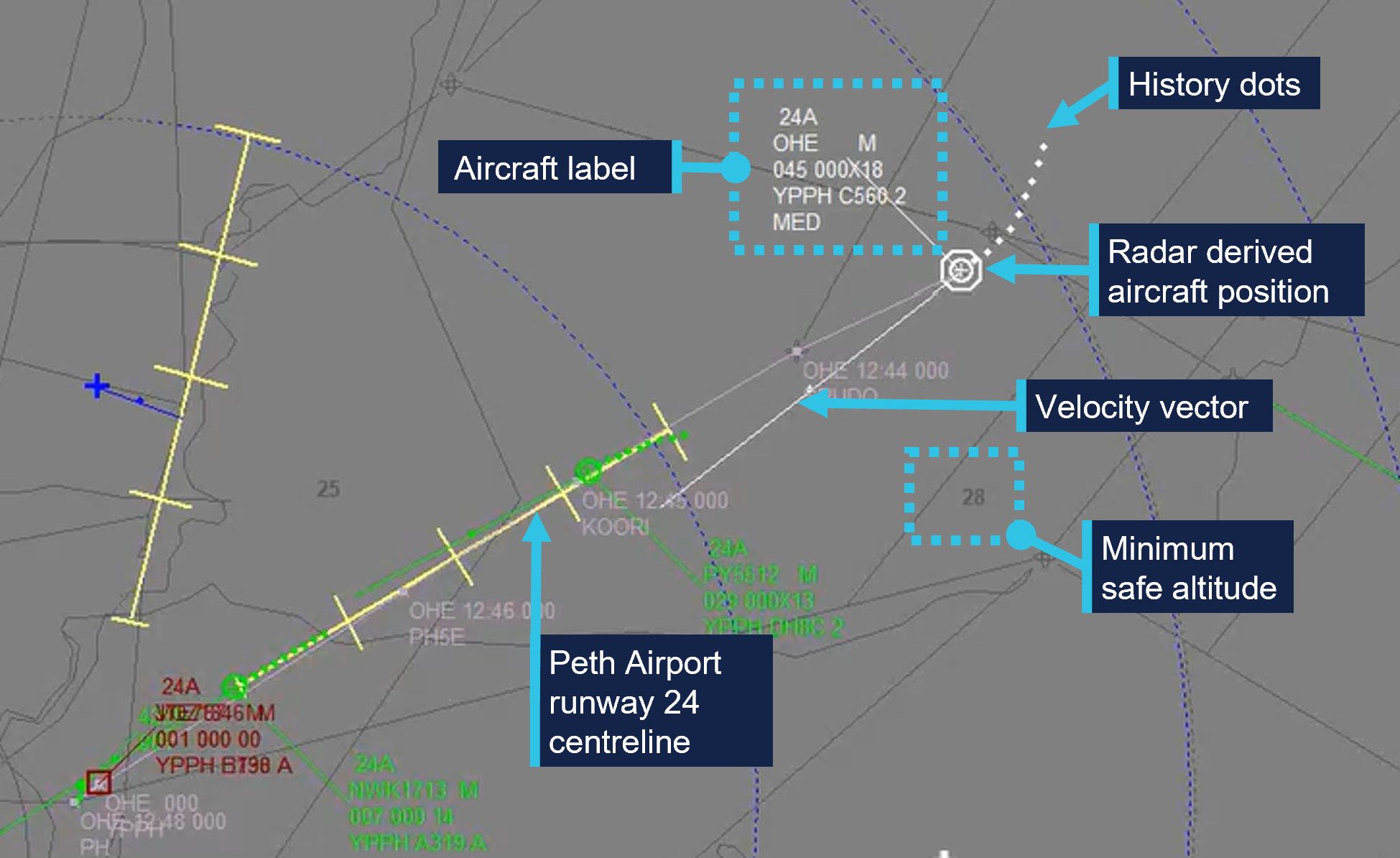
Approach controllers relied on an air situational display, which depicted an aircraft’s radar derived position overlaid on a composite of the Airservices Australia terminal area chart. The air situation display also included the aircraft’s velocity vectors, history dots as well as an aircraft label which presented the aircraft’s callsign, type and present altitude (Figure 11).
Figure 11: Air situational display
Minimum safe altitude warning
The minimum safe altitude warning (MSAW) function was a software enhancement that relied on existing radar hardware to alert air traffic controllers to an increased risk of an aircraft collision with terrain. The system provided the controller with a warning time of 60 seconds. When an MSAW was triggered, controllers were presented with an aural and visual alert (Figure 12).
Figure 12: MSAW alert for VH-OHE triggered at 2046:32
The Airservices Australia National Air Traffic Services Procedure Manual (NAPM) categorised an MSAW as a ‘priority 1’ situation display alert, which required immediate intervention by the controller. The NAPM stated that:
On receipt of an MSAW, controllers must:
1. assess its integrity
2. issue a 'Safety Alert' when appropriate.
The phraseology to be used by ATC when providing safety alerts and avoiding action was contained in the AIP. An example of a generic ‘low altitude warning’ alert was:
SAFETY ALERT, LOW ALTITUDE WARNING, CHECK YOUR ALTITUDE IMMEDIATELY, QNH IS (number) [(units)]. [THE MINIMUM SAFE ALTITUDE IS (altitude)].
Nuisance MSAW alerts
In late 2023, Airservices Australia increased the trigger level for MSAW alerts within the vicinity of Perth Airport. The change resulted in a significant number of nuisance MSAW alerts for aircraft conducting the approach for runway 24. In December 2024, Airservices Australia finalised a safety case assessment and reporting determination (SCARD) to evaluate further changes intended to address the nuisance alerts. The SCARD stated:
About a year ago, the MSAW levels around Perth were raised (only marginally by about 30 feet or so) but it was enough to generate MSAW alerts for almost every aircraft arriving on RWY24, particularly when these aircraft are on a 4-5 NM final approach at approximately 1700 FT which is a normal level for that distance to touch. This issue is creating a situation where controller[s] are becoming desensitised to the alarms.
The SCARD assessed a proposal for a revised MSAW inhibit area which encompassed 1 NM either side of the runway 24 centreline and extended to 6 NM from the runway threshold and would be activated 24 hours a day. The proposal also stated:
No training required for new MSAW area, as the system is not currently functioning as expected. Local Instructions will be updated to desc[r]ibe the new area and method of operation.
The new area and method of operation of the MSAW inhibition area were incorporated into the Perth Terminal Control Unit (TCU) local instructions on 12 June 2025. Airservices Australia reported that information relating to the MSAW changes were also included in a corresponding New Information Register, which air traffic controllers were responsible for reviewing and acknowledging prior to commencing duties. The ATSB was unable to obtain a copy of the applicable New Information Register due to the MATS records retention procedures, which required records to be retained for a period of 30 days only.
At the time of the incident flight (August 2025), the approach controller reported they were not aware of any changes that had been implemented to address nuisance MSAW alerts at Perth Airport and did not recall if either the local instructions or New Information Register contained any related information.
Recorded information
Airservices Australia recorded data
Airservices Australia provided the ATSB with radar and local audio recordings of the approach controller’s console during the incident on 13 August 2025. Air traffic control (ATC) audio recordings and radar data records were also provided.
Cockpit video camera
Cockpit video recordings from the incident flight were obtained and reviewed by the ATSB. The recordings captured pilot actions, flight instruments and aural alerts during the approach and subsequent recovery.
Flight data recorder
Flight data from the aircraft’s flight data recorder (FDR) was downloaded and analysed by the ATSB. The information sourced from the flight data recorder was synchronised and combined with the cockpit video recordings using common events present in both sources.
Related occurrences
ATSB investigation AO-2024-030
On 9 May 2024 an Embraer ERJ 190-100 IGW aircraft, registered VH-UZI, was being operated on a flight from Cairns to Brisbane, Queensland. During the approach, the pilot flying disconnected the autopilot and shortly after, the aircraft’s automated ILS flight mode unexpectedly disengaged. Following the unexpected change to the aircraft’s flight mode, the flight crew diverted their attention to recapturing the ILS approach mode and did not effectively monitor the aircraft's flight path.
Consequently, the aircraft exceeded the glideslope limit requirement of the stabilised approach criteria. This was not detected by the flight crew. The aircraft continued to descend below the glideslope, resulting in the EGPWS glideslope alert activating. Subsequently, the flight crew did not perform the required terrain avoidance manoeuvre and instead continued the approach.
Safety analysis
Altitude preselector selection
While the first officer (FO) was flying the aircraft using the autopilot in heading and vertical navigation flight director (FD) modes, Perth Airport air traffic control (ATC) provided a clearance to descend to 3,000 ft and conduct the runway 24 instrument landing system (ILS) approach. In response, the FO set 3,000 ft in the altitude preselector (ASEL) and armed the localiser (LOC) and glideslope (GS) FD modes.
The operator’s procedures required the ASEL to be set to the ATC assigned altitude then the missed approach altitude after glideslope capture, which was also 3,000 ft for the runway 24 ILS. This meant no further ASEL selections were required for the approach. However, the flight crew agreed to set the approach decision altitude of 260 ft in the ASEL, which could only be set in 100 ft increments, resulting in an assigned altitude of 300 ft. This was actioned by the captain before the autopilot captured 3,000 ft or the ILS glideslope and, as a result, the aircraft continued descending below 3,000 ft (towards 300 ft).
The selection of the decision altitude in the ASEL was similar to the operator’s procedure for conducting a non-precision approach, which required the flight crew to set the minimum descent altitude +50 ft in the ASEL. In the 19 weeks leading up to the incident, the majority of the airports the flight crew operated to were only equipped with non‑precision approaches. Consequently, it is possible that the incorrect selection of the ILS DA in the ASEL was influenced by the flight crew’s recent repeated exposure to non‑precision approach procedures.
Contributing factor The flight crew incorrectly set the approach decision altitude in the altitude selector before the autopilot levelled the aircraft at the assigned altitude. The incorrect altitude setting, in combination with the selected flight director modes, resulted in the autopilot not capturing the glideslope and continuing the descent towards terrain. |
When the aircraft did not level off at 3,000 ft as expected by the flight crew, the continued descent was queried by the FO. In response, the captain identified that the aircraft was below the glideslope in the pitch hold FD mode, which would activate when an active vertical FD mode is disengaged while the autopilot was engaged. The ATSB was unable to determine why the pitch hold FD mode activated at that time.
The captain then directed the FO to select the vertical speed (VS) FD mode to arrest the descent. However, the FO encountered difficulty locating the VS button on the FD mode selector panel, at which point the captain also attempted to assist the FO without success. Both the captain’s and FO’s FD mode selector panels had a lighting fault. On the FO’s side, the VS mode button was illuminated, but the adjacent button to the right was not. This altered the visual presentation of the row of buttons at night and impacted the flight crew’s ability to locate the desired mode. Additionally, the FO’s limited experience flying the 560 may have further impacted their ability to locate the VS FD mode button.
Shortly after, the autopilot disengaged, which was likely the result of the FO depressing the ‘AP/TRIM DISC’ switch on their yoke or electrically trimming the elevator trim system.
While the flight crew were attempting to locate the VS FD mode button, their attention was diverted from monitoring the aircraft state. When attention is directed to resolving an unexpected problem, monitoring of other information sources degrades, often without the flight crew being aware of it (Civil Aviation Authority, 2023). In this case, the flight crew’s attention shifted from monitoring the aircraft’s flight path to managing the automation system as the descent continued unchecked.
As the aircraft continued to descend, the flight crew were presented with 2 EGPWS alerts. The first occurred as the aircraft passed 2,100 ft (1,130 ft AGL) and was accompanied by a ‘caution, terrain.’ However, neither the captain nor the FO recalled being aware of the alert and they did not initiate the required terrain avoidance procedures. This was consistent with the known effects of narrowed attention, whereby other events and stimuli that would normally attract attention, including highly salient alerts, fail to do so (Civil Aviation Authority, 2023). At this point, the captain re-engaged the autopilot.
The second EGPWS alert occurred as the aircraft descended through 1,650 ft (650 ft AGL) and was accompanied by a ‘terrain terrain, pull up’ aural alert. The captain recalled being aware of the second alert and, after briefly directing the FO to fly towards the glideslope, they took control of the aircraft. During this time, the autopilot disengaged a second time, which was likely a result of the FO applying a sustained force through their control yoke in either the vertical or horizontal axis.
Contributing factor The flight crew became preoccupied with the flight director mode selection, and their attention was diverted from monitoring the aircraft state. During this time the aircraft descended below the minimum sector altitude, the aircraft entered an uncommanded left bank, and the crew did not appropriately respond to the enhanced ground proximity warning system alerts. |
Recovery and unstable approach
At an altitude of about 1,480 ft (500 ft AGL) the captain took control of the aircraft and initiated a recovery. However, the recovery was not consistent with the required terrain avoidance procedures. During the recovery, the captain’s control inputs resulted in the aircraft reaching a bank angle of 50° with a pitch angle of 13° at around 2,100 ft (1,100 ft AGL). This exceeded the operator’s maximum bank angle deviation limit of 25°. However, neither of the flight crew performed the ‘bank angle’ deviation call as required by the Aircraft Operating Procedures or took timely action to correct the exceedance.
Although the aircraft was subsequently re-established on the correct approach path, the manoeuvring during the recovery was consistent with the development of an undesired aircraft state (UAS). A UAS can occur due to flight crew action or inaction and results in the aircraft being placed in a condition of unnecessary risk (International Civil Aviation Organization, 2002). In this instance, the high angle of bank increased the risk of a loss of control at a low altitude.
Contributing factor The captain took control of the aircraft and commenced a recovery climb. During this time the aircraft exceeded the maximum angle of bank, which resulted in an undesired aircraft state and increased the risk of a loss of control at a low altitude. |
Following the recovery, the flight crew elected to continue the ILS approach for runway 24. On passing 1,000 ft, the aircraft was within the operator’s required flight tolerances to continue the approach. However, as the aircraft continued below 500 ft, the airspeed exceeded the operator’s stabilised approach criteria for a period of about 31 seconds, reaching a maximum of 133 kt. The stable criteria required the aircraft to be operated at a calculated airspeed of no faster than 117 kt. Any exceedance of this speed required the flight crew to conduct a go-around. Neither crew member verbalised the speed exceedance, as required by the operator’s standard calls, and they continued with the approach and subsequently landed.
Contributing factor The aircraft’s airspeed exceeded the operator’s stabilised approach criteria during the late stage of the approach. However, rather than conducting the required go-around, the flight crew elected to continue the approach. |
Air traffic control response to MSAW
The Perth Airport approach controller (approach controller) received an initial minimum safe altitude warning (MSAW) on their air situation display for VH‑OHE as the aircraft continued its descent below the assigned altitude. The approach controller cancelled the audible alert associated with the MSAW and assessed that the aircraft was likely above the minimum safe altitude of 2,700 ft. This is despite their air situational display indicating the aircraft’s altitude at that time was 2,100 ft.
The MSAW was observed in an area where the approach controller and Airservices Australia had previously identified an increase in the frequency of nuisance MSAW alerts due to a system change. A high number of nuisance alerts decreases controller trust in automation systems and desensitises controllers to genuinely hazardous situations (Federal Aviation Administration, 2008). Airservices Australia had acknowledged the hazards associated with the Perth Airport nuisance alerts in its safety case assessment and reporting determination documentation that stated that controllers were ‘becoming desensitised to the alarms’. While Airservices Australia had implemented a fix for the nuisance alerts and advised the controllers at Perth Terminal Control Unit, the approach controller reported they were unaware that the issue had been resolved.
Expectation strongly influences where an individual will search for information, what information they will search for, and how they perceive information (Wickens and McCarley 2008; and Wickens and others 2013). People are more likely to perceive information that is expected, and less likely to perceive information that is unexpected. In this instance, expectation bias resulting from the approach controller’s previous exposure to the nuisance alerts likely influenced their perception of the initial MSAW information. This led them to conclude that the aircraft was likely above the minimum safe altitude despite the information presented to them.
The approach controller recalled observing a second MSAW and, in response, they issued a safety alert to the flight crew of VH‑OHE. However, this occurred 35 seconds after the initial MSAW was first triggered. This delay was a missed opportunity to alert the flight crew of the detected terrain proximity at a time when the aircraft was still descending.
Contributing factor The air traffic controller issued a safety alert to the flight crew 35 seconds after the controller received a minimum safe altitude warning about the aircraft. This delay was a missed opportunity to alert the flight crew of the detected terrain proximity at a time when the aircraft was still descending. The delay in communicating the information to the flight crew was likely influenced by the controller’s exposure to previous nuisance warnings within the same area. |
Flight director mode selector illumination fault
During the incident flight, the captain’s and FO’s flight director mode selector panels had a fault that resulted in the intermittent illumination of mode selector buttons. A similar defect was also observed on 3 mode selector buttons on the FO side during a flight in VH‑OHE that took place on 7 August 2025. Following that flight, the defect was not recorded in the aircraft flight log or maintenance release, as required by the operator’s procedures and the Civil Aviation Regulations 1988, and no related rectification maintenance had occurred.
Contributing factor The flight director mode selector panels had a fault that resulted in the intermittent illumination of mode selector buttons. This likely degraded the crew's ability to identify and select the desired mode. This defect was present during a flight that took place several days prior, but it had not been entered into the maintenance release, and no maintenance action had been undertaken. |
Cockpit camera
The information sourced from the installed cockpit video camera, which provided an accurate record of the events as they unfolded from within the cockpit, was invaluable to the incident investigation. Analysis of the video recording provided an insight into flight crew communications and actions, environmental factors, aircraft systems status, and instrument indications.
Other finding The information sourced from the installed cockpit video camera was invaluable to the incident investigation. Analysis of the video recording provided an insight into crew communications and actions, aircraft systems status, and instrument indications. |
Findings
ATSB investigation report findings focus on safety factors (that is, events and conditions that increase risk). Safety factors include ‘contributing factors’ and ‘other factors that increased risk’ (that is, factors that did not meet the definition of a contributing factor for this occurrence but were still considered important to include in the report for the purpose of increasing awareness and enhancing safety). In addition ‘other findings’ may be included to provide important information about topics other than safety factors. These findings should not be read as apportioning blame or liability to any particular organisation or individual. |
From the evidence available, the following findings are made with respect to the descent below minimum safe altitude, ground proximity alert and unstable approach involving Cessna 560, VH‑OHE, 23 km north‑east of Perth Airport, Western Australia, on 13 August 2025.
Contributing factors
- The flight crew incorrectly set the approach decision altitude in the altitude selector before the autopilot levelled the aircraft at the assigned altitude. The incorrect altitude setting, in combination with the selected flight director modes, resulted in the autopilot not capturing the glideslope and continuing the descent towards terrain.
- The flight crew became preoccupied with the flight director mode selection, and their attention was diverted from monitoring the aircraft state. During this time the aircraft descended below the minimum sector altitude, the aircraft entered an uncommanded left bank, and the crew did not appropriately respond to the enhanced ground proximity warning system alerts.
- The captain took control of the aircraft and commenced a recovery climb. During this time the aircraft exceeded the maximum angle of bank, which resulted in an undesired aircraft state and increased the risk of a loss of control at a low altitude.
- The aircraft’s airspeed exceeded the operator’s stabilised approach criteria during the late stage of the approach. However, rather than conducting the required go-around, the flight crew elected to continue the approach.
- The air traffic controller issued a safety alert to the flight crew 35 seconds after the controller received a minimum safe altitude warning about the aircraft. This delay was a missed opportunity to alert the flight crew of the detected terrain proximity at a time when the aircraft was still descending. The delay in communicating the information to the flight crew was likely influenced by the controller’s exposure to previous nuisance warnings within the same area.
- The flight director mode selector panels had a fault that resulted in the intermittent illumination of mode selector buttons. This likely degraded the crew's ability to identify and select the desired mode. This defect was present during a flight that took place several days prior, but it had not been entered into the maintenance release, and no maintenance action had been undertaken.
Other findings
- The information sourced from the installed cockpit video camera was invaluable to the incident investigation. Analysis of the video recording provided an insight into crew communications and actions, aircraft systems status, and instrument indications.
Safety action
| Whether or not the ATSB identifies safety issues in the course of an investigation, relevant organisations may proactively initiate safety action in order to reduce their safety risk. The ATSB has been advised of the following proactive safety action in response to this occurrence. |
Safety action by the operator of VH-OHE
The operator of VH-OHE advised the ATSB that all company pilots were provided with additional ground-based training relating to the use of aircraft automation and crew resource management. The organisation also communicated to pilots the importance of reporting incidents and defects in accordance with the Transport Safety Investigation Act 2003 and established operator procedures.
Sources and submissions
Sources of information
The sources of information during the investigation included:
- flight crew of VH-OHE
- the operator
- aircraft manufacturer
- Civil Aviation Safety Authority
- Airservices Australia
- Bureau of Meteorology
- recorded data from the cockpit video camera fitted to the aircraft
- recorded data from the flight data recorder fitted to the aircraft.
References
Civil Aviation Authority. (2023). Flight-crew human factors handbook. Retrieved from https://www.caa.co.uk/publication/download/14984
Civil Aviation Safety Authority. (2025). Safety behaviours: human factors for pilots 4th edition. Retrieved from https://www.casa.gov.au/sites/default/files/2021-06/safety-behaviours-human-factor-for-pilots-8-threat-error-management.pdf
Federal Aviation Administration. (2008). Nuisance Alerts in Operational ATC Environments: Classification and Frequencies. Retrieved from https://hf.tc.faa.gov/publications/2008-nuisance-alerts-in-operational-atc-environments/full_text.pdf
Federal Aviation Administration. (2021). Airplane Flying Handbook. Retrieved from https://www.faa.gov/sites/faa.gov/files/regulations_policies/handbooks_manuals/aviation/airplane_handbook/00_afh_full.pdf
International Civil Aviation Organization. (2002). Line Operations Safety Audit (LOSA) Doc 9803. International Civil Aviation Organization.
International Civil Aviation Organization. (2025). State of Global Aviation Safety. Retrieved from https://www.icao.int/sites/default/files/sp-files/safety/Documents/ICAO_SR_2025.pdf
Wickens CD, Hollands JG, Banbury S & Parasuraman R. (2013). Engineering psychology and human performance, 4th edition, Pearson Boston, MA.
Wickens, CD & McCarley, JS. (2008). Applied attention theory, CRC Press, Boca Raton, FL.
Submissions
Under section 26 of the Transport Safety Investigation Act 2003, the ATSB may provide a draft report, on a confidential basis, to any person whom the ATSB considers appropriate. That section allows a person receiving a draft report to make submissions to the ATSB about the draft report.
A draft of this report was provided to the following directly involved parties:
- flight crew of VH-OHE
- the operator
- Civil Aviation Safety Authority
- Airservices Australia
- Bureau of Meteorology.
Submissions were received from:
- the captain of VH-OHE
- the operator.
Purpose of safety investigationsThe objective of an ATSB safety investigation is to improve transport safety through:
In accordance with the TSI Act, the ATSB does not investigate for the purpose of taking administrative, regulatory or criminal action, and cannot apportion blame, assist in determining liability, or, as a general rule, assist in court proceedings. About ATSB reportsATSB safety investigation reports are developed in accordance with ATSB procedures and guidelines, and with regard to applicable international standards and instruments. Reports must include factual material of sufficient weight to support the investigation’s analysis and findings. At all times the ATSB endeavours to balance the use of material that could imply adverse comment with the need to properly explain what happened, and why, in a fair and unbiased manner. An explanation of terminology used in ATSB investigation reports is available here. Publishing informationReleased in accordance with section 25 of the Transport Safety Investigation Act 2003 Published by: Australian Transport Safety Bureau © Commonwealth of Australia 2026 Ownership of intellectual property rights in this publication Unless otherwise noted, copyright (and any other intellectual property rights, if any) in this report publication is owned by the Commonwealth of Australia. Creative Commons licence 
With the exception of the Commonwealth Coat of Arms, ATSB logo, and photos and graphics in which a third party holds copyright, this report is licensed under a Creative Commons Attribution 4.0 International licence. The CC BY 4.0 licence enables you to distribute, remix, adapt, and build upon our material in any medium or format, so long as attribution is given to the Australian Transport Safety Bureau. Copyright in material obtained from other agencies, private individuals or organisations, belongs to those agencies, individuals or organisations. Where you wish to use their material, you will need to contact them directly. |
- ^ Instrument flight rules (IFR) are a set of regulations that permit the pilot to operate an aircraft in instrument meteorological conditions (IMC), which have much lower weather minimums than visual flight rules (VFR).
- ^ Pilot flying (PF) and pilot monitoring (PM): procedurally assigned roles with specifically assigned duties at specific stages of a flight. The PF does most of the flying, except in defined circumstances, such as planning for descent, approach and landing. The PM carries out support duties and monitors the PF’s actions and the aircraft’s flight path.
- ^ Local time in Perth was Western Standard Time (WST), which is Coordinated Universal Time (UTC) +8 hours. Times in this report are WST unless otherwise noted.
- ^ Flight level: at altitudes above 10,000 ft in Australia, an aircraft’s height above mean sea level is referred to as a flight level (FL). FL 410 equates to 41,000 ft.
- ^ Standard instrument arrival (STAR): a designated IFR arrival route linking a significant point, normally on an ATS route, with a point from which a published instrument approach procedure can be commenced.
- ^ Runway number: the number represents the magnetic direction of the runway centreline and is expressed in 10 degree increments of azimuth.
- ^ Localiser: part of the instrument landing system and provides lateral position necessary to align with the runway centreline.
- ^ Instrument landing system (ILS): a precision runway approach aid based on two radio beams which together provide pilots with both vertical and horizontal guidance during an approach to land.
- ^ Altitude alert: an aural alert (tone) and/or a visual alert when an aircraft on climb/descent approaches the designated altitude and when deviating from that altitude during cruise. Aircraft conducting IFR operations in controlled airspace were required to have either an assigned altitude indicator or an altitude alerting system.
- ^ Although the captain, who was the PM, announced ‘1,000 [ft] to go,’ Avcair Aircraft Operating Procedures required the PM to announce ‘Alert to 3,000 ft’ in response to the activation of the audible altitude alert.
- ^ Decision altitude (DA): a specified altitude (referenced to mean sea level) in a 3D instrument approach operation at which a missed approach must be initiated if the required visual reference to continue the approach has not been established.
- ^ Electronic attitude director indicator (EADI): an EADI is a part of the primary flight display (PFD) in glass cockpit aircraft. The EADI displays pitch and roll, and it also includes a slip/skid indicator for turn coordination. The EADI also provides the display for flight director symbols, which give the pilot a visual indication of the aircraft attitude required to follow flight director guidance.
- ^ Initial approach fix (IAF): the commencement of an instrument approach.
- ^ ‘Established’ means being within half full scale deflection for the ILS.
- ^ ‘LAND Position’ on the 560 is 35° of flap extension.
- ^ Flight management system (FMS): an avionics system. It supports navigation, flight plans, positioning, guidance, and other flight-related tasks.
- ^ The function of an MFD system is to provide the pilot access to various data, or combinations of data, used to fly the aircraft, to navigate, to communicate, and/or to manage aircraft systems.
- ^ Maintenance release: a document that provides registered operators and pilots with evidence that an aircraft has had the required maintenance carried out, provides details of any defects that may require rectification before a flight can commence, and also provides essential information about any scheduled maintenance actions that may become due before completion of a planned flight.
- ^ HAMC: head of aircraft airworthiness and maintenance control.
- ^ MC: maintenance controller.
- ^ VREF: The landing approach airspeed at the 50-foot point with flaps in landing position and landing gear extended (1.3 times the stalling speed in the landing configuration).
- ^ HAT: Height above touchdown.
- ^ The maximum operating airspeed for flap 35° (landing position) in the 560 was 173 kt.
- ^ Few: a meteorological term used in aviation to describe cloud coverage that occupies 1 to 2 oktas (eighths) of the sky.
- ^ Broken: a meteorological term used in aviation to describe cloud coverage that occupies 5 to 7 oktas (eighths) of the sky.
- ^ An ILS approach procedure which provides for an approach to a decision height not lower than 60 m (200 ft) and a visibility not less than 800 m (2,400 ft) or a runway visual range not less than 550 m (1,800 ft).
- ^ Very high frequency omnidirectional range station (VOR): transmitters that support non-precision (lateral guidance only) approach and en route navigation.
- ^ The Manual of Air Traffic Services is a joint document of Defence and Airservices and is based on the rules published in Civil Aviation Safety Regulations Part 172 – Manual of Standards and International Civil Aviation Organization standards and recommended practices, combined with rules specified by Airservices and Defence.
Occurrence summary
| Investigation number | AO-2025-048 |
|---|---|
| Occurrence date | 13/08/2025 |
| Occurrence time and timezone | 2025 Australian Western Standard Time |
| Location | 23 km north-east of Perth Airport |
| State | Western Australia |
| Report release date | 11/11/2026 |
| Report status | Final |
| Investigation type | Occurrence Investigation |
| Investigation phase | Final report: Dissemination |
| Investigation status | Completed |
| Mode of transport | Aviation |
| Aviation occurrence category | E/GPWS warning, Flight below minimum altitude, Unstable approach, Warning devices |
| Occurrence class | Serious Incident |
| Highest injury level | None |
Aircraft details
| Manufacturer | Cessna Aircraft Company |
|---|---|
| Model | 560 |
| Registration | VH-OHE |
| Serial number | 560-0320 |
| Aircraft operator | Avcair Pty Ltd |
| Sector | Jet |
| Operation type | Part 135 Air transport operations - smaller aeroplanes |
| Activity | Commercial air transport-Non-scheduled-Medical transport |
| Departure point | Learmonth Airport, Western Australia |
| Destination | Perth Airport, Western Australia |
| Injuries | None |
| Damage | Nil |