

Final report
Report release date: 17/01/2017
What happened
On 15 November 2016, at about 1150 Eastern Daylight-saving Time (EDT), a Ryan STA-SPL aircraft, registered VH-SQD, departed from Tyabb aircraft landing area (ALA), Victoria, for a private local pleasure flight. The pilot was the sole occupant of the aircraft.
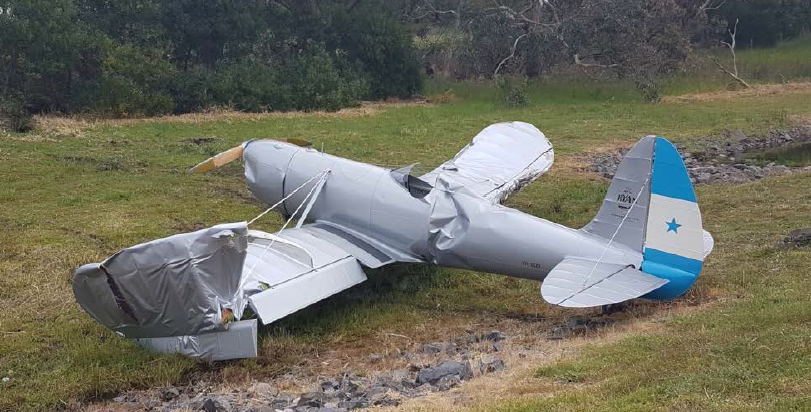
About 10 minutes after take-off, when at about 1,000 ft above mean sea level, the aircraft’s engine suddenly stopped, then briefly restarted and then stopped again. The pilot conducted a forced landing into a field. The aircraft landed heavily and with a tailwind, and the pilot assessed that the aircraft may not slow down sufficiently before a fence up ahead. The pilot therefore used the available airspeed to take-off again and fly the aircraft about 15 ft over the fence. The pilot aimed the aircraft’s wing at a tree to reduce the remaining speed and ensure it stopped prior to a major freeway. The aircraft collided with the tree, then the ground and was substantially damaged (Figure 1). The pilot sustained a minor injury.
Figure 1: Accident site showing damage to VH-SQD
Source: Victoria Police
Engineering report
A post-accident inspection found no evidence indicating the cause of the engine failure.
Pilot comments
The pilot reported that their priorities in the event of engine failure were to control the aircraft, land as soon as possible, and get rid of any excess energy (speed). The conditions may have been conducive to carburettor icing, but the aircraft was not fitted with carburettor heat.
Weather conditions and carburettor icing
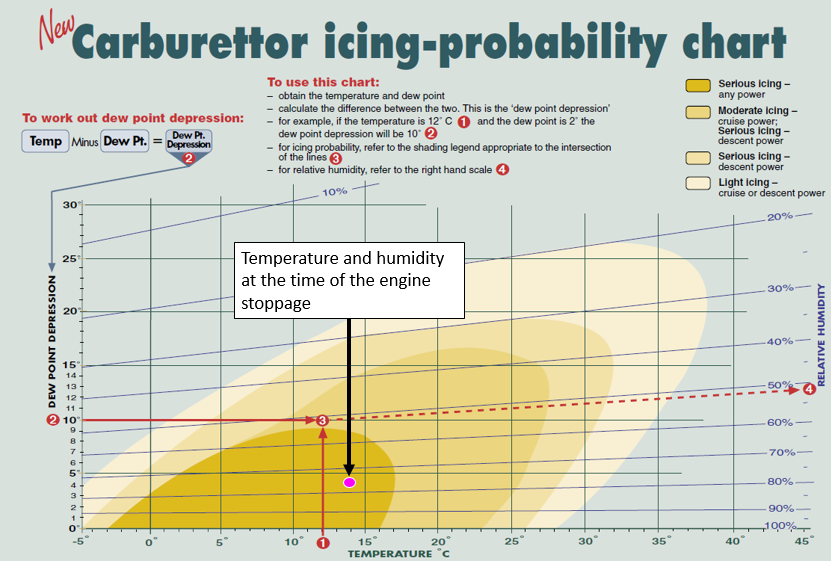
The temperature at the time of the accident was 14 °C, the relative humidity 76 per cent, and the dew point depression 4 °C. According to the carburettor icing probability chart (Figure 2), there was a serious risk of carburettor icing at any power setting.
Figure 2: Carburettor icing probability chart
Source: CASA – annotated by ATSB
Safety analysis
The engine probably stopped due to carburettor icing, and the aircraft was not (and was not required to be) fitted with carburettor heat.
The aircraft was below 1,000 ft above ground level when the engine failed and the pilot had limited options for landing sites. The pilot landed the aircraft with a tailwind component, and directed the aircraft towards a tree to reduce the ground roll and prevent the aircraft continuing onto a freeway.
Findings
These findings should not be read as apportioning blame or liability to any particular organisation or individual.
- The engine probably failed due to carburettor icing, at relatively low level and with few options for the pilot to safely conduct a forced landing.
Safety message
It is essential to have a plan and practise simulated forced landings to assist in reducing the consequences of conducting one in the event of engine failure. The height above ground at which an engine failure occurs affects the time available to complete failure management checks and select an appropriate landing site.
Aviation Short Investigations Bulletin - Issue 56
About this reportDecisions regarding whether to conduct an investigation, and the scope of an investigation, are based on many factors, including the level of safety benefit likely to be obtained from an investigation. For this occurrence, a limited-scope, fact-gathering investigation was conducted in order to produce a short summary report, and allow for greater industry awareness of potential safety issues and possible safety actions. Publishing informationReleased in accordance with section 25 of the Transport Safety Investigation Act 2003 Published by: Australian Transport Safety Bureau © Commonwealth of Australia 2017 
Ownership of intellectual property rights in this publication Unless otherwise noted, copyright (and any other intellectual property rights, if any) in this report publication is owned by the Commonwealth of Australia. Creative Commons licence With the exception of the Coat of Arms, ATSB logo, and photos and graphics in which a third party holds copyright, this publication is licensed under a Creative Commons Attribution 3.0 Australia licence. Creative Commons Attribution 3.0 Australia Licence is a standard form licence agreement that allows you to copy, distribute, transmit and adapt this publication provided that you attribute the work. The ATSB’s preference is that you attribute this publication (and any material sourced from it) using the following wording: Source: Australian Transport Safety Bureau Copyright in material obtained from other agencies, private individuals or organisations, belongs to those agencies, individuals or organisations. Where you wish to use their material, you will need to contact them directly. |
Occurrence summary
| Investigation number | AO-2016-153 |
|---|---|
| Occurrence date | 15/11/2016 |
| Location | 14 km north-north-west of Tyabb ALA |
| State | Victoria |
| Report release date | 17/01/2017 |
| Report status | Final |
| Investigation level | Short |
| Investigation type | Occurrence Investigation |
| Investigation status | Completed |
| Mode of transport | Aviation |
| Aviation occurrence category | Engine failure or malfunction |
| Occurrence class | Accident |
| Highest injury level | Minor |
Aircraft details
| Manufacturer | Ryan Aeronautical Corp |
|---|---|
| Model | STA-SPL |
| Registration | VH-SQD |
| Serial number | 193 |
| Sector | Piston |
| Departure point | Tyabb, Victoria |
| Destination | Point Cook, Victoria |
| Damage | Substantial |