

Final report
Report release date: 22/11/2016
What happened
On 4 September 2016, at about 1655 Western Standard Time (WST), an amateur-built Van’s RV-9A aircraft registered VH-KLV (KLV), departed Albany Airport, Western Australia (WA), for a flight to Jandakot Airport, WA. On board the private flight were a pilot and one passenger.
About 15 minutes into the flight, the aircraft was north-west of Mount Barker and climbing through about 4,000 ft. At this time, the pilot observed an oil temperature indication greatly exceeding the normal operating limit, all other engine indications appeared normal. The pilot immediately reduced power to idle and turned the aircraft towards an airstrip to the west of Mount Barker (Figure 1). As the aircraft descended through about 2,500 ft, the pilot assessed that they did not have sufficient altitude to glide to the airstrip. The pilot then elected to conduct a precautionary[1] landing.
Figure 1: Approximate flight path of VH-KLV
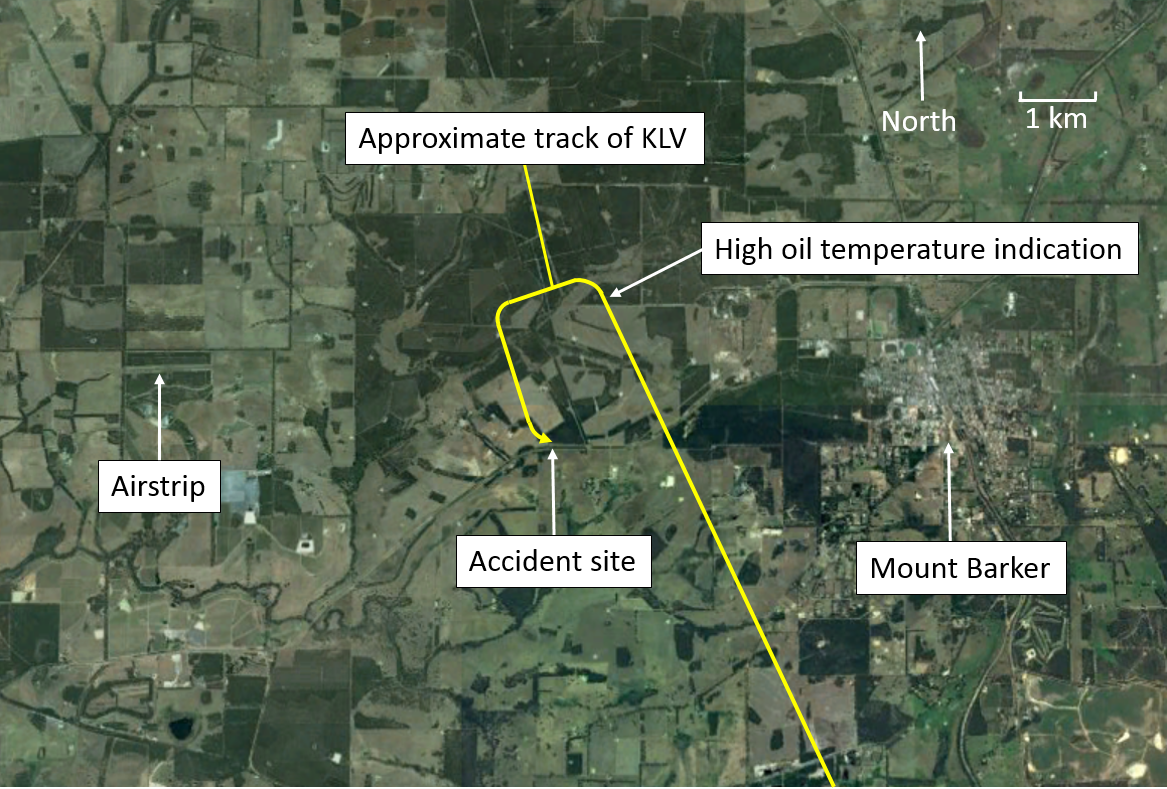
Source: Google maps, modified by ATSB
The pilot identified a section of disused road as suitable to conduct the precautionary landing and positioned the aircraft to make a curving approach to the road. At about 200 ft above ground level, the pilot detected the aircraft becoming low and applied power to continue the approach. The engine responded briefly before losing all power. The pilot identified that they did not have sufficient height to glide to the disused road. To avoid powerlines located next to the disused road, the pilot elected to fly the aircraft into trees.
The aircraft struck the tree canopy and slowed to a near stop before falling onto the disused road. The aircraft landed nose first before overturning and coming to rest inverted (Figure 2). The weight of the aircraft prevented the pilot from opening the sliding canopy. The pilot and passenger exited through the broken windscreen.
The pilot and passenger sustained minor injuries and the aircraft was substantially damaged.
Figure 2: VH-KLV after the accident
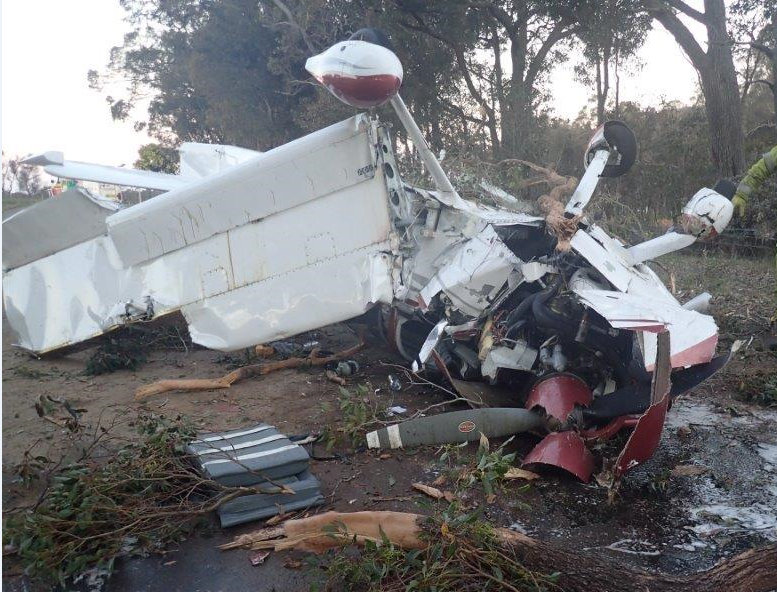
Source: Western Australia Police
Pilot comments
The pilot of VH-KLV provided the following comments:
- After the pilot identified the high oil temperature, they prepared for a precautionary landing. They did not consider a forced[2] landing until the engine failed.
- The pilot advised that when they are flying, they are always looking for places to land as if the engine fails there is only a short time to decide where to land.
- The aircraft is fitted with a four point harness. This worked extremely well and prevented more serious injuries.
Engineering examination
Due to the limited scope of this investigation a post-accident engineering examination was not conducted. The cause of the high oil temperature indication was not determined.
Safety message
This incident highlights the importance of actively managing an emergency situation. The pilot identified the abnormal engine indication and elected to conduct a precautionary landing while the engine continued to develop power. Once an engine malfunction is identified it is important to consider that remaining power may be inconsistent and unreliable.
The US Federal Aviation Administration airplane flying handbook chapter: Emergency procedures provides information on effective management of precautionary and forced landings.
The RV-9A is not an aerobatic aircraft, however, KLV was fitted with a four-point aerobatic type harness. Four-point harnesses provide superior occupant protection during an accident, in particular when an aircraft overturns. The fitment and use of the four-point harness most likely prevented more serious injuries to the occupants.
Aviation Short Investigations Bulletin - Issue 54
About this reportDecisions regarding whether to conduct an investigation, and the scope of an investigation, are based on many factors, including the level of safety benefit likely to be obtained from an investigation. For this occurrence, a limited-scope, fact-gathering investigation was conducted in order to produce a short summary report, and allow for greater industry awareness of potential safety issues and possible safety actions. Publishing informationReleased in accordance with section 25 of the Transport Safety Investigation Act 2003 Published by: Australian Transport Safety Bureau © Commonwealth of Australia 2016 
Ownership of intellectual property rights in this publication Unless otherwise noted, copyright (and any other intellectual property rights, if any) in this report publication is owned by the Commonwealth of Australia. Creative Commons licence With the exception of the Coat of Arms, ATSB logo, and photos and graphics in which a third party holds copyright, this publication is licensed under a Creative Commons Attribution 3.0 Australia licence. Creative Commons Attribution 3.0 Australia Licence is a standard form licence agreement that allows you to copy, distribute, transmit and adapt this publication provided that you attribute the work. The ATSB’s preference is that you attribute this publication (and any material sourced from it) using the following wording: Source: Australian Transport Safety Bureau Copyright in material obtained from other agencies, private individuals or organisations, belongs to those agencies, individuals or organisations. Where you wish to use their material, you will need to contact them directly. |
__________
Occurrence summary
| Investigation number | AO-2016-109 |
|---|---|
| Occurrence date | 04/09/2016 |
| Location | 39 km north-north-west of Albany Airport |
| State | Western Australia |
| Report release date | 22/11/2016 |
| Report status | Final |
| Investigation level | Short |
| Investigation type | Occurrence Investigation |
| Investigation status | Completed |
| Mode of transport | Aviation |
| Aviation occurrence category | Engine failure or malfunction |
| Occurrence class | Accident |
| Highest injury level | None |
Aircraft details
| Manufacturer | Amateur Built Aircraft |
|---|---|
| Model | VAN'S RV-9A |
| Registration | VH-KLV |
| Serial number | 90509 |
| Sector | Piston |
| Operation type | Private |
| Departure point | Unknown |
| Damage | Substantial |