

Final report
Report release date: 14/10/2016
What happened
On 27 July 2016, at about 0930 Eastern Standard Time (EST), the pilot of a Robinson R22 Beta helicopter, registered VH-HRL (HRL), completed mustering operations at a property about 33 km south of Blackall, Queensland. The helicopter then departed from the property on a ferry flight and tracked towards the pilot’s home about 110 km to the west-northwest. The pilot was the sole occupant of the helicopter.
At about 1002, the pilot’s GPS tracker indicated that the helicopter had stopped moving, about 41 km from its destination and on the helicopter’s direct track. The helicopter had struck a powerline and subsequently collided with terrain. At about 1030, a local landowner notified the energy provider of a power outage. Two line workers from the energy provider later departed from Blackall to determine the source of the power outage.
At about 1500, while inspecting the powerlines in the area, the line workers located the wreckage of HRL. The windshield and right skid of the helicopter had struck the single wire, which was strung east-west across a cleared area, 4.8 m above the ground. The first point of impact of the helicopter was about 31 m beyond the powerline and it then collided with the ground inverted about 18 m further away. During that impact, it appeared that the pilot’s seatbelt sheared through and the pilot was ejected from the helicopter sustaining serious injuries. The wire had been stretched about 30 m, two power poles broke off and another two were pulled out of the ground. The helicopter was destroyed (Figure 1).
The line workers called emergency services using a satellite phone, and remained with the pilot until police and paramedics arrived at about 1700.
Figure 1: Accident site showing damage to VH-HRL
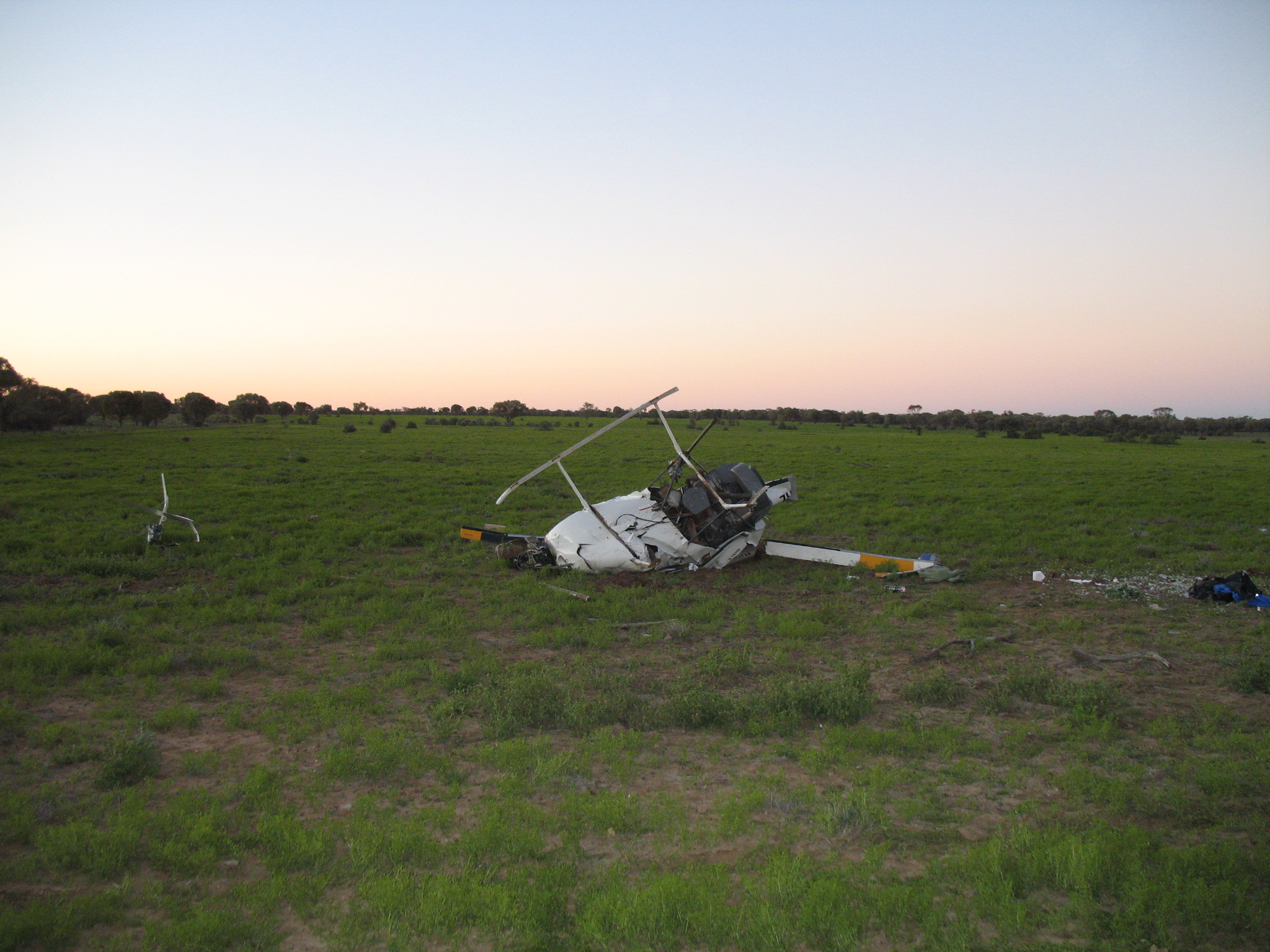
Source: Queensland Police
Accident site
The helicopter struck the powerline in a clearing, mid-span between two power poles about 250 to 300 m apart. The helicopter was travelling across the direction of the powerline.
An aircraft warning marker may be installed on an overhead cable or its supporting structures to warn pilots of their presence. The powerline struck in this incident was not, and was not required to be, marked with aircraft warning markers according to the relevant Australian Standard (AS3891.1).
Based on the forward speed indicated by the distance of the wreckage from the wires, and the marks left in the ground by the helicopter main rotor blades, the helicopter engine was probably producing power at the time it struck the wire.
ATSB comment
Due to the injuries sustained in the accident, the pilot was unable to recall the event or provide any comments for the investigation.
Safety message
Low-level flight carries an increased risk of striking hazards, such as powerlines, many of which are difficult to see in flight. The ability of pilots to detect powerlines depends on many factors, including the physical characteristics of the powerline (such as the spacing of power poles and the orientation of the wire), prevailing weather and light conditions, and the nature of surrounding terrain and vegetation.
Aviation Short Investigations Bulletin - Issue 53
About this reportDecisions regarding whether to conduct an investigation, and the scope of an investigation, are based on many factors, including the level of safety benefit likely to be obtained from an investigation. For this occurrence, a limited-scope, fact-gathering investigation was conducted in order to produce a short summary report, and allow for greater industry awareness of potential safety issues and possible safety actions. Publishing informationReleased in accordance with section 25 of the Transport Safety Investigation Act 2003 Published by: Australian Transport Safety Bureau © Commonwealth of Australia 2016 
Ownership of intellectual property rights in this publication Unless otherwise noted, copyright (and any other intellectual property rights, if any) in this report publication is owned by the Commonwealth of Australia. Creative Commons licence With the exception of the Coat of Arms, ATSB logo, and photos and graphics in which a third party holds copyright, this publication is licensed under a Creative Commons Attribution 3.0 Australia licence. Creative Commons Attribution 3.0 Australia Licence is a standard form licence agreement that allows you to copy, distribute, transmit and adapt this publication provided that you attribute the work. The ATSB’s preference is that you attribute this publication (and any material sourced from it) using the following wording: Source: Australian Transport Safety Bureau Copyright in material obtained from other agencies, private individuals or organisations, belongs to those agencies, individuals or organisations. Where you wish to use their material, you will need to contact them directly. |
Occurrence summary
| Investigation number | AO-2016-086 |
|---|---|
| Occurrence date | 27/07/2016 |
| Location | 63 km W of Blackall Airport |
| State | Queensland |
| Report release date | 14/10/2016 |
| Report status | Final |
| Investigation level | Short |
| Investigation type | Occurrence Investigation |
| Investigation status | Completed |
| Mode of transport | Aviation |
| Aviation occurrence category | Wirestrike |
| Occurrence class | Accident |
| Highest injury level | Serious |
Aircraft details
| Manufacturer | Robinson Helicopter Co |
|---|---|
| Model | R22 BETA |
| Registration | VH-HRL |
| Serial number | 3490 |
| Sector | Helicopter |
| Operation type | Aerial Work |
| Departure point | Unknown |
| Damage | Destroyed |