

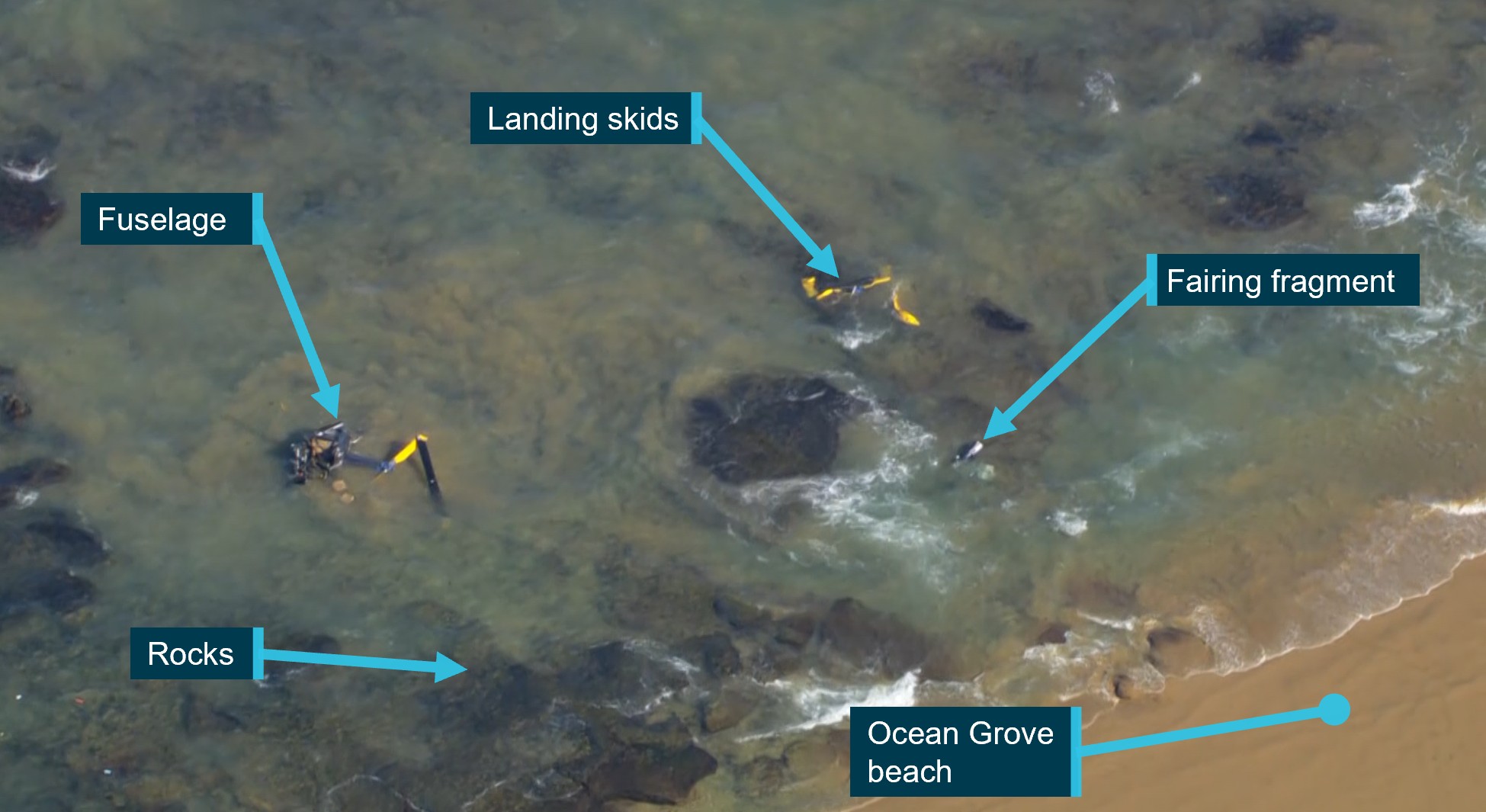
A Robinson R44 helicopter was seriously damaged when it impacted the water following an attempted autorotation landing after the pilot observed a low rotor RPM warning, an ATSB investigation final report details
All three occupants of the single piston-engined R44 were seriously injured in the accident near Ocean Grove, on Victoria’s Bellarine Peninsula, on 2 May 2025.
The helicopter was conducting a tourist flight over the Geelong and Corio Bay areas and was cruising at about 600 ft, a short distance from the coast, when the pilot observed the low rotor RPM indication and warning horn.
The pilot responded by turning the helicopter towards the beach and lowering the collective to attempt an autorotation landing.
“A safe autorotation landing requires the use of the momentum and altitude available to manage rotor RPM, and control the rate of descent,” ATSB Chief Commissioner Angus Mitchell explained.
“In this case, the rotor RPM likely degraded below the target range and did not recover during the autorotative descent.
“This shortened how far the helicopter could glide, and reduced the energy available for the pilot to flare the helicopter and soften the landing as it came close to the water.”
The helicopter subsequently landed hard on the shallow water, resulting in a significant water impact, in which the pilot and both passengers sustained serious injuries. (The helicopter was generally intact when the occupants evacuated the aircraft with most of the damage seen in the post-accident images the result of the wreckage being repeatedly forced into rocks.)
“Fortunately, the occupants were able to get out of the helicopter and get to the beach,” Mr Mitchell said.
The ATSB examined aircraft components recovered from the accident site, and found at least 17 metres of vinyl tape fouling the tail rotor driveshaft bearing, likely left within the airframe prior to flight.
“While fouling in this specific location did not create a restriction to the rotor in flight, some of the tail assembly was not recovered, and it was possible more fouling existed,” Mr Mitchell said.
“While the evidence available did not allow this to be confirmed as the cause of the low rotor RPM, it serves as a reminder to personnel working around aircraft to be alert to the threat presented by foreign objects to the safety of flight.”
The investigation also found that, prior to the flight, the passengers were not given information about the emergency brace position for their seating location.
While not shown to have increased the severity of the passengers’ injuries, the operator has responded to the ATSB’s finding by updating its pre-flight safety briefing to include the relevant brace position for each seating location.
“It is vitally important that passengers are made aware of the position applicable to their seating position during the pre-flight safety briefing so they can adopt it immediately if required,” Mr Mitchell concluded.
Read the final report: Collision with water involving Robinson R44, VH-CTT, 13 km east of Barwon Heads Airport, Victoria, on 2 May 2025