

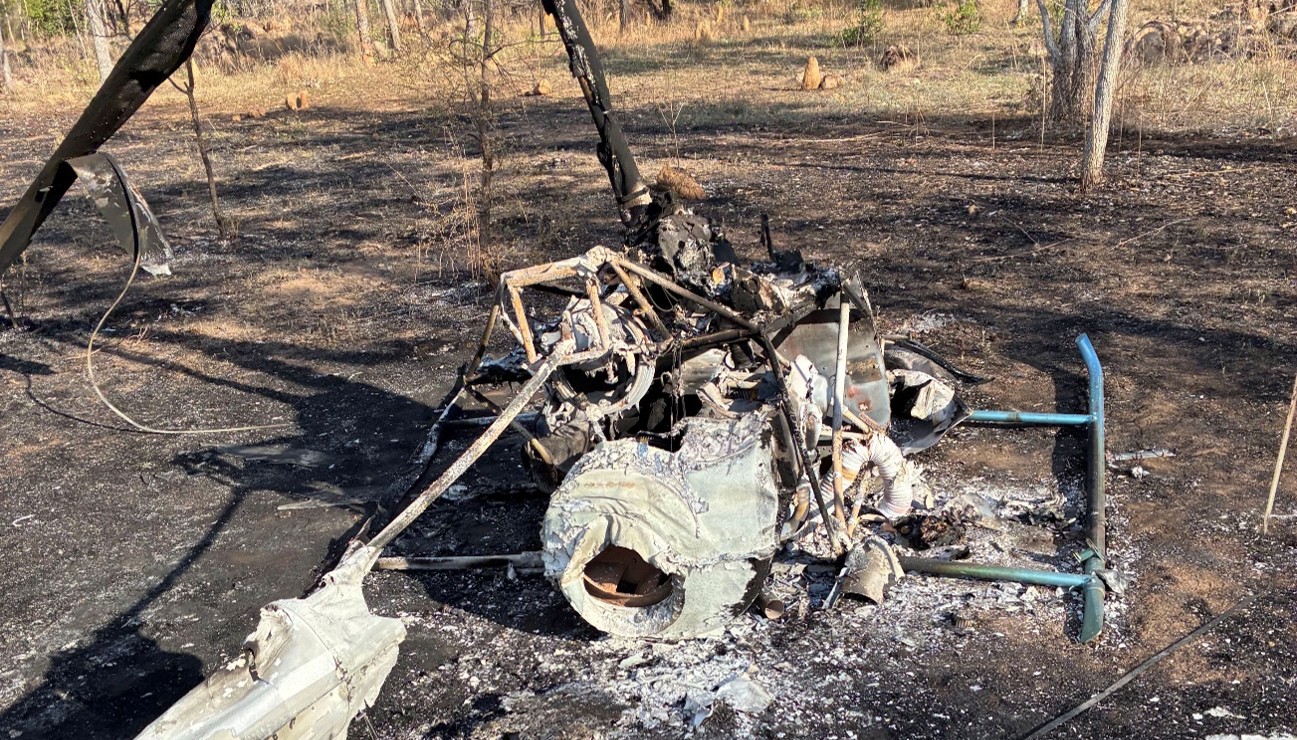
The ATSB has released its final report from its investigation into two separate suspected rotor drive belt failures involving Robinson R22s in northern Australia last November. Both incidents, involving helicopters with different operators and maintainers, resulted in hard landings, but no significant injuries.
The first accident occurred in the Northern Territory’s Barkly Region, when an R22 was being used for aerial work with a pilot and passenger on board on 15 November.
Cruising at about 300 ft, the pilot smelled burning rubber, then heard a bang and observed a sharp increase in engine RPM, followed by a decay in rotor RPM.
The pilot initiated an autorotation landing, during which the helicopter impacted the ground with significant forward speed and rolled over before coming to rest.
Although the helicopter was substantially damaged, the pilot and passenger sustained only minor injuries.
In the second accident, another R22 was being flown from Mount Surprise to Chillagoe, in Far North Queensland, on 23 November.
Cruising at around 550 ft, the pilot heard a loud slapping noise and felt a vibration from the rear of the helicopter, then observed a rapid decay in main rotor RPM.
The pilot lowered initiated an autorotation, and when just above tree height, attempted to slow the helicopter and momentarily applied collective to confirm the loss of drive.
The helicopter then dropped quickly and landed hard, causing the skids to splay, and for the base of the pilot’s seat to compress.
The pilot was uninjured, however, and was able to self-extract before a fire ignited in the dry grass around the engine, and subsequently destroyed the helicopter.
The ATSB found both accidents were likely the result of drive belt failures.
“In the first accident, it was very likely the forward belt became misaligned in the drive sheaves on startup, leading to rapid wear and failure, which then likely impacted and contributed to the failure of the rear belt,” ATSB Director of Transport Safety Dr Stuart Godley said.
Due to the extensive fire damage, there was not enough evidence available to the ATSB to determine the specific mechanism of the drive belt failure in the second accident.
“These accidents reinforce the importance of pilot vigilance during pre-flight inspections, particularly in checking for drive belt slack and alignment prior to startup,” Dr Godley said.
The ATSB report also notes the maintainers of both helicopters reported several previous instances of R22 drive belts requiring replacement at low hours due to stretching beyond allowable limits.
“While this appeared to be the case, any reasons for it could not be determined,” Dr Godley said.
“While we did not uncover any evidence of a broader issue, we encourage aircraft operators and maintainers to report technical component or system issues through the defect reporting service managed by the Civil Aviation Safety Authority.
“This helps in building an understanding any common aircraft issues, and allows action to be taken where appropriate.”