

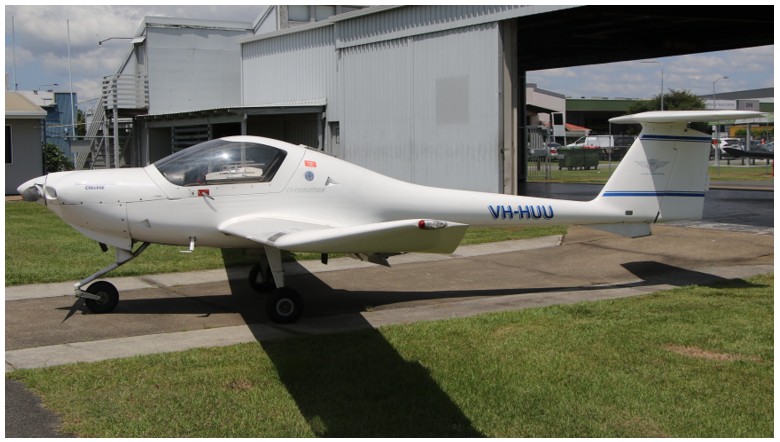
A student and instructor pilot did not effectively crosscheck fuel prior to or during a training flight, which ended with a precautionary landing at Toowoomba Wellcamp Airport, west of Brisbane, an ATSB final report explains.
On 5 December 2025, a Diamond DA20 single-engine training aircraft, operated by Flylink Aviation College, was being used for a training flight from Archerfield Airport, Queensland.
Towards the end of the 2-hour flight, and approaching the planned destination of Toowoomba City Aerodrome, the aircraft’s engine power reduced momentarily, and then restored.
This was quickly followed by another similar cycle of power reducing and then restoring, at which point the instructor took control and diverted to the nearby Toowoomba Wellcamp Airport, for an uneventful landing.
A post-flight inspection showed 5–6 litres of useable fuel remained on board, significantly less than expected.
The ATSB was unable to determine whether the engine issues were due to failing fuel supply, or a pre‑existing engine defect.
However, the investigation did conclude fuel management discrepancies meant the instructor and student pilots did not identify when the amount of fuel on board decreased below the final reserve required.
Before the flight, the instructor and student separately measured the amount of fuel on board with the aircraft’s dipstick, each recording between 70 and 74 litres of fuel.
This was significantly more than the 61 litres measured at the conclusion of the previous flight, despite no fuel being added. The instructor dismissed the discrepancy, however, assuming the student had added fuel.
The instructor and student then did not crosscheck the fuel volume they had measured against the aircraft’s fuel quantity gauge prior to the departure, nor during the flight.
The investigation also identified that a calibration card, designed to indicate the actual volume of fuel represented by different readings on the fuel gauge, was not present in the incident aircraft, as required under Australian regulations.
One other Flylink Aviation College DA20 was also found to be missing a calibration card, an issue the operator has subsequently rectified in both aircraft.
“While fuel gauges in piston-driven aircraft are dismissed by some pilots as not being an accurate source of fuel quantity information, they are often the only way to independently verify the quantity of fuel on board against a pre‑flight measurement,” ATSB Director of Transport Safety Graham Drummond said.
“Sole reliance on one method of fuel assessment leaves the operation vulnerable to fuel exhaustion or starvation.
“And operators and owners are reminded that maintaining the aircraft’s fuel quantity indicating system to the regulated standard, including displaying a fuel calibration card when required, allows the system to be used properly.”
The final report notes the ATSB could not rule out possible engine defect issues, in part because the operator primarily used an informal process for raising and tracking defects.
“The operator had a preference for face-to-face and phone communication, to encourage open communication between pilots, the operator, and maintenance personnel,” Mr Drummond observed.
“However, this made the management of repetitive defects, including an ongoing intermittent engine‑related defect, more difficult.”
Flylink Aviation College is in the process of updating its procedures to improve recording and tracking of defects in its aircraft fleet in response to this finding.
Read the final report: Partial power loss involving Diamond DA20, VH-HUU, near Toowoomba Wellcamp Airport, Queensland, on 5 December 2025