

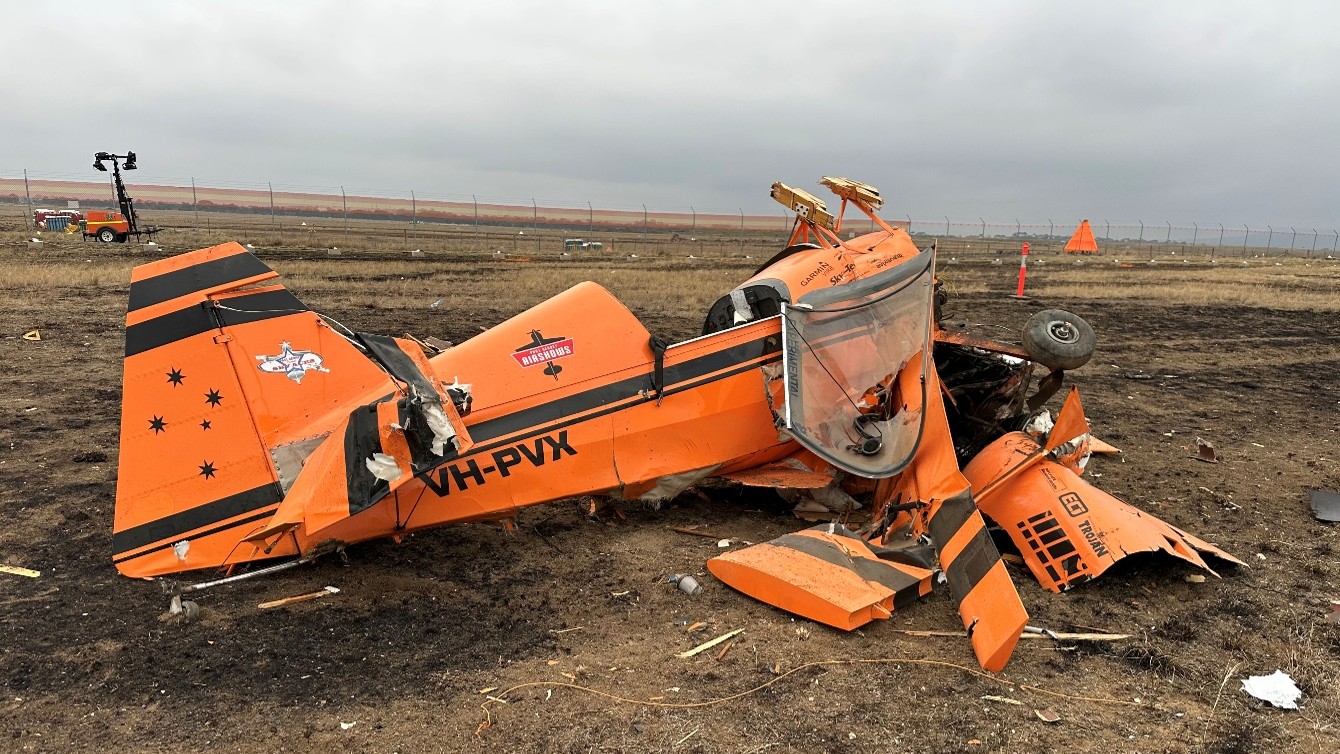
The ATSB’s investigation of an airshow display accident at Avalon last year highlights the importance of minimum safe heights for aerobatic manoeuvres.
The Sky Aces formation aerobatics team, made up of four Pitts-type aircraft operated by Paul Bennet Airshows, was performing a display at the Australian International Air Show at Avalon, Victoria, on 28 March 2025, an ATSB investigation final report notes.
One of the four aircraft, a Pitts S1-11X, collided with the ground when exiting a loop towards the conclusion of an attempted triple avalanche manoeuvre.
The aircraft was substantially damaged, and the pilot was seriously injured.
The ATSB’s investigation concluded the triple avalanche manoeuvre, which comprises a loop with three snap rolls at the top, was commenced at around 100 ft above ground level, rather than the 200 ft height used during previous flights.
The aircraft still climbed to 800 ft during the first half of the loop, similar to other flights, but the changed profile resulted in the aircraft having a lower than usual nose attitude during the snap rolls.
“The low nose attitude limited the ability of the aircraft to climb further during the snap rolls, and resulted in the pilot finishing the snap rolls still at around 800 ft, rather than having climbed above 1,000 ft, as demonstrated in previous flights,” ATSB Chief Commissioner Angus Mitchell said.
“The pilot then commenced the second half of the loop with insufficient height to safely recover.”
Mr Mitchell noted that low-level aerobatics is a high-risk activity.
“Low-level aerobatics and airshow display pilots can mitigate and reduce risk by setting and adhering to minimums for various points during a manoeuvre, and by ensuring there is an exit strategy if they are below minimums,” he said.
“Undertaking regular debriefs and reviews of their, and their team members’ in‑flight video recordings can also be an important safety tool to check that selected minimum commencement heights are adequate.”
The ATSB also found a number of factors increased the time taken for emergency services to respond to the accident, although these likely did not contribute to the severity of the pilot’s injuries.
“The flight display took place above a pyrotechnic detonation area, which the aircraft came to rest in, and responding Aviation Rescue Fire Fighting Service crews had to assess and safely navigate the pyrotechnics to get to the pilot,” Mr Mitchell noted.
“The ambulance service also required escorts to ensure safe access to the accident site.”
In response, the event organiser is redesigning the pyrotechnic area for future airshows to provide clearly identified routes of entry for emergency services, and is proposing to stage an ambulance with the Aviation Rescue Fire Fighting Services to reduce accident response times
The organiser has also committed to adopt similar requirements for aerobatic displays to those introduced by the United Kingdom Civil Aviation Authority, which include minimum height requirements based on aircraft performance, and pilots having ‘gate’ parameters or check altitudes set for all critical junctures of an aerobatic manoeuvre.
Read the final report: Collision with terrain involving Wolf Pitts S1-11X, VH-PVX, Avalon Airport, Victoria, on 28 March 2025