

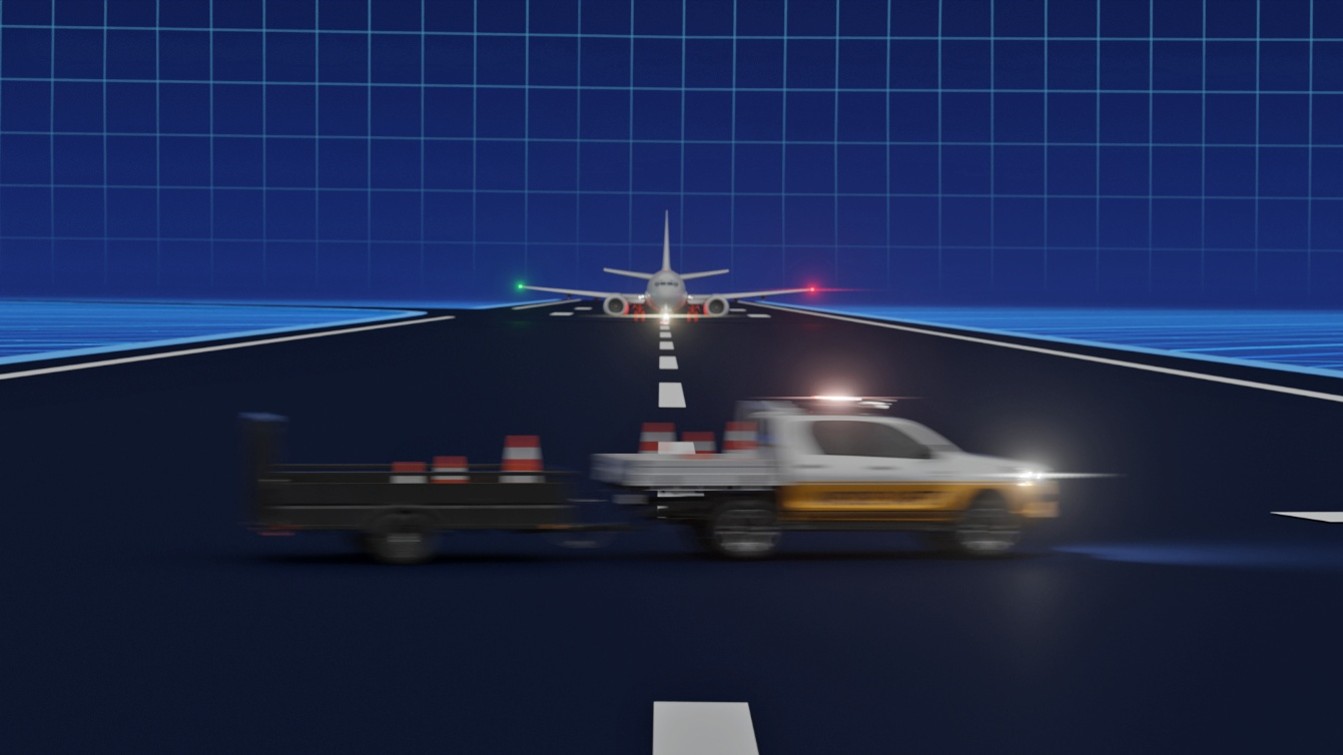
An airport safety vehicle inadvertently entered the active runway at Melbourne Airport causing the flight crew of a Boeing 737 freighter to conduct a high-speed rejected take-off, an ATSB investigation final report details.
The incident occurred about 4:45 in the morning on 17 February 2026, in dark night conditions, with runway 34 active and the crossing runway 09/27 closed for maintenance. The closure did not impact the intersection between the two runways, so the full length of runway 34 was available.
“As the 737 was lining up on runway 34 for a scheduled freight service to Adelaide, the driver of the airport safety vehicle was retrieving unserviceability markers and lights along runway 09/27, so it could be re-opened,” explained ATSB Chief Commissioner Angus Mitchell.
“After the 737 commenced its take-off roll, the air safety officer inadvertently drove the vehicle, with a trailer, onto the active runway 34.
“This runway incursion triggered an electronic alert for a controller in the tower, who immediately instructed the vehicle to exit the runway and the aircraft to stop.”
The investigation report details that the pilot in command of the 737, who was pilot flying, recalled seeing the vehicle at the same time as receiving the ATC instruction, and subsequently initiated a high-speed rejected take-off at 139 kt.
The vehicle accelerated and exited the active runway when the aircraft was about 400 m from the intersection. The aircraft then passed through the intersection at what the pilot estimated to be about 70–80 kt.
Mr Mitchell said the airside safety officer had misidentified their position on runway 09/27, believing they were crossing the adjacent taxiway when they entered the crossing runway.
“The airside safety officer was experienced in night-time maintenance works, but was operating in a complex airside environment in the dark,” Mr Mitchell observed.
“The positioning of unserviceability lights had changed when the works plan progressed the night prior to the occurrence, and the pre-shift briefing did not include the required review of the local works plan.
“Consequently, the airside safety officer had an incomplete understanding of the revised works.”
Further, the ATSB found available visual cues did not sufficiently distinguish the active runway intersection from other crossings within the works.
“Civil Aviation Safety Authority guidance did not require sufficient distinction between these markings to mitigate the greater potential consequences associated with inadvertently entering an active runway,” Mr Mitchell noted.
In response, CASA plans to amend relevant sections of two Advisory Circulars on aerodrome works.
Finally, and while it did not contribute to the incident, the investigation also found Melbourne Airport did not risk assess all stages of the runway overlay project during its development.
The airport has subsequently taken several steps to strengthen the management of airside works aimed at reducing the likelihood of future runway incursions.
“Runway incursions are a global safety concern,” Mr Mitchell noted.
“Positively in this incident, the airport vehicle was fitted with a transponder, and its entry onto the runway trigged an alert to the air traffic controller, allowing for timely action to help prevent a collision, but this investigation does highlight how airport works can substantially alter the visual cues that aircrew and airside vehicle operators rely upon.
“Effective worksite controls must provide clear and distinct indications of the boundary between active and inactive runways when temporary works alter or remove normal runway and taxiway cues.”
Read the final report: Runway incursion and near collision involving Boeing 737, ZK-TXB, and a ground vehicle, at Melbourne Airport, Victoria, on 17 February 2026