

An Air Tractor agricultural aircraft was manoeuvring to avoid a power pole while flying under intersecting powerlines when it collided with terrain, an ATSB investigation has found.
On the day of the accident, 8 September last year, the AT‑802A single-seat aircraft was spraying wheat in two fields north of Cummins Town, on South Australia’s Eyre Peninsula, the investigation final report details.
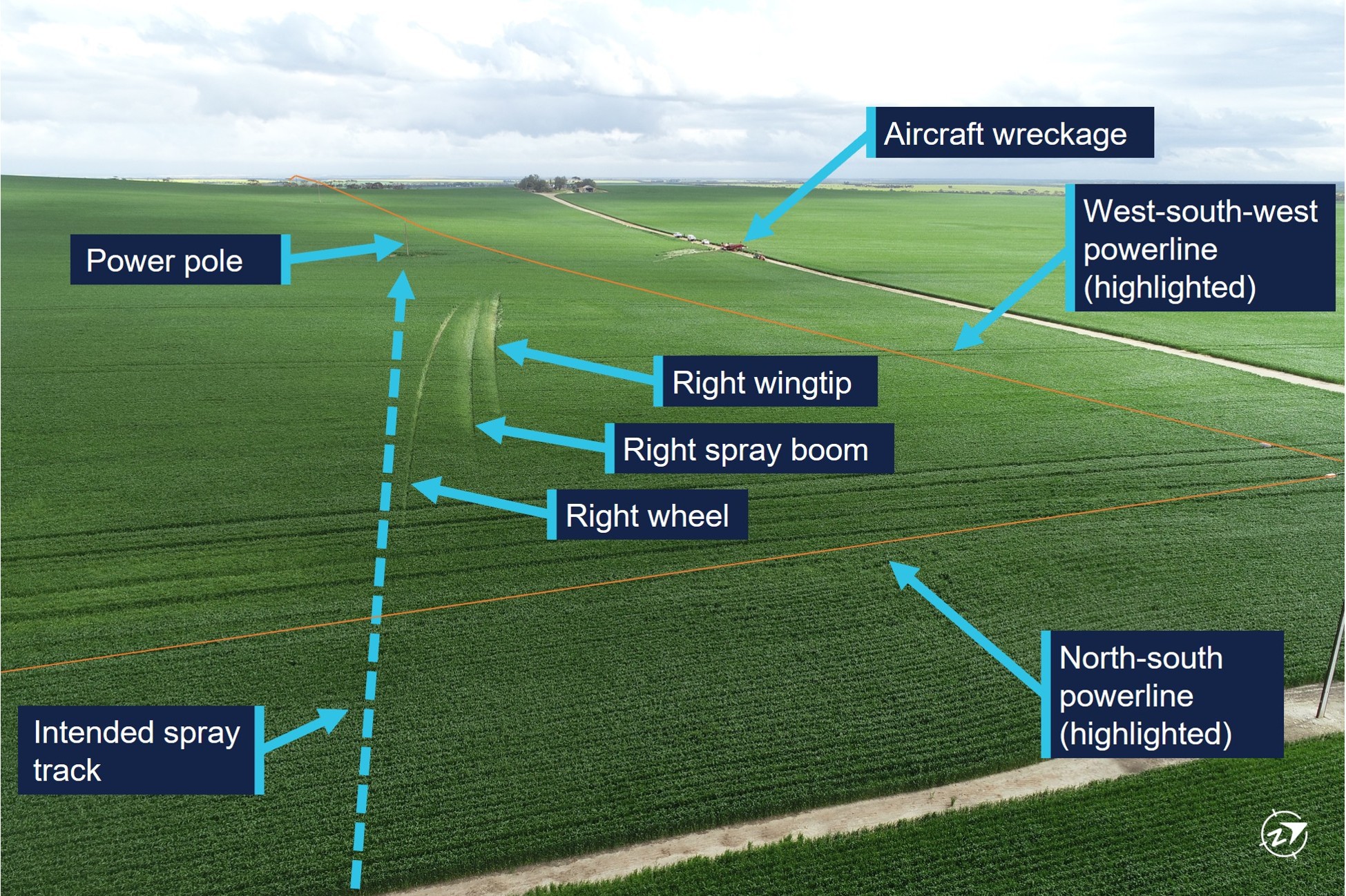
During a spraying pass, at a groundspeed of about 130 kt and a height of 15–18 ft (5–6 m), the aircraft’s flight path was in line with a pole that was supporting the second of two closely spaced and intersecting powerlines.
After passing under the first powerline, the pilot conducted a right turn away from the pole, during which the aircraft contacted the crop and the ground. It then passed under the second powerline, climbed, rolled inverted and collided with terrain. The pilot was fatally injured.
“On the accident pass, there was about 240 m between the powerlines, with a pole directly in front of the aircraft,” ATSB Chief Commissioner Angus Mitchell said.
“Compared to previous passes, there was less distance available for the pilot to manoeuvre the aircraft and maintain separation from the powerline and poles.”
ATSB examination of the accident site and wreckage determined that, during the turn to avoid the pole, the aircraft entered a significant right skid with right roll attitude, and its right wheel, spray boom, aileron and wingtip struck the ground, reducing airspeed.
The report details that it was likely that the pilot applied left aileron to pick the right wing up and to lower the left wing – a secondary effect of using rudder to change direction is roll into the direction of the turn – to ensure clearance with the second powerline. This led to a cross-control situation where opposite aileron was required to maintain wings level while using rudder to change direction to the right.
After avoiding the pole and passing under both powerlines, the crop markings indicated that the aircraft remained in a crossed-control state and was pitched up to climb away from the crop.
During the pitch up it was likely that the right wing stalled, resulting in the aircraft rolling inverted, at a height from which recovery was not possible.
“There is no single solution or approach to managing the significant risk to safety powerlines and poles present in aerial application operations, given the configurations of powerlines across fields is variable,” Mr Mitchell noted.
“This underlines the importance of thorough planning, preparation, and inspections prior to conducting spraying, and the careful consideration of the risks of flying in proximity to multiple, closely situated powerlines.”
In response to the accident, the aircraft operator, Aerotech, has amended its operations manual to include additional guidance for pilots on managing hazards during spraying operations.
Aerotech is also in the process of configuring its fleet with systems to provide GPS hazard marking and alerting to pilots during operations.
The operator has also further developed its risk register and implemented a human factors and non-technical skills program.
The ATSB report also notes that post-mortem toxicology showed the pilot had likely used cocaine within the 24 hours prior to the accident.
“While the pilot was unlikely to have been directly affected by the drug at the time of the accident, illicit substances are incompatible with safety sensitive aviation activities,” Mr Mitchell noted.
“The actual effect of illicit substances on the safety of flight cannot be predicted by users and periods of impairment beyond the anticipated effects can occur.”
Read the final report: Collision with terrain involving Air Tractor AT-802, VH-ODX, 17 km north of Cummins Town aerodrome, South Australia, on 8 September 2025