

Preliminary report
Report release date: 03/11/2026
| The ATSB has released this preliminary report to provide a timely update on evidence gathered and investigation activities to date. It outlines areas of further investigation but does not contain analysis or findings, which will be detailed in a final report at the conclusion of the investigation. The information in this report is released in accordance with section 25 of the Transport Safety Investigation Act 2003. |
The occurrence
Sequence of events
On 7 September 2026, a Beechcraft A36 Bonanza aircraft, registered VH-MPT, was being prepared for a private flight from Archerfield Airport, Queensland, to St. George Airport, with a pilot and one passenger on board. Earlier that morning, the pilot had organised for the aircraft to be refuelled with full tanks. Fuel records indicated 80 L of aviation gasoline was added to the aircraft at about 0854 local time.
Closed-circuit television footage showed that the pilot and passenger arrived at the aircraft at about 0940 and, after a pre-flight inspection was conducted, boarded at about 1021. Several attempts were made to start the engine before the occupants disembarked. It was reported that an engineer from a nearby hangar then assisted to start the engine with a battery cart. At about 1041, the aircraft was taxied from the apron via the engine runup bay for runway 10 right.
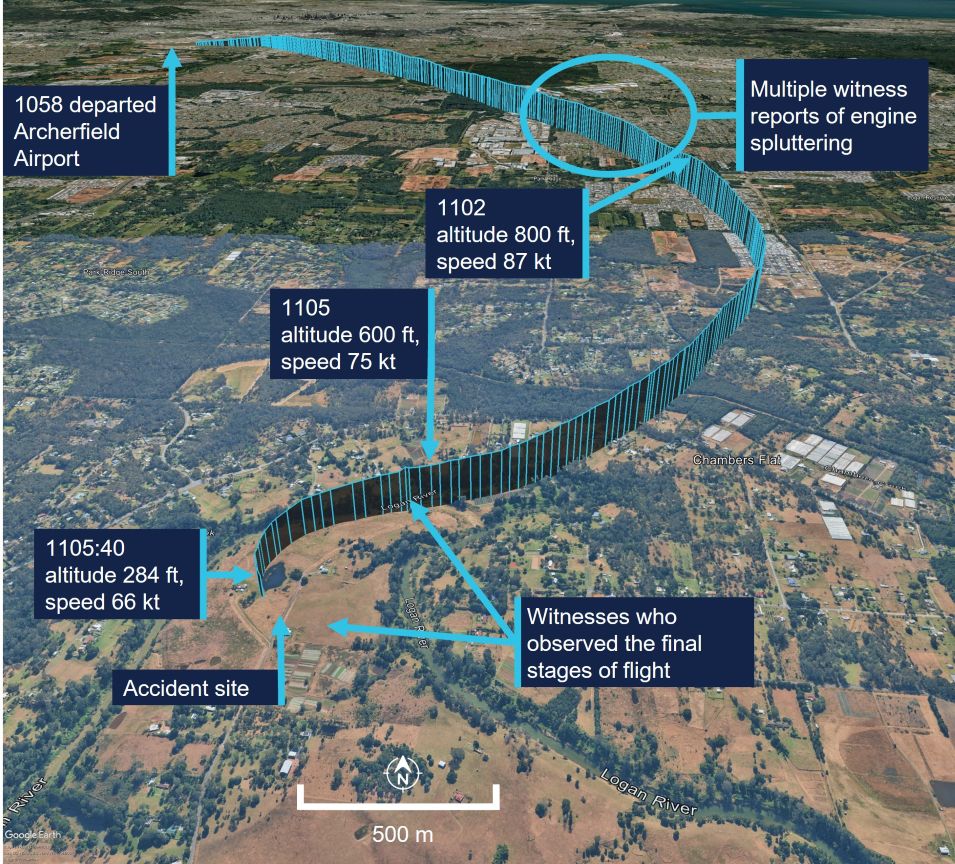
At about 1058, the recorded flight data showed that the aircraft commenced the take-off roll, departed to the south‑south-east and climbed to about 1,100 ft. The aircraft maintained that height for a short period of time before it began to descend.
At about 1102, when 8 NM (15 km) from Archerfield, at 800 ft and with an 87 kt groundspeed, the aircraft commenced a steady right turn and continued to descend. At about 1105, the aircraft crossed the Logan River at 600 ft with a 75 kt groundspeed and commenced a left turn.
The last recorded data point showed the aircraft’s position at 1105:40 at 284 ft and a 66 kt groundspeed (Figure 1). Shortly after, the aircraft collided with terrain in an easterly direction. Both occupants were fatally injured, and the aircraft was destroyed by a post‑impact fire.
Witness observations
A nearby resident to the accident site stated they were drawn to the sound of a ‘spluttering’ engine and observed the aircraft’s landing gear extend. The aircraft then ‘dropped’ and collided with terrain, however, they were not in a position to observe the collision. Another witness also observed the final stages of the flight and reported that as the aircraft turned it ‘nosedived’, however trees prevented them from seeing the impact. Numerous other witnesses reported they observed an aircraft flying low and heard the engine spluttering around the time of the accident.
Figure 1: VH-MPT flight track
Context
Pilot information
The pilot held a Private Pilot’s Licence (Aeroplane) issued on 30 September 2022 and was rated for single‑engined aircraft with design feature endorsements for manual propellor pitch control and retractable undercarriage. The pilot’s licence indicated a flight review was last conducted on 2 September 2024 and was valid until 30 September 2026.
The pilot held a class 2 aviation medical certificate that was valid to 7 September 2026 (the day of the accident). The certificate included a restriction that distance vision correction must be worn to exercise the privileges of the licence.
A witness who spoke with the pilot prior to the flight recalled they were in a good mood and seemed ‘fit and well’.
Aircraft information
VH-MPT was a Beechcraft A36 Bonanza single piston-engine aircraft manufactured in the United States in 1979 and first registered in Australia in the same year. The aircraft was modified by supplemental type certificate with a Teledyne Continental Motors IO‑550-BB engine and 3‑bladed Hartzell propeller. The aircraft had accumulated 6,376.7 hours total time in service.
Meteorological information
The meteorological conditions recorded at Archerfield Airport at 1100 were consistent with the forecast conditions and indicated:
- wind was 170° at 3 kt
- visibility greater than 10 km
- cloud scattered1 at 4,800 ft
- temperature 24°C and a dewpoint2 of 11°C
- QNH3 1020
- nil rainfall.
Recorded information
The aircraft was not fitted with, nor was it required to have, a flight data recorder or cockpit voice recorder. The aircraft was fitted with electronic flight and engine instrument systems that had the capacity to record flight and engine parameters. These devices were damaged beyond the ability to recover data.
Historical automatic dependent surveillance‑broadcast4 data recorded by the website ‘ADS-B Exchange’ showed the aircraft was last flown on 31 July 2026 and landed at Archerfield Airport at about 1600 on that day. For the accident flight, tracking data was obtained from Airservices Australia, which recorded the aircraft’s position from 1058:07 prior to the take-off, until the last data point at 1105:40.
Closed-circuit television footage (no audio available) from several locations at Archerfield Airport showed when the pilot and passenger boarded and started the aircraft, and its taxi prior to departure. Home security footage provided by members of the public along the aircraft’s flight track recorded audio of an aircraft engine with fluctuating revolutions per minute at the time VH-MPT was airborne.
Wreckage and impact information
The area around the accident site consisted of sparsely populated open grass farmland, which extended to the south-south-east of the site. The aircraft came to rest adjacent to a power pole, which had a single strand power line that was strung adjacent to the road (Figure 2).
Figure 2: VH-MPT flight track and local area of the accident site
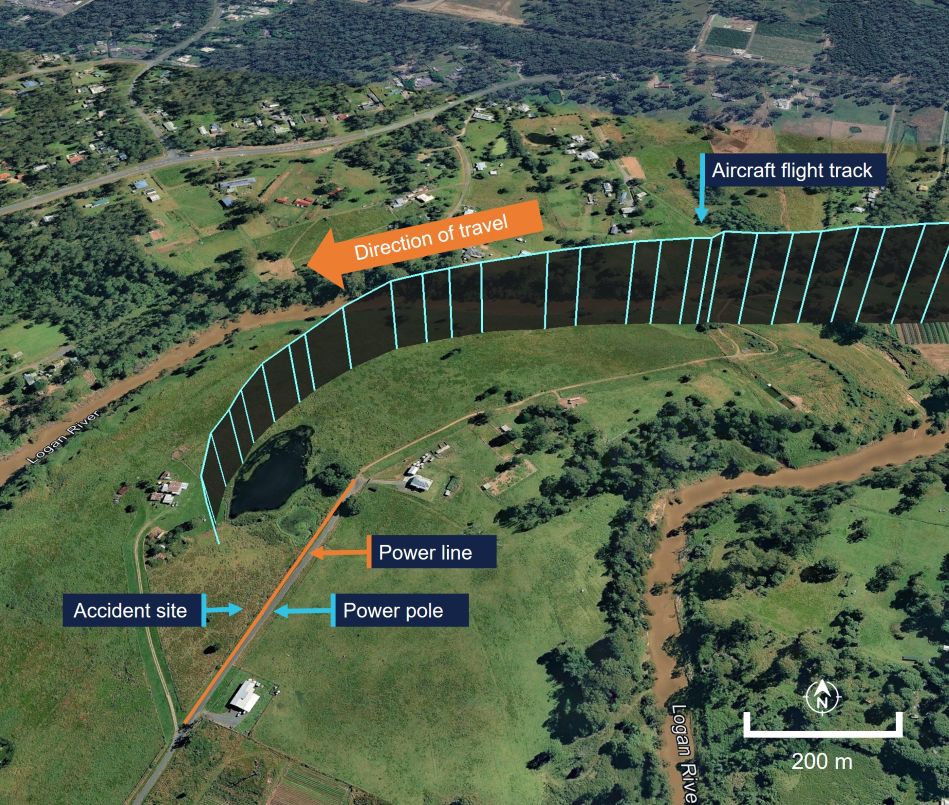
The aircraft impacted with terrain in a steep left wing low, nose down attitude. The propeller, which had separated from the crankshaft in overload, was located at the initial impact point. The propeller blades displayed back bending and low rotational damage, which was indicative of low engine power at impact. The landing gear was assessed as being in the down position and the wing flaps were in a fully retracted position.
The wreckage trail extended for about 15 m. The aircraft was relatively intact and came to rest facing opposite the direction of flight. No pre-impact defects were identified in the limited aircraft systems and structure that were available for inspection following the post‑impact fire.
Further investigation
To date, the ATSB has:
- examined the wreckage and accident site
- recovered and conducted an initial external examination of the engine
- interviewed involved parties with knowledge of the pilot and the aircraft
- collected aircraft and pilot documentation.
The investigation is continuing and will include:
- a performance assessment of the flight tracking data
- review of aircraft maintenance and pilot documentation
- further analysis of refuelling procedures
- further analysis of audio recordings and other recorded data
- review of the post-mortem information
- examination of pilot training records.
Acknowledgements
The ATSB acknowledges the assistance provided by the Queensland Police Service, the Queensland State Emergency Services, and the residents nearby to the accident site during the onsite phase of the investigation.
Purpose of safety investigationsThe objective of an ATSB safety investigation is to improve transport safety through:
In accordance with the TSI Act, the ATSB does not investigate for the purpose of taking administrative, regulatory or criminal action, and cannot apportion blame, assist in determining liability, or, as a general rule, assist in court proceedings. About ATSB reportsATSB safety investigation reports are developed in accordance with ATSB procedures and guidelines, and with regard to applicable international standards and instruments. Reports must include factual material of sufficient weight to support the investigation’s analysis and findings. At all times the ATSB endeavours to balance the use of material that could imply adverse comment with the need to properly explain what happened, and why, in a fair and unbiased manner. An explanation of terminology used in ATSB investigation reports is available here. Publishing informationReleased in accordance with section 25 of the Transport Safety Investigation Act 2003 Published by: Australian Transport Safety Bureau © Commonwealth of Australia 2026 Ownership of intellectual property rights in this publication Unless otherwise noted, copyright (and any other intellectual property rights, if any) in this report publication is owned by the Commonwealth of Australia. Creative Commons licence 
With the exception of the Commonwealth Coat of Arms, ATSB logo, and photos and graphics in which a third party holds copyright, this report is licensed under a Creative Commons Attribution 4.0 International licence. The CC BY 4.0 licence enables you to distribute, remix, adapt, and build upon our material in any medium or format, so long as attribution is given to the Australian Transport Safety Bureau. Copyright in material obtained from other agencies, private individuals or organisations, belongs to those agencies, individuals or organisations. Where you wish to use their material, you will need to contact them directly. |
- ^ Cloud cover: in aviation, cloud cover is reported using words that denote the extent of the cover – ‘scattered’ indicates that cloud is covering between a quarter and a half of the sky.
- ^ Dewpoint: the temperature at which water vapour in the air starts to condense as the air cools. It is used, among other things, to monitor the risk of aircraft carburettor icing or the likelihood of fog.
- ^ QNH: the altimeter barometric pressure subscale setting used to indicate the height above mean sea level.
- ^ Automatic dependent surveillance-broadcast (ADS-B) is a surveillance technology in which an aircraft determines its position via satellite navigation and periodically broadcasts it, enabling it to be tracked.
Occurrence summary
| Investigation number | AO-2026-095 |
|---|---|
| Occurrence date | 07/09/2026 |
| Occurrence time and timezone | 1105 Australian Eastern Standard Time |
| Location | Stockleigh |
| State | Queensland |
| Report release date | 03/11/2026 |
| Report status | Pending |
| Anticipated completion | Q1 2027 |
| Investigation level | Short |
| Investigation type | Occurrence Investigation |
| Investigation phase | Examination and analysis |
| Investigation status | Active |
| Mode of transport | Aviation |
| Aviation occurrence category | Collision with terrain |
| Occurrence class | Accident |
| Highest injury level | Fatal |
Aircraft details
| Manufacturer | Beech Aircraft Corp |
|---|---|
| Model | A36 |
| Registration | VH-MPT |
| Serial number | E-1456 |
| Aircraft operator | Manana Pastoral |
| Sector | Piston |
| Operation type | Part 91 General operating and flight rules |
| Activity | General aviation / Recreational-Unknown general aviation flying |
| Departure point | Archerfield Airport, Queensland |
| Destination | St. George Airport, Queensland |
| Injuries | Crew - 1 (fatal), Passengers - 1 (fatal) |
| Damage | Destroyed |