

Preliminary report
Report release date: 30/09/2026
| The ATSB has released this preliminary report to provide a timely update on evidence gathered and investigation activities to date. It outlines areas of further investigation but does not contain analysis or findings, which will be detailed in a final report at the conclusion of the investigation. The information in this report is released in accordance with section 25 of the Transport Safety Investigation Act 2003. |
Summary video
The occurrence
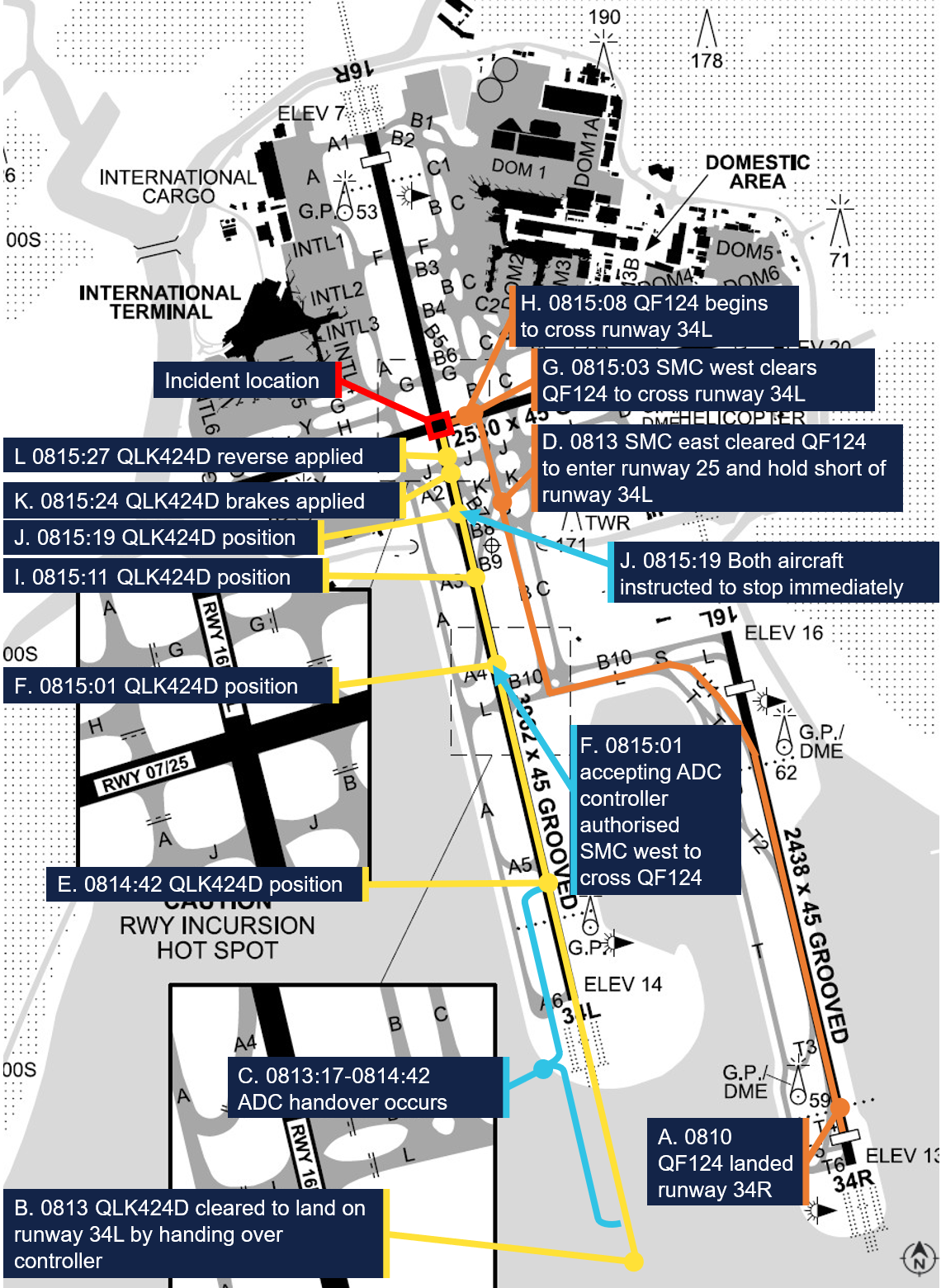
On the morning of 27 July 2026, a Qantas Boeing 737‑800 aircraft, registered VH‑XZG, was being operated as flight QF124 from Queenstown, New Zealand, to Sydney, New South Wales, with 2 flight crew, 5 cabin crew and 147 passengers on board. At about 0810 local time (Figure 2, A), the aircraft landed on runway 34 right (R)1 at Sydney Airport. The flight crew vacated the runway with the intention of taxiing the aircraft to parking bay 11 at the international terminal. The surface movement controller (SMC) east on radio frequency 121.7, who was the air traffic controller responsible for ground movements in that part of the airport, provided the flight crew with initial taxi instructions to follow taxiway Bravo (B) and hold short2 of runway 25 (Figure 1).
Figure 1: Sydney Airport with aircraft landing positions and final parking positions
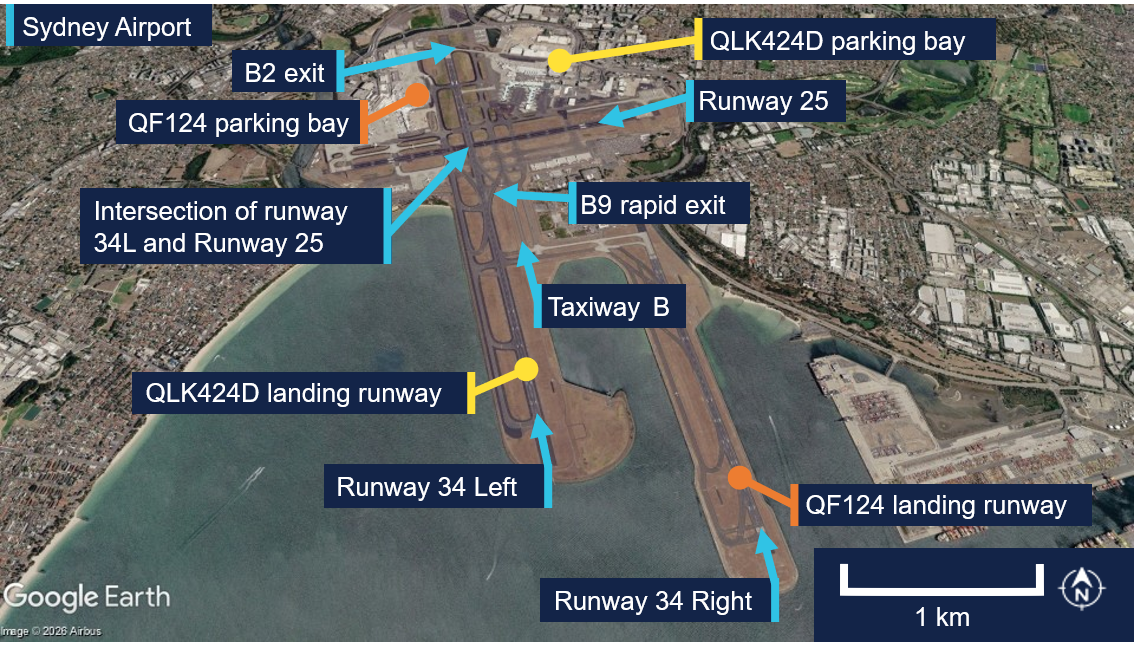
At about 0813 (Figure 2, B), a QantasLink Bombardier DHC‑8‑400 aircraft, registered VH‑QOC, operating as flight QLK424D from Canberra, Australian Capital Territory, to Sydney, New South Wales, was on approach to runway 34 left (L) with 2 flight crew, 2 cabin crew and 51 passengers on board. The aerodrome controller (ADC) west on radio frequency 120.5, who was responsible for traffic movements on runway 34L, provided the flight crew with a landing clearance including a requirement to vacate runway 34L at taxiway B2, rolling through to the end of the runway.
At the same time (Figure 2, D), QF124 was cleared to enter runway 25, hold short of runway 34L and change radio frequencies from SMC east (frequency 121.7) to SMC west (frequency 126.5). At about 0814, the flight crew of QF124 contacted SMC west and reported their position on runway 25, holding short of runway 34L.
In the air traffic control tower, the ADC west who issued the landing and roll through clearance to QLK424D, was due for a rest break. This break was required to manage their predicted fatigue risk level, which was high for their shift (see Fatigue management). The accepting ADC west controller was coming from the clearance delivery control position to relieve the ADC west handing over.
In 25 seconds, between 0814:17 and 0814:42 (Figure 2, C), the outgoing ADC west provided a handover brief to the controller taking over the position. This handover included:
- the runways in use were runway 34L and 34R
- weather was fine
- advice that the aircraft on final approach [QLK424D] was ‘a little fast’
- standard SIDs3 and headings were in use
- there were no unserviceabilities4
- airport lighting was on daytime settings
- Q-Link [QLK424D] was about to touch down and roll through to taxiway B2
- that there was a pending crossing on runway 25.
After receiving verbal confirmation that the accepting ADC west had received the handover information, the original ADC west controller went on their scheduled rest break.
QLK424D landed at 0814:49, 7 seconds after the controller handover was completed.
The controller now in charge of ADC west observed QLK424D slowing down and assumed the aircraft would take the rapid exit at B9, which was the expected exit for DHC‑8 aircraft if not cleared otherwise. Through internal communications recorded at 0815:01 (Figure 2, F), the ADC west instructed the SMC west to cross QF124 from their current position on runway 25. The SMC west acknowledged that they were clear to make the cross on 25 (Figure 2, G). ADC west extinguished the stop bars5 and the SMC west provided clearance to the flight crew of QF124 to cross runway 34L. At approximately 0815:08(Figure 2, H), the aircraft began moving forward.
At 0815:11 (Figure 2, I), QLK424D passed the B9 rapid exit at an indicated airspeed of approximately 88 kts. While the flight crew of QF124 was reading back their crossing clearance, the SMC west transmitted over that readback to cancel their crossing clearance and instructed them to hold short on runway 34L.
At 0815:19 (Figure 2, J), both the SMC west and ADC west transmitted on their respective frequencies instructing both aircraft to stop immediately.
The captain of QLK424D reported to the ATSB that, at the time of the stop instruction, they were already slowing the aircraft. Flight data from QLK424D showed that brake pressure was applied at 0815:24 (Figure 2, K) and reverse thrust was selected at 0815:27 (Figure 2, L).
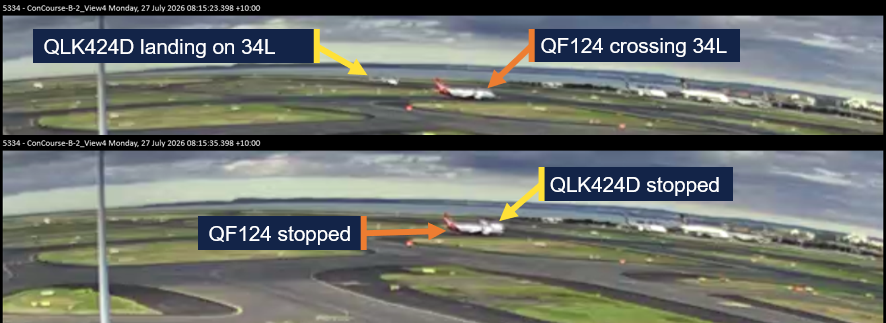
QF124 had stopped before reaching the intersection of runway 34L and runway 25 but was within the runway surface area past the runway stop bars resulting in a runway incursion.6 QLK424D came to a stop prior to the runway 34L and 25 runway intersection. When both aircraft came to a stop, they were approximately 120 m apart.
No injuries or damage were reported. QF124 was cleared to cross runway 34L while QLK424D waited. QLK424D then proceeded to vacate runway 34L at B2.
Figure 2: Positions of both aircraft at the times of notable events
Context
Personnel information
QLK424D flight crew
The captain held an Air Transport Pilot Licence (Aeroplane), a Bombardier DHC‑8 type rating, and a class 1 aviation medical certificate. They had approximately 5,672 hours of flight experience, with 1,833 hours on the Bombardier DHC‑8 type. The captain described their mental fatigue level at the time of the occurrence as very lively, responsive, but not at peak (Samn-Perelli scale 2).7.
The first officer held a Commercial Pilot Licence (Aeroplane), a Bombardier DHC‑8 type rating, and a class 1 aviation medical certificate. They had approximately 1,076 hours of flight experience, with 823 hours on the Bombardier DHC‑8 type. The first officer described their mental fatigue level as very lively, responsive, but not at peak (Samn‑Perelli scale 2).
The flight crew reported they were on duty for approximately 1 hour and 30 minutes prior to the occurrence.
QF124 flight crew
The captain held an Air Transport Pilot Licence (Aeroplane), a Boeing 737‑800 type rating, and a class 1 aviation medical certificate. They had approximately 8,540 hours of flight experience, with 4,316 hours on the Boeing 737 type. The captain described their mental fatigue level at the time of the occurrence as okay, somewhat fresh (Samn-Perelli scale 3).
The first officer held an Air Transport Pilot Licence (Aeroplane), a Boeing 737‑800 type rating, and a class 1 aviation medical certificate. They had approximately 6,266 hours of flight experience, with 2,463 hours on the Boeing 737 type. The first officer described that they felt fresh and good.
The flight crew reported they were on duty for approximately 4 hours and 15 minutes prior to the occurrence.
Airservices Australia personnel
Aerodrome controllers
The handing over controller for ADC west reported that they held the Sydney tower ADC west, SMC west, and coordinator endorsements. The controller began their shift at 0700 on ADC west and worked that position until their scheduled rest break when they handed the position over at 0814. At the time of the occurrence, the controller’s predicted fatigue level was high, however, they reported to the ATSB that they felt fine and alert.
The accepting controller for ADC west reported that they held the Sydney tower ADC east, ADC west, and clearance delivery endorsements, and had not been trained on SMC. The controller began their shift at 0700 and worked the clearance delivery position from this time until they took over ADC west. At the time of the occurrence, the on‑coming controller’s predicted fatigue level was medium, however, they reported to the ATSB that they did not have any concerns about their alertness or fatigue.
Surface movement controller west
The SMC west reported that they held the Sydney tower SMC east, SMC west, and clearance delivery endorsements. The controller began their shift at 0600 on SMC west and worked that position until the time of the occurrence. Their predicted fatigue level was high, however, they reported to the ATSB that they felt fully awake and not fatigued.
Aircraft information
QLK424D (VH‑QOC)
VH‑QOC was a Bombardier DHC‑8‑400 aircraft operating as QLK424D. It was manufactured in Canada in 2006 and issued serial number 4117. It was first registered in Australia in March 2006, and the registered operator was Sunstate Airlines. The total seating capacity was 4 crew members and 78 passengers. It was powered by 2 Pratt & Whitney PW150A turboprop engines driving 6‑bladed Dowty‑Rotol Limited propellers.
QF124 (VH‑XZG)
VH-XZG was a Boeing 737-800, which was operating as QF124. It was manufactured in the United States in 2013 and issued serial number 39371. It was first registered in Australia in January 2013, and the registered operator was Qantas. The total seating capacity was 7 crew members and 168 passengers. It was powered by 2 CFM International CFM‑56 turbofan engines.
Meteorological information
The visibility at Sydney Airport at the time of the occurrence was greater than 10 km. The temperature was 11°C and the dewpoint8 was 5°C. The wind speed was approximately 9 kt from a north westerly direction. The weather conditions were not reported as a contributing factor to the occurrence.
Airport information
Sydney Airport had 3 runways, runway 16R/34L, runway 16L/34R, and runway 25/07 (Figure 1). When operating in the runway 34 configuration, the main runway was 34L, which had an available landing distance of 3,962 m. At the intersection of runway 34L and runway 25, a marked runway holding point and stop bar lights were present.
Runway 34L had a rapid exit at B9, which could be used by landing aircraft to vacate the runway without requiring a significant change in direction and could be used at a higher speed than an exit that required a 90° turn, thereby minimising time on the runway. Taxiway B2 was used by aircraft accessing the northern domestic gates to vacate runway 34L. When it was available, it reduced the number of aircraft having to cross runway 25 and allowed traffic to reach their parking gate quicker. In interview with the ATSB, the controllers reported that the airlines appreciated the roll through when it was able to be accommodated.
The airport design required international aircraft landing or departing on runway 34R to cross runway 34L. Domestic aircraft departing from runway 34L had to cross 34L to access the full length of the runway.
Air traffic services information
Roles
At Sydney Airport, air traffic services were provided by Airservices Australia (Airservices). Sydney tower had 7 control positions, which included the aerodrome controller east and west, SMC east and west, clearance delivery, coordinator, and tower shift manager (TSM).
The aerodrome controller east was responsible for movements on runway 34R/16L, and the west controller was responsible for movements on runway 34L/16R.
The SMC east was responsible for vehicles and aircraft using taxiways east of runway 34L/16R, and SMC west was responsible for vehicles and aircraft using taxiways west of runway 34L/16R.
The clearance delivery controller was responsible for obtaining and providing airways clearances9 to aircraft in preparation for their departure.
The coordinator was responsible for keeping the automatic terminal information service10 updated and working with external stakeholders on departure times. The position helped control the flow of departures and keep aircraft engine run times to a minimum. The coordinator role supported the SMC by providing sequencing of ground movements and deconfliction of ground traffic.
The TSM role was to provide general supervision of operational staff to ensure a safe and efficient air traffic service and to provide overall responsibility for the provision of the tower’s air traffic service.
At the time of the occurrence, all 7 control positions were occupied by a different controller and none of the controllers were undertaking training at the time.
Fatigue management
Regulatory information
The Civil Aviation Safety Regulations Part 172 (Air Traffic Service Providers) Amendment (Fatigue Rules) Manual of Standards 2023 required Airservices to have a fatigue risk management system (FRMS) that was approved by the Civil Aviation Safety Authority (CASA) for implementation by 1 September 2024. Airservices had submitted a draft FRMS to CASA, however, the FRMS had not yet been approved. Airservices had been operating under a CASA exemption since 1 September 2024, which permitted operations without an approved FRMS.
CASA reported that, while the exemption was in place, Airservices continued to operate under existing fatigue risk management arrangements and was required to meet a number of additional conditions. This included providing CASA with regular reports on fatigue risk management and progress towards the development of an FRMS.
The current exemption commenced on 1 September 2026 and was due to expire on 28 February 2027. CASA expects Airservices to have an approved FRMS in place by the expiry of the exemption.
Fatigue risk management process
The Airservices fatigue risk management process focused on 2 controls: work scheduling, and education and awareness. Managing fatigue-related risk involved developing planned rosters/work cycles via a strategic roster planning process (which contained 12 strategic roster planning rules) and application of the tactical roster management process (risk identification, assessment and control) when changes to planned rosters/work cycles were required.
A controller could be allocated to a shift if their predicted fatigue level was ‘medium’ or ‘high’. However, a formal risk assessment was required. The risk assessment considered the expected operational situation for the shift (for example, the time of day and traffic volume) and applicable controls. The outcome of the risk assessment required acceptance by a supervisor or manager, dependent on the risk level.
Fatigue level predictions did not indicate that a controller was fatigued, but rather, that they were at risk of fatigue based on their roster. In addition to the organisational fatigue monitoring, Airservices required all controllers to advise their manager if they felt they were not fit for duty.
Airservices provided a list of risk controls that could be implemented to mitigate the impact of fatigue, which was managed by the TSM. Some of those risk controls included extra breaks for controllers at risk, change of duties during the shift, and releasing the controllers from their duties earlier than their scheduled finish time.
At the time of the occurrence, Sydney tower was operating with high predicted fatigue levels for 4 controllers including SMC west, SMC east, the coordinator, and clearance delivery. The handing over ADC west controller who had just started their first break of their shift, was also predicted as a high fatigue level. The accepting ADC west was predicted as a medium fatigue level.
Roster information
The rostered duty times for the TSM, ADC west handing over, ADC west accepting, and SMC west during the period 21 to 27 July are depicted in Table 1.
Table 1: Controller rostered duty times 21 to 27 July 2026
| Controller | 21 Jul 26 | 22 Jul 26 | 23 Jul 26 | 24 Jul 26 | 25 Jul 26 | 26 Jul 26 | 27 Jul 26 | |
|---|---|---|---|---|---|---|---|---|
| ADC west handing over | Off | Off | Off | Off | 0550-1330 | 1500-2300 | 0700-1500 | |
| ADC west accepting | Off | 1400-2200 | Off | 1400-2200 | Off | 1400-2200[1] | 0700-1500 | |
| SMC west | 0730-1530 | 0730-1530 | Off | 0700-1500 | 1100-1900 | 1500-2300 | 0600-1400 | |
| TSM | 1530-2330 | 2145-0545 | 2145-0545[1] | Off | Off | 0515-1345 | ||
| [1] Roster showed that the controller was sick and did not work this shift. Source: Airservices Australia | ||||||||
Controller equipment and procedures
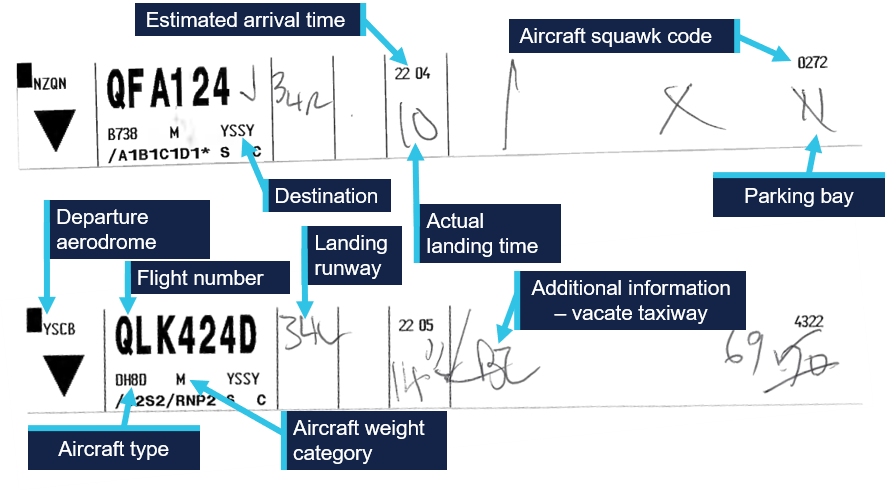
Controllers at Sydney tower used flight progress strips (FPS) to keep track of aircraft details and position. The FPS was moved between different controller positions as aircraft moved around the airport and transferred between controller frequencies. Within control positions, controllers moved the FPS around a flight progress board to indicate the aircraft sequence, and which aircraft were cleared to occupy a runway. Figure 3 shows the FPS for QLK424D and QF124 indicating their respective landing runways, parking gates, and for QLK424D, the FPS included additional information about the cleared runway vacate position.
Figure 3: Flight progress strips for involved aircraft
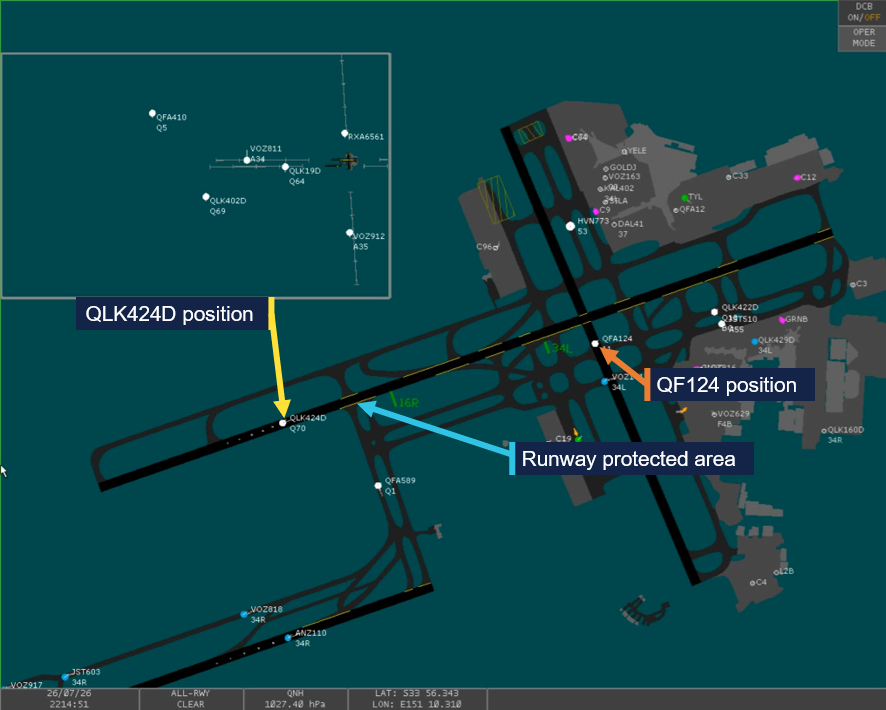
Both the ADC and SMC also had an advanced surface movement guidance and control system (A‑SMGCS) display. This system uses many distributed radio frequency sensors and surface movement radar to detect vehicles and aircraft on the airport surface. Aircraft and ground vehicles are fitted with a transponder, which transmits a signal to a receiver at the airport. Used at major airports, the A-SMGCS showed the position of aircraft and ground vehicles on a screen in front of the controller in the tower. When an aircraft met the parameters to occupy the runway, the display would show the runway as protected by displaying yellow lines across the taxiways that intersected that runway (Figure 4). If the safety logic parameters were met, an alert would be generated and provided to controllers. The yellow runway safety lines (Figure 4) were independent of the stop bars.
The controllers reported to the ATSB that an alarm would be triggered if an aircraft crossed the yellow line while the runway was protected. In this occurrence, QF124 had not passed the yellow line, and therefore no alarm was activated.
The Manual of Air Traffic Services provided a checklist for items to be considered during a transfer of responsibility of any air traffic control position. The checklist included:
- runways
- airspace
- present and forecast weather
- facilities/frequencies/equipment
- navaids and NOTAMs11
- traffic and separation
- outstanding instructions/matters.
The manual also stated that a handing over controller must remain available to assist until the accepting controller indicated that assistance was no longer required. At the time of the handover, the accepting ADC west controller indicated they had understood the information included in the handover and the handing over controller left the position immediately.
Recorded information
QF124 and QLK424D
The respective operators provided recorded flight data from the aircraft’s quick access recorder for QF124 and QLK424D. The flight data included multiple parameters for each aircraft, which included the position, indicated airspeed, thrust lever positions, and brake application. The ATSB received comparison data for QLK424D for further analysis of the braking force applied. Analysis of the data pertaining to the occurrence will be provided in the ATSB’s final investigation report.
Airservices Australia data
Airservices provided a recording from the A-SMGCS (Figure 4).
Figure 4: The advanced surface movement guidance and control system display showing QF124 and QLK424D
Air traffic control very high frequency radio and coordination recordings along with relevant internal phone call recordings were also provided as part of the investigation.
Sydney Airport video footage
Closed-circuit television (CCTV) footage was provided by Sydney Airport directed towards the intersection of runway 34L and 25. The footage shows the proximity of QLK424D landing on runway 34L and QF124 moving to cross that runway (Figure 5).
Figure 5: Video footage showing the intersection of runway 34L and runway 25
Further investigation
To date, the ATSB has:
- received Airservices advanced surface movement guidance and control system and air traffic control audio recordings
- interviewed the involved tower controllers and both flight crews
- received manuals and procedures for Qantas and Airservices
- obtained flight data recordings from both aircraft
- obtained CCTV of the occurrence.
The investigation is continuing and will include:
- analysis of recorded aircraft and air traffic control data
- further review, examination and analysis of the supplied CCTV
- review of the warning/alerting available to controllers
- review of policy and procedures related to handing‑over and accepting control of a tower position
- review of Airservices fatigue management and rostering.
Should a critical safety issue be identified during the course of the investigation, the ATSB will immediately notify relevant parties so appropriate and timely safety action can be taken.
A final report will be released at the conclusion of the investigation.
Purpose of safety investigationsThe objective of an ATSB safety investigation is to improve transport safety through:
In accordance with the TSI Act, the ATSB does not investigate for the purpose of taking administrative, regulatory or criminal action, and cannot apportion blame, assist in determining liability, or, as a general rule, assist in court proceedings. About ATSB reportsATSB safety investigation reports are developed in accordance with ATSB procedures and guidelines, and with regard to applicable international standards and instruments. Reports must include factual material of sufficient weight to support the investigation’s analysis and findings. At all times the ATSB endeavours to balance the use of material that could imply adverse comment with the need to properly explain what happened, and why, in a fair and unbiased manner. An explanation of terminology used in ATSB investigation reports is available here. Publishing informationReleased in accordance with section 25 of the Transport Safety Investigation Act 2003 Published by: Australian Transport Safety Bureau © Commonwealth of Australia 2026 Ownership of intellectual property rights in this publication Unless otherwise noted, copyright (and any other intellectual property rights, if any) in this report publication is owned by the Commonwealth of Australia. Creative Commons licence 
With the exception of the Commonwealth Coat of Arms, ATSB logo, and photos and graphics in which a third party holds copyright, this report is licensed under a Creative Commons Attribution 4.0 International licence. The CC BY 4.0 licence enables you to distribute, remix, adapt, and build upon our material in any medium or format, so long as attribution is given to the Australian Transport Safety Bureau. Copyright in material obtained from other agencies, private individuals or organisations, belongs to those agencies, individuals or organisations. Where you wish to use their material, you will need to contact them directly. |
- ^ Runway number: the number represents the closest 10° magnetic heading of the runway (for example, runway 34 is oriented 335° magnetic). The runway identification may include L, R or C as required for left, right or centre.
- ^ Hold short: A clearance requiring that the aircraft stops at the marked runway holding point and that no part of the aircraft extends onto the runway.
- ^ Standard instrument departure: an air traffic control defined procedure that simplifies departure tracking while also balancing terrain/obstacle avoidance, noise abatement and airspace management considerations.
- ^ Unserviceabilites: an unserviceability would be noted if equipment or infrastructure was not in working condition and/or not available for operational use.
- ^ Stop bars: stop bars were intended to provide additional protection of runway/taxiway intersections to prevent aircraft inadvertently entering the runway without an air traffic control clearance. They comprise a row of red lights inset into the surface of the taxiway. Aircraft or authorised vehicles must not cross the stop bars without both an air traffic control clearance and the red stop bar lights being extinguished.
- ^ Runway incursion: any occurrence at an aerodrome involving the incorrect presence of an aircraft, vehicle or person on the protected area of a surface designated for the landing and take-off of aircraft.
- ^ The Samn-Perelli scale for self-evaluating fatigue ranges from 1 (fully alert) to 7 (completely exhausted). A rating of 2 indicates ‘very lively, responsive, but not at peak’ and a rating of 3 indicates ‘okay, somewhat fresh’.
- ^ Dewpoint: the temperature at which water vapour in the air starts to condense as the air cools. It is used, among other things, to monitor the risk of aircraft carburettor icing or the likelihood of fog.
- ^ Airways clearance: in controlled airspace such as Sydney, aircraft are required to obtain a cleared route from air traffic control which, they are required to follow.
- ^ Automatic terminal information service (ATIS): an automated pre-recorded transmission indicating the prevailing weather conditions at the aerodrome and other relevant operational information for arriving and departing aircraft.
- ^ Notice to Airmen (NOTAM): a notice issued by an aviation authority to alert pilots and other flight personnel to potential hazards or changes that may affect flight operations.
Occurrence summary
| Investigation number | AO-2026-086 |
|---|---|
| Occurrence date | 27/07/2026 |
| Occurrence time and timezone | 0814 Australian Eastern Standard Time |
| Location | Sydney Airport |
| State | New South Wales |
| Report release date | 30/09/2026 |
| Report status | Preliminary |
| Anticipated completion | Q1 2027 |
| Investigation level | Short |
| Investigation type | Occurrence Investigation |
| Investigation phase | Examination and analysis |
| Investigation status | Active |
| Mode of transport | Aviation |
| Aviation occurrence category | Information/procedural error, Near collision, Runway incursion |
| Occurrence class | Serious Incident |
| Highest injury level | None |
Aircraft details
| Manufacturer | The Boeing Company |
|---|---|
| Model | 737-838 |
| Registration | VH-XZG |
| Serial number | 39371 |
| Aircraft operator | Qantas Airways Limited |
| Sector | Jet |
| Operation type | Part 121 Air transport operations - larger aeroplanes |
| Activity | Commercial air transport-Scheduled-International |
| Departure point | Queenstown International Airport, New Zealand |
| Destination | Sydney Airport, New South Wales |
| Injuries | None |
| Damage | Nil |
Aircraft details
| Manufacturer | Bombardier Inc |
|---|---|
| Model | DHC-8-402 |
| Registration | VH-QOC |
| Serial number | 4117 |
| Aircraft operator | Sunstate Airlines (Qld) Pty. Limited |
| Sector | Turboprop |
| Operation type | Part 121 Air transport operations - larger aeroplanes |
| Activity | Commercial air transport-Scheduled-Domestic |
| Departure point | Canberra Airport, Australian Capital Territory |
| Destination | Sydney Airport, New South Wales |
| Injuries | None |
| Damage | Nil |