

Final report
Report release date: 17/11/2026
Investigation summary
What happened
On 4 December 2024, a Robinson R44 Raven II helicopter, registered VH-XIX and operated by Riverina Helicopters, was conducting aerial application operations at a property approximately 50 km east of Young, New South Wales.
During delivery of the 11th load of the day, and while flying at low level over steep terrain, the helicopter struck a dead tree. This dislodged the stabiliser assembly and tail rotor system. The helicopter then collided with terrain, sliding across sloping terrain before entering a gully, fatally injuring the pilot.
What the ATSB found
The ATSB found, for reasons that could not be determined, VH-XIX collided with a dead tree and subsequently impacted terrain in a level, straight, and controlled manner. The site and wreckage examination identified signatures consistent with the engine rotating but the main rotor system in a low energy state at the time of the collision with the tree.
Examination and testing of components recovered from the helicopter revealed some abnormalities, but no mechanical defects were found that were likely to have contributed to the accident. There was no evidence of any flight control or mechanical abnormality that would warrant the need for an immediate landing or prevent the helicopter from operating normally. However, the possibility of an intermittent issue or unknown emergency with the helicopter could not be completely discounted. It was equally hypothesised that, while flying at a low level, the pilot did not see the dead tree, which was set against high terrain and dead grass, until it was too late to avoid it.
Safety message
Low-level flight over complex terrain, within the obstacle environment, brings several significant complexities to an operation. One such complexity is the significantly reduced time available to diagnose and respond to aircraft issues. Another is not seeing obstructions in an area too complex to remember every detail. Obstructions may be camouflaged or difficult to see and the pilot may have limited opportunity to manoeuvre.
The occurrence
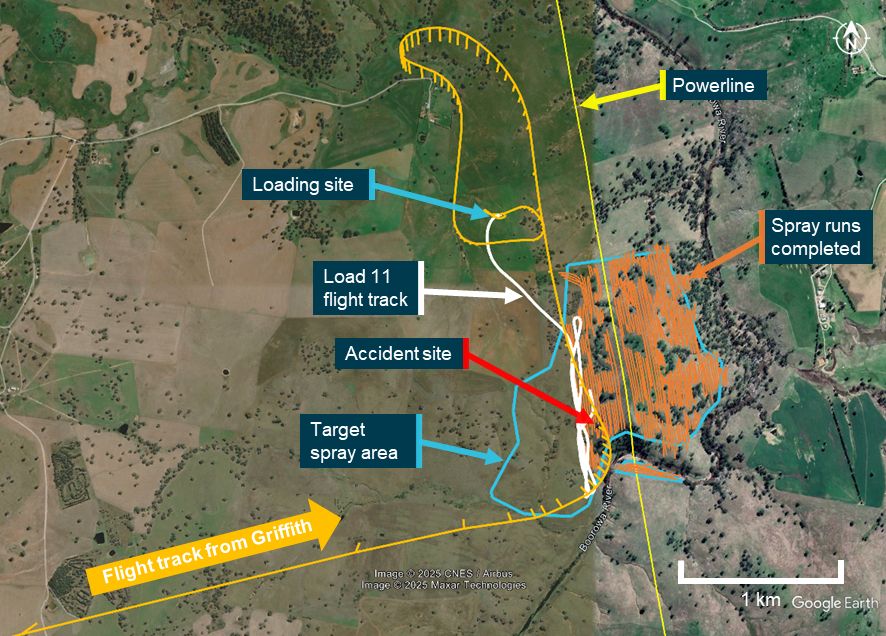
On 4 December 2024, at about 0530 local time, a Robinson R44 Raven II helicopter, registered VH‑XIX and operated by Riverina Helicopters, departed from Griffith Airport, New South Wales, to conduct a ferry flight to a rural property approximately 50 km east of Young for the conduct of aerial application operations.1 On board were the operator’s Griffith base manager and a loader2 (acting as pilot for the ferry flight). They arrived at a paddock on the property at about 0744, landing next to a mobile chemical storage tank. They were met by the farm manager, and the agricultural pilot for the day, who had arrived shortly before by motor vehicle from their accommodation base at Crookwell. The tasking for the day was spraying herbicide across 2 properties.
The base manager, pilot, loader and farm manager discussed the aerial work and then prepared the helicopter for noxious weed spraying operations, including refuelling, attaching the spray booms and mixing herbicide. At about 0912, the base manager, who had sprayed the paddocks on a previous occasion, accompanied the pilot in the helicopter to survey the target area, and returned 5 minutes later. The base manager reported that during the survey flight, high‑tension powerlines were confirmed as an operational hazard.
The helicopter was loaded with herbicide, and at about 0921, the pilot departed for the first application of the day. The pilot applied 10 consecutive loads, each taking around 10 minutes, with the pilot returning for the helicopter to be replenished with herbicide and fuel between loads.
The loader advised that, prior to the commencement of load 10, about 30 L of fuel was added to the main fuel tank and then the helicopter departed to apply further herbicide. At about 1134, as the pilot departed for load 11, the farm manager from an adjacent property arrived and discussed with the base manager the aerial spraying to be conducted for their property.
After about 15 minutes, at around 1149, the base manager realised the helicopter was overdue. They attempted, unsuccessfully, to contact the pilot via radio. The base manager then checked a flight tracking application on their mobile phone that showed the position of the helicopter had not moved from its last indicated location for around 10 minutes. The base manager and second farm manager drove toward the spray area, while the loader stayed to monitor the radio communications.
The base manager and farm manager initially drove to a location of a known hazard, high‑tension powerlines within the spray area, but did not locate damage or the helicopter. After extending the search, they located the wreckage of the helicopter at approximately 1212, in a gully within the spray area. Emergency services were notified of the accident as the search party made their way down to the helicopter. They found the pilot had exited their seat but was among the wreckage and seriously injured. At about 1315, the emergency services arrived at the accident site, however, the pilot later succumbed to their injuries. There were no witnesses to the accident.
Figure 1: Overview of the target area and selected helicopter tracks leading up to the accident site
Context
Pilot information
The pilot held a Civil Aviation Safety Authority (CASA) Commercial Pilot Licence (Helicopter) with a single‑engine helicopter class rating, a gas turbine design feature endorsement, and numerous piston and turbine type ratings. In addition, they held aerial application, low‑level, and sling operational ratings. All of the pilot’s recent flying was in R44 helicopters.
The pilot had recently returned to Australia after 3 years in New Zealand and had reconverted to the Australian licencing system, renewing their licence on 13 November 2024. On 28 November 2024, they completed an aerial application proficiency check.
The pilot’s logbook recorded that they had 637 hours flying R44 helicopters and had accrued 1,035 hours total aeronautical experience. From May 2021 to November 2024, the pilot had flown 636 hours flying helicopters in New Zealand including training, examinations, ferry flights, agricultural spraying and spreading. They accumulated 384.6 hours flying agricultural work in addition to 81.5 hours of training in various helicopter types and roles. Further to gaining local qualifications, they obtained a mountain flying operational rating.3
The pilot held a valid class 1 aviation medical certificate and was reported to be well rested and appearing fully alert prior to the accident flight.
Helicopter information
General
The Robinson Helicopter Company (RHC) R44 Raven II is a 4‑seat helicopter, powered by a 6‑cylinder Textron Lycoming IO‑540‑AE1A5 piston engine driving a 2‑blade semi‑rigid (teetering) main rotor system and 2‑blade tail rotor system. The helicopter was manufactured in the United States in 2003 and registered in Australia in May 2003. It was issued with a special certificate of airworthiness in the restricted category in January 2017. The certificate permitted VH‑XIX to be used in agricultural operations and aerial surveying, and other similar operations.
At the time of the accident, the helicopter had accumulated about 5,820 hours total time in service.
Maintenance review
The helicopter was maintained by Riverina Helicopters in accordance with the RHC maintenance schedule, which required a periodic inspection every 100 hours or 12 months, whichever came first. The records indicated that a periodic inspection and additional minor maintenance tasks were completed on 30 October 2024. The helicopter was then flown an additional 54 hours with no outstanding defects listed in the maintenance release. The maintenance release also indicated that the helicopter had accumulated a total of 5,816 hours in service prior to commencing operations on 4 December 2024. About 4 hours were flown on the day of the accident.
Airworthiness directives and RHC service bulletins were indicated as being completed or not applicable. Maintenance records also stated that the helicopter completed its last 2,200 hour/12‑year overhaul and inspections on 14 July 2021.
Teeter angle
All helicopters with a teetering main rotor system have a limitation as to the angle of slope they can land on due to the limits of teeter angle. The fuselage of a helicopter hangs below the main rotor disc via the main rotor driveshaft. Pilots control the main rotor system via the cyclic4 and collective5 controls, which in turn connect to the main rotor blades via push rods, a swash plate, and pitch links. For a semi‑rigid rotor system, the rotor head at the centre of the main rotor blades pivots about the mast. If the plane of the rotor disc rotates excessively away from the mast, contact between the blade hubs and mast can occur in a feature known as mast bump. Severe mast bumping can be catastrophic to the system’s integrity and lead to loss of the rotor system and helicopter.
There was no published landing slope limit in the R44 Pilot’s Operating Handbook or Robinson Helicopter guidance material. The United States Federal Aviation Administration Helicopter Flying Handbook recommended a maximum landing slope of 5° in training. Additional training was generally required to be proficient for any steeper slopes within the limits of any manufacturer’s published limitations or guidance.
Rotor drive system
In the R44 II helicopter, the main rotor system, tail rotor system and engine are interlinked to enable engine power to be applied to the combined rotor system to generate lift and anti‑torque reactions. The main and tail rotor systems are directly linked by driveshafts and gearboxes. The engine, however, is coupled to the driveshafts via a freewheel connection that allows the engine to automatically disconnect when the engine rotational speed reduces below the rotor driveshaft speed. This may occur when very low engine power is selected by the pilot during rapid descents, practice autorotation manoeuvres, or during engine failure.
The pilot is provided with engine and rotor system rotational speed indications. These are placed on the same instrument and are scaled so that, with the engine driving the rotor system during normal operations, the needles are positioned to cross over each other evenly. During operations when the engine speed reduces below the rotor speed, and the freewheel disconnects the drive, the needle for the engine rotation speed will drop below that of the rotor system indication, a condition known as needle splitting. This indicates to the pilot the engine is no longer providing power to the rotor system while also indicating if the engine has stopped, is at idle, or providing some reduced power level below that required to drive the rotor system.
Agricultural spray system
An approved agricultural spray system had been installed to VH‑XIX that consisted of 2 fibreglass 145 L external chemical tanks, interconnected plumbing to a petrol‑powered water pump controlled by a valve, and a cantilevered spray boom system underneath and off each side of the cabin. The control valve was activated by the pilot via a switch on the cyclic control.
The approved system imposed limitations of an 80 kt velocity never exceed speed (Vne)6 and a maximum positive load factor7 of 2.67. The system provided a method to jettison the chemical load by a trap door in the bottom of each tank that could be activated by a ‘DUMP’ button on the cyclic control.
Meteorological information
The company personnel working with the pilot both reported the weather as blue skies with a few clouds, and light winds from the north‑west. Weather was also available from the Bureau of Meteorology (BoM) and community weather monitoring stations,8 as shown in Table 1. While it was noted that community weather stations may be less accurate due to the calibration and installation location of sensing equipment, the observations recorded at the closest location (Frogmore) to the accident site were consistent with that reported by the company personnel.
Table 1: Local weather at the time of the accident
| Weather station | Location from accident site | Wind direction | Wind speed (kt) | Temp (°C) | (above ground level) |
| Young Airport (BoM) | 50 km west | North-westerly | 7–8 | 28 | Few 3,500 ft Broken 4,800 ft |
| Cowra (BoM) | 53 km north | Varying northerly to westerly | 4–7 | 28-30 | Clear |
| Boorowa (private) | 14 km south‑south-west | South-south-westerly | 3.6–3.9 | 29 | Not recorded |
| Frogmore (private) | 8 km north-east | North-north-westerly | 0.5–1 | 31 | Not recorded |
At the time of the accident, the sun was at an elevation of approximately 78° due north, and unlikely to have been an adverse influence on the pilot’s vision.
Recorded information
Sources
The helicopter had analogue instrumentation and did not record any flight or engine parameters but was fitted with SpotTrace and TracMap devices.
SpotTrace
A SpotTrace device was carried inside the helicopter. Every few minutes, when the unit detected movement, it broadcast the helicopter’s position. The operator provided login details to the ATSB. The device provided position data shortly after take‑off from Griffith, until the helicopter stopped moving, in a position coincident with the collision with terrain.
TracMap
To assist with aerial application tasks, the helicopter was fitted with a TracMap GPS guidance device with recording capability. The flight tracks from the day of the accident were recorded on the device and subsequently downloaded by the ATSB, including information about the completed spray runs based on the spray valve activation (Figure 2, in orange). Figure 2 also shows the target spray area outlined in blue.
Figure 2: TracMap spray runs completed
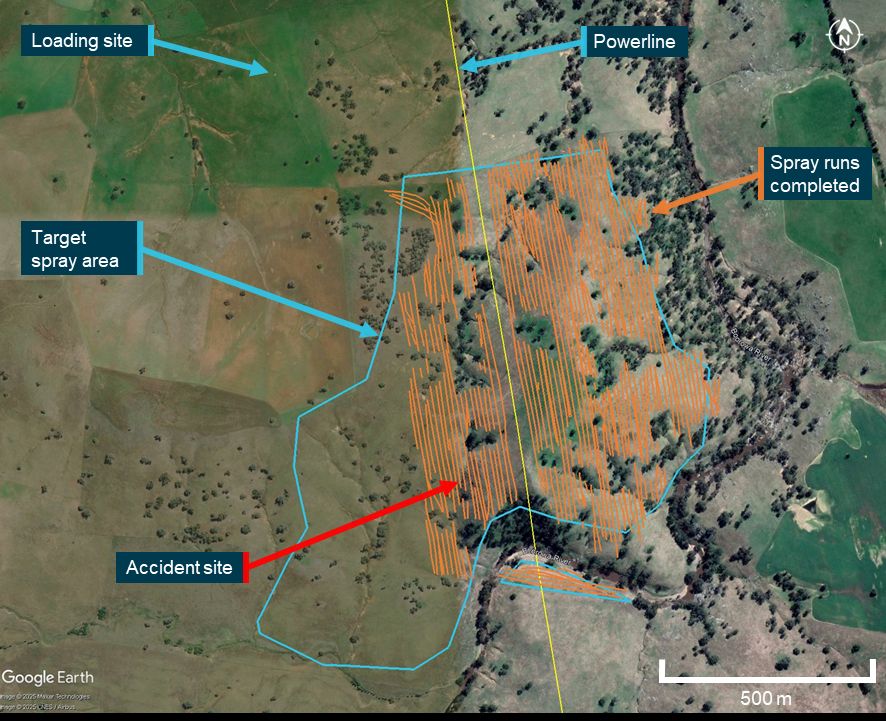
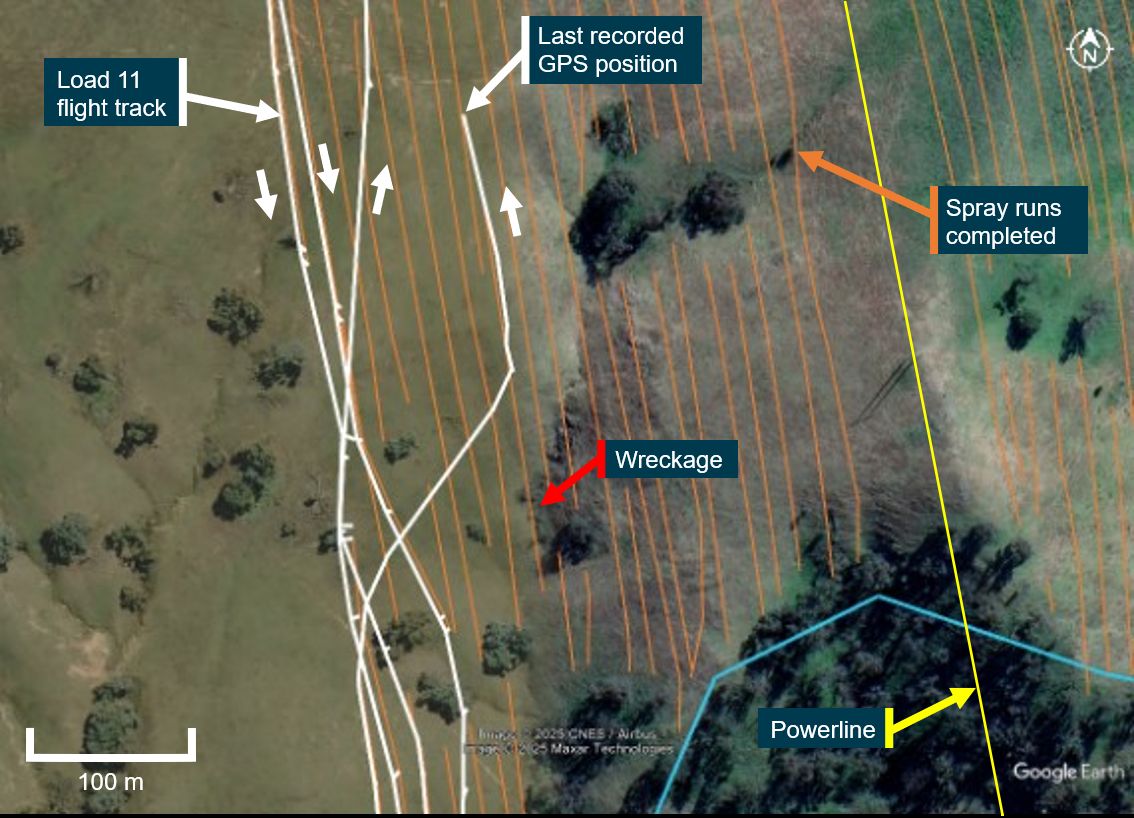
The recording ceased approximately 03:09 minutes after the start of load 11. The spray valve was recorded active 5 times during that load. Due to the sudden stoppage of the device in the accident, some volatile data collected towards the end of the flight was unavailable for download (Figure 3). A chip level recovery10 was conducted on the device but it confirmed the device contained no further information.
Figure 3: Plot of the final spray runs for load 11 and final GPS track point
Data review
Application area and approach
The terrain was steep, uneven and cut by creeks and gullies. In the vicinity of the accident site, the slope in the direction of spray runs was measured to be up to 25°. It was also dotted with stands of trees, including dead trees. The area was divided by a large high‑tension powerline running north‑south. The recorded tracks showed the pilot flew parallel to the powerline and tracked progressively away from it on each new spray run. Due to the terrain and obstacles, the spray runs were not exactly parallel, often diverging with small fill‑in runs as required.
The operator stated the target spray height was below 5 ft and trees interrupting runs were managed by closing the spray valve, climbing and descending over the trees using the collective control and resuming spraying on the other side. Three‑quarters of the loads included at least one mid‑run pull up followed by an orbit or figure‑8 turn before descending to recommence spraying. At the end of runs, the pilot appeared to have a preference for making right hand turns, likely turning in the direction of the main rotor system torque to assist with the rate of turn and reduce engine power requirements.
Over the course of 11 runs, the average recorded groundspeed while the spray activation was set to ‘ON’ was 48.4 kt.
Accident flight
The collision with terrain took place on load 11. Compared with prior runs, load 11 consisted of 4 recorded runs, which were characterised by 5 shorter than usual ‘spray on’ periods interspersed with longer periods of not spraying. Additionally, just before the recording stopped, the TracMap system recorded a non‑spraying climb up the slope near the accident site over previously sprayed areas and at an angle near 45° to these existing runs (see Figure 3).
Wreckage and impact information
Onsite examination
The helicopter was significantly disrupted with its wreckage located about 1,200 m south‑south‑east of the base of operations for that day, in a steep gully towards the southern end of the target spray area. The terrain was hilly, covered with high dry grass and scattered with large trees. Some of the trees were dead and devoid of foliage.
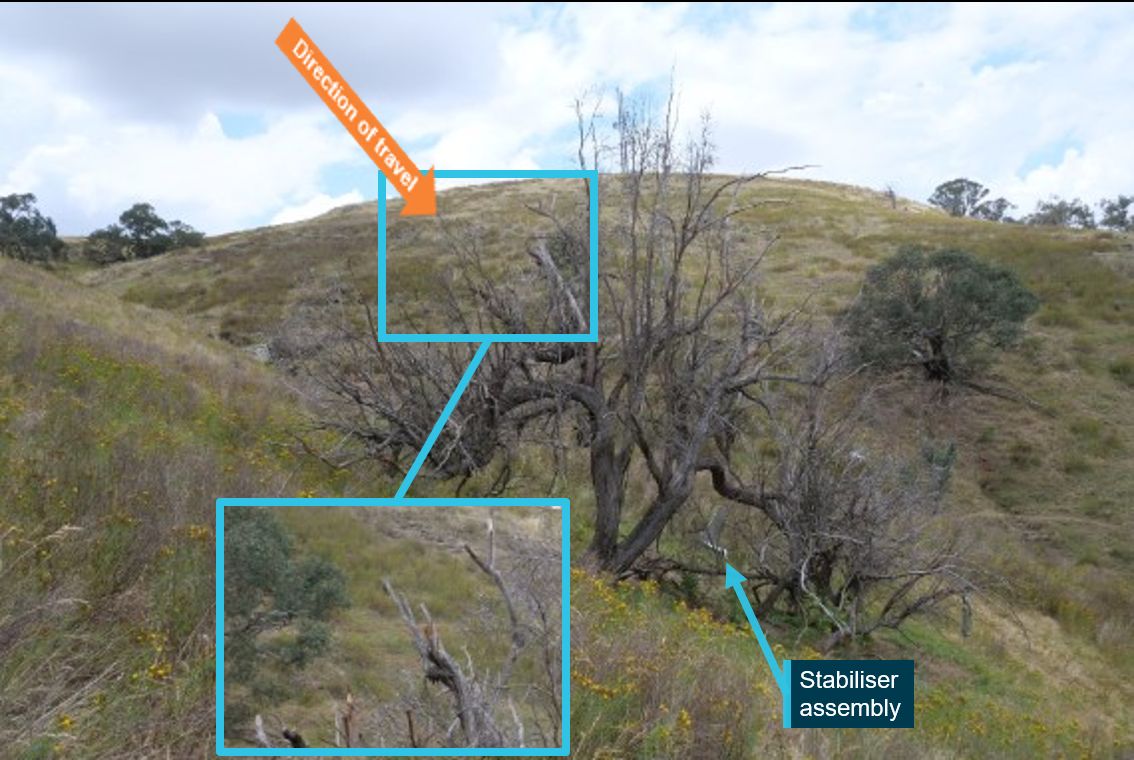
The first items from the helicopter in the debris trail were fragments of tree branches, the stabiliser assembly and right‑side spray boom. These items were adjacent a dead tree with freshly broken limbs on one side, from near the treetop (Figure 4), indicating the direction of travel was approximately from the west‑south‑west. The estimated flight path was downhill toward steeply rising terrain, with 2 stands of trees just prior to the dead tree.
Figure 4: Tree top struck by the helicopter when viewed in the direction of the wreckage
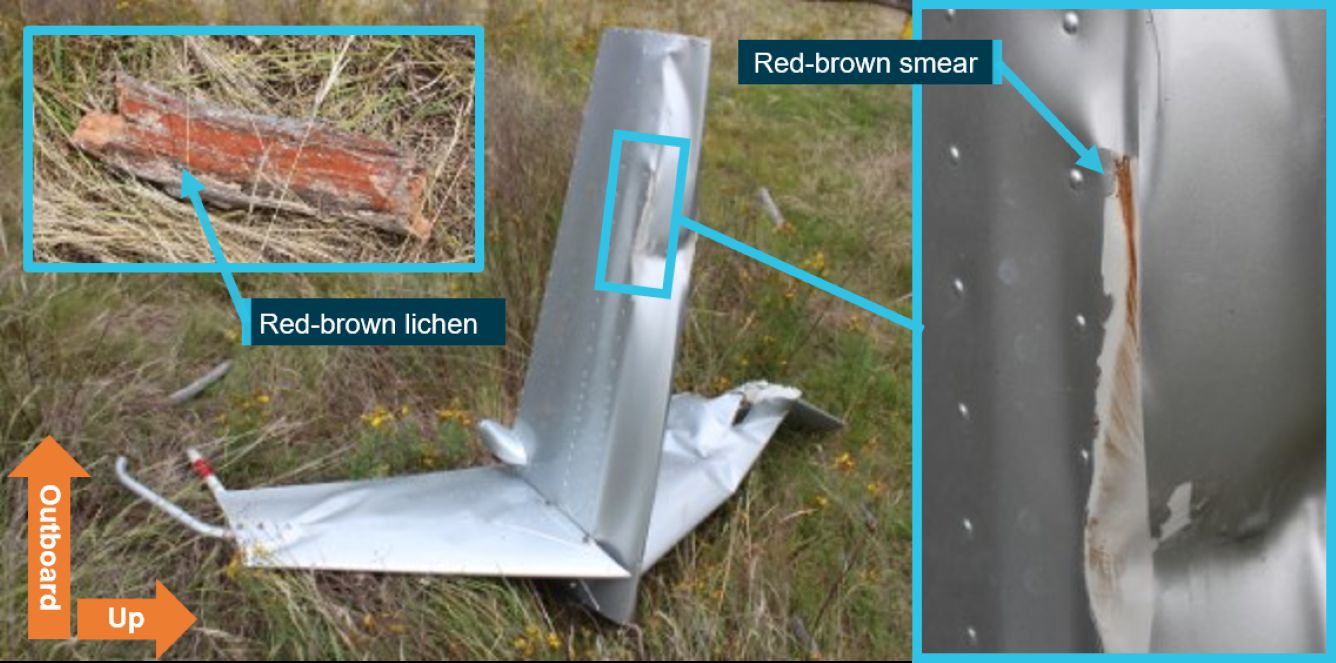
The stabiliser assembly was approximately 7 m from the tree. The stabiliser mount casting fractured with part of the casting remaining attached to the stabiliser assembly. The assembly still contained all 3 stabiliser surfaces, the tail skid,11 and a short section of tail guard tube.12 The horizontal stabiliser contained a leading‑edge dent about midspan with abraded paint and a red‑brown smear consistent with lichen‑covered branches located in the tree and on the nearby ground (Figure 5).
Figure 5: Stabiliser assembly impact consistent with tree branches
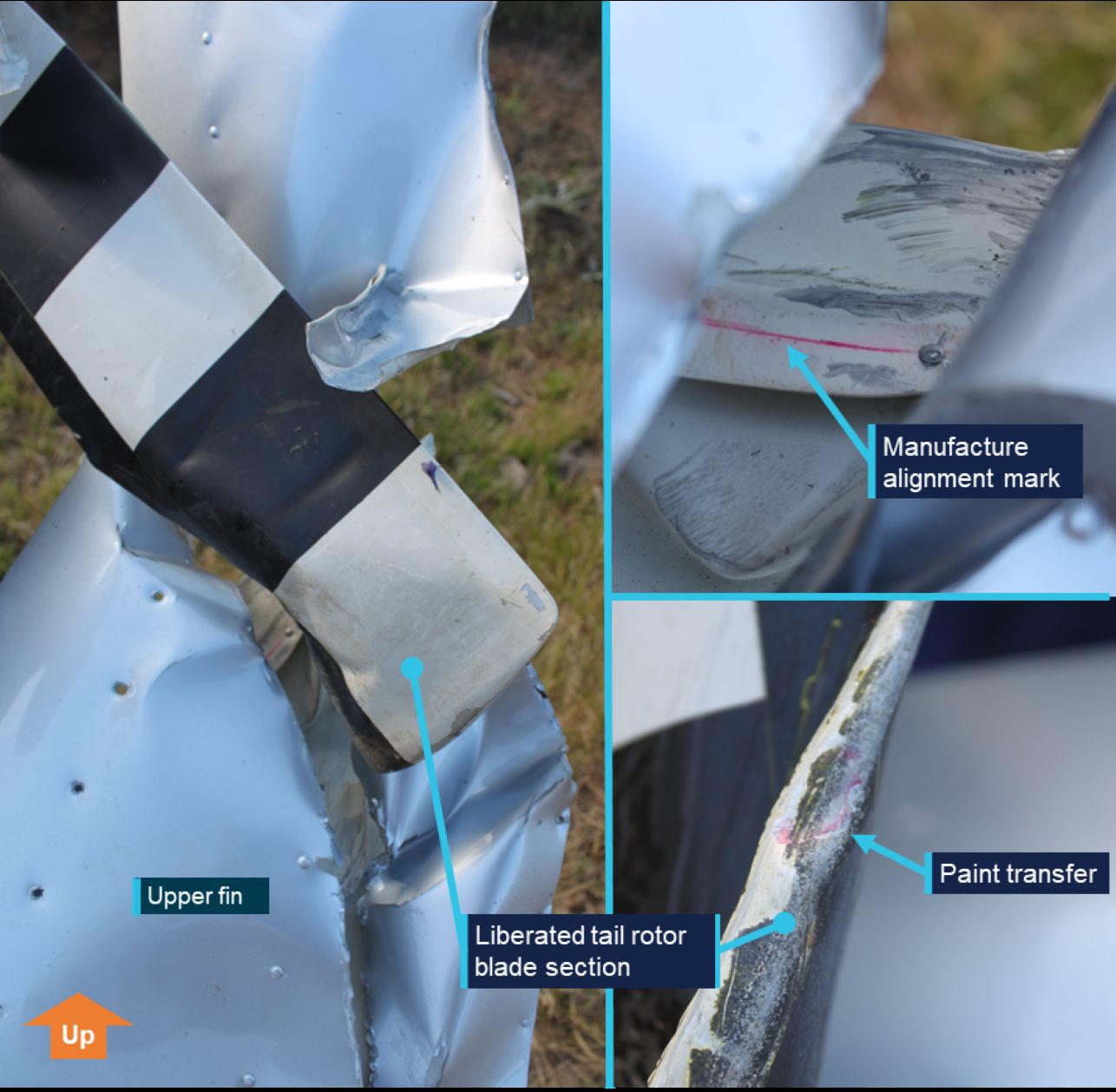
The upper vertical fin sustained damage to the leading and trailing edge skin, which exposed the internal frame and painted alignment marks from manufacture. One tail rotor blade separated at approximately one quarter semi‑span. Damage to the leading edge and a paint transfer mark was consistent with the blade section passing through the skin of the upper vertical fin (Figure 6).
The remaining root section, second blade, hub assembly and gearbox had also separated from the tailcone as one assembly, being found on the other side of the gully about 34 m from the stabiliser and to the right of the flight track. The tail rotor yaw control ‘push‑pull’ tube was located a short distance from the stabiliser. It had a curve distortion over almost the entire length, indicating it was pulled out of the tailcone, coincident with liberation of the tail rotor gearbox.
Figure 6: Damage to stabiliser upper fin and liberated tail rotor blade
The helicopter was laying on its left side and facing the direction of travel (Figure 7). Outboard sections of both main rotor blades had fractured and been liberated during the accident sequence. One was found 3 m north of the fuselage and the other 42 m south. Both teeter stops13 were cut. Neither the stainless steel mounting brackets nor the mast underneath were damaged.
All critical components were accounted for at the accident site. All fragmented windscreen acrylic was found amongst the wreckage with no pieces located earlier in the ground slide or towards the base of the tree.
The fuel tanks were inspected and found to be holding a substantial quantity of fuel. The gascolator (fuel strainer) was full of fuel and the screen was free of any debris. There was no evidence of in‑flight or post‑impact fire.
There was no evidence of a birdstrike found on the wreckage or in the surrounding area.
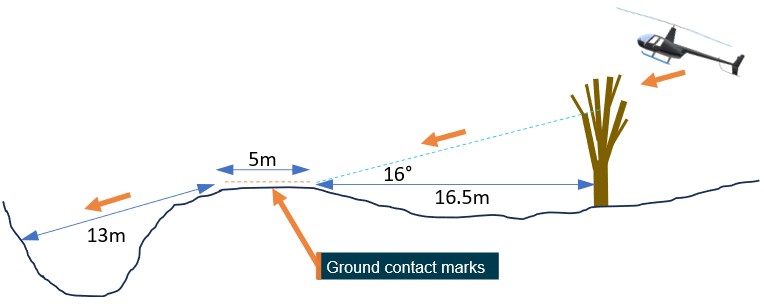
Two ground contact marks from the landing gear skids were identified between the dead tree and the main wreckage (Figure 7, in red). The marks were indicative of the helicopter being upright and sliding along the ground in a straight line, with no slip angle or rotation, prior to it impacting the far side of a gully. The length of the marks and distances to relevant features are shown in Figure 8.
Figure 7: Site overview showing the location of the main wreckage and other items liberated during the accident sequence
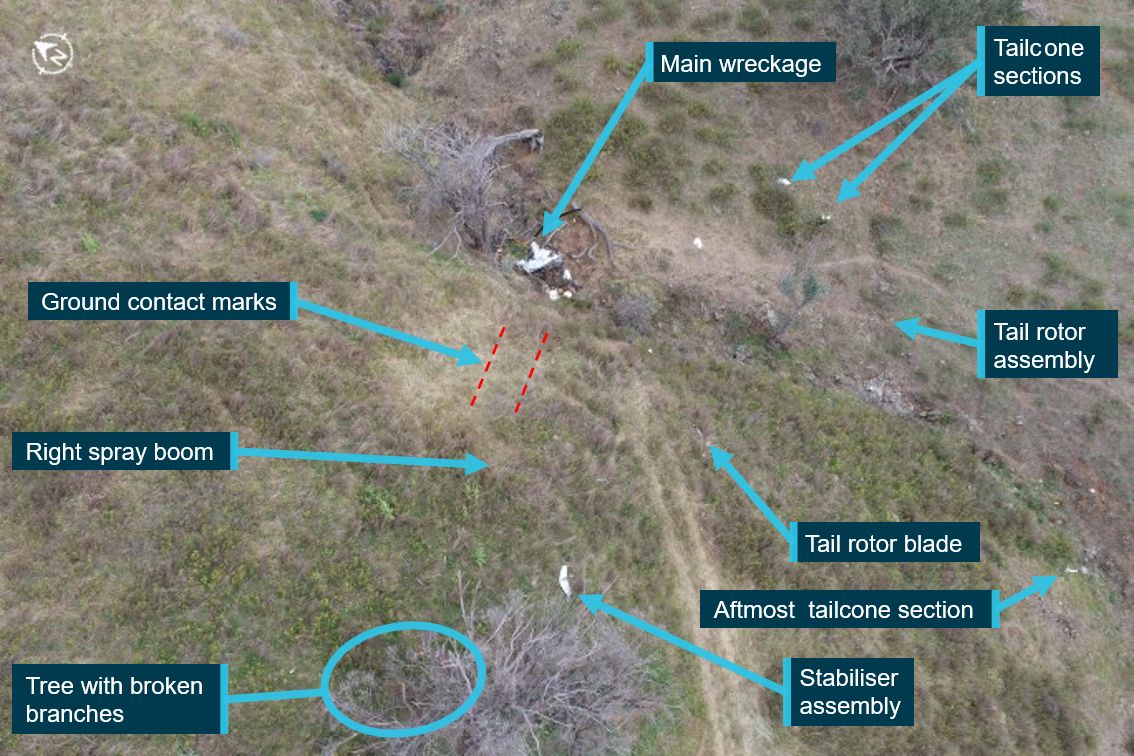
Figure 8: Approximate distances from the collision with the tree to the terrain
Post-onsite wreckage examination
While the ATSB conducted a preliminary examination of the helicopter at the site, in December 2024 the wreckage was relocated to a secure facility for further inspection. A summary of the findings is provided here with detailed examination information provided in Appendix: Post‑onsite wreckage examination and testing:
- The airframe was substantially damaged, particularly in the areas of the cabin and tailcone.
- While highly damaged, there was no evidence of an electrical issue identified.
- The landing gear had permanently spread consistent with initial ground impact forces.
- The agricultural spray system actuation valve was found in the ‘SPRAY ON’ position, and the chemical tank jettison doors were found in the closed position.
- Both main rotor blades had fractured in multiple locations, had evidence of downward and rearward bending,14 and localised scrape marks, with one blade having also broken a pitch link and been folded downward.
- The main and tail rotor gearboxes turned smoothly and contained no metallic debris.
- All 3 driveshaft flex couplings15 exhibited pull type distortion.
- All flight controls were heavily damaged, but continuity of the controls was confirmed.
- The hydraulic and governor systems appeared undamaged and tested satisfactory.
- The starter motor was found engaged with the ring gear but was likely to be a result of the impact with terrain.
- The fuel system contained adequate fuel for flight and the gascolator was free of water and contaminants.
- The engine and drive system had multiple signs it was operating at the time of the accident but was stopped suddenly during the impact with the gully:
- The upper sheave had scoring marks on the aft face aligning with contact from the centring rod for only 75% of the circumference. The scoring sharply stopped indicating the engine was turning but was stopped suddenly.
- All 4 drive belts jumped forward 2 grooves on the upper sheave also indicating rotation as the upper and lower sheaves came out of alignment during the impact.
- The front drive belt was found turned back on itself and pinched on the left side of the lower sheave (looking airframe forward) consistent with the direction of engine rotation and is a signature that the engine was turning at the time the belts jumped off the sheaves.16
- The engine was removed from the airframe and the following checks conducted:
- A cold cylinder compression test found one cylinder had low compression.
- The magneto drive system was intact, and both magnetos were found to be timed correctly.
- The mechanical and electrical fuel pumps were found to be functional.
- The engine was placed on an engine test stand and fitted with a club propeller.17 With minimal preparation, the engine was able to be started and ran smoothly. During a magneto check, a high‑tension spark plug lead was found broken. The test showed that the engine was capable of providing full power to the helicopter drive system.
In summary, numerous parts of the wreckage indicated the engine was operating at the time of the impact and capable of supplying power to the helicopter’s rotor systems.
Low rotor energy signatures
The tailcone mount was secured to the airframe, however, the remainder of the tailcone was severed into many pieces which, when arranged in assembly order, indicated 3 complete strikes had occurred from the main rotor blades (Figure 9). In addition, the rearmost section of the tailcone indicated one tail rotor blade contact externally and one rear tail rotor drive shaft yoke impact internally, likely during the liberation of the tail rotor assembly.
The 3 cuts through the tailcone exhibited folding and tearing of the aluminium tube with cut #3 exhibiting the complete enclosing of the second bay of the tailcone by remnant material, indicating rapid energy depletion of the main rotor system.
The tail rotor driveshaft was cut into 4 pieces, which aligned with breaks in the tailcone. All sections exhibited bending along their lengths, and the drive yokes and flex couplings at each end were fractured and exhibited tension distortion (pulling) before failure.
Figure 9: Tailcone cuts by the main rotors
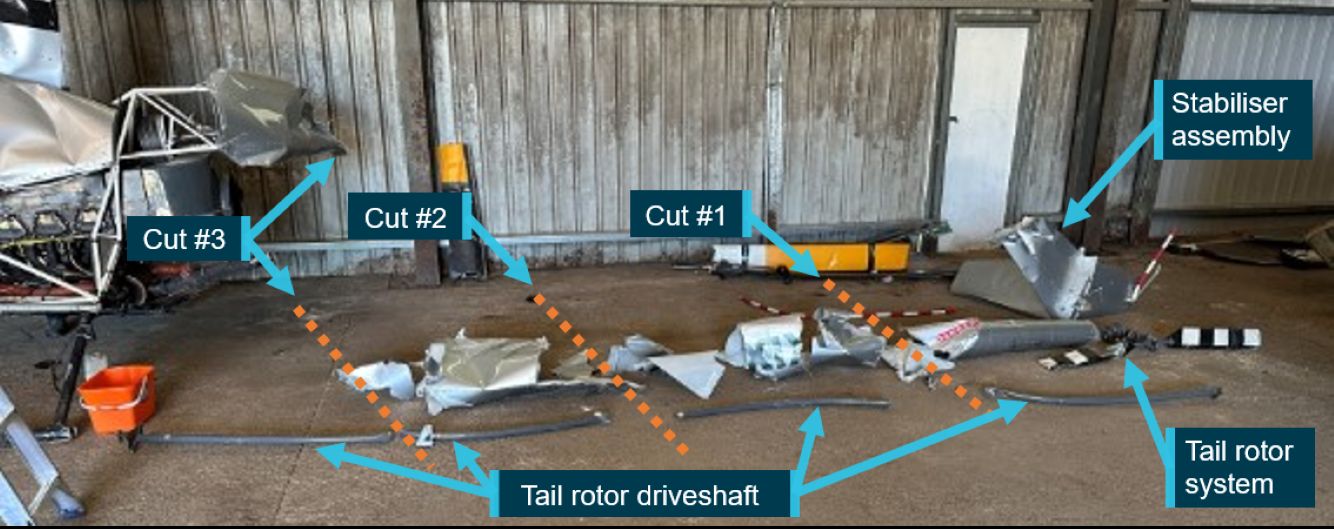
The nature of main rotor blade cuts through the tailcone can give an indication of the main rotor energy at the time. A main rotor system operating at 102% will cut the tailcone and tail rotor driveshaft comparatively cleanly. A slower main rotor system will tend to bend both the driveshaft cut faces and the shaft lengths. Tension applied to the shafts by this bending can distort the flex plates in an axial (pull) direction. Additionally, a driveshaft with a high torque load will exhibit twist type distortion, which was not displayed in this case.
Finally, a low energy main rotor system on impact with the ground can exhibit permanent downward bending distortion. A system at 100% rpm is more likely to remain straight as the increased centrifugal tension in the blades assists in reducing the downward bending moment applied to the blade during the impact with the terrain.
For VH-XIX, all main rotor energy signatures indicated it was turning at less than 100% rpm.
Medical and pathological information
Aviation medical
The pilot’s last Civil Aviation Safety Authority required medical assessment was conducted on 25 November 2024, 9 days before the accident, and it contained no restrictions. Due to the pilot’s age, no recurring additional tests were required for this exam apart from an electrocardiogram, which reported no issues.
Post-mortem and toxicology
An external post-mortem examination of the pilot was conducted by a qualified pathologist for the New South Wales Coroner. The cause of death was recorded as being from multiple injuries. Toxicology testing was conducted to detect common therapeutic medicines and illicit drugs, and these tests were negative for all substances. A carbon monoxide saturation level of 3% was detected in the pilot’s blood and was recorded in the post‑mortem report as being at a normal level.
Survival aspects
The forward part of the cabin had extensively collapsed on impact with the gully. The cabin structure was found to have been pushed and collapsed rearward by about 1 m, reducing the survivable space. Compression during the impact would have been greater before the structure spung back to its final state. While the seat and restraint systems remained attached to airframe structures, those structures themselves were destroyed and displaced. The impact forces and collapse of the cabin were not considered survivable.
The pilot’s 4-point safety harness was found released when the first responder arrived, with the pilot having self‑extricated from the seat. Both lap strap portions of the safety harness had witness marks in the webbing at the adjuster indicating a high load had been applied, and the webbing had not slipped, which was consistent with the pilot being secured in the harness at the time of the accident.
The pilot was wearing a Gentex helmet. The only damage to the helmet was one small yellow scuff mark and associated fixing damage to the visor cover. While the colliding component was not positively identified, the only probable helicopter component with yellow paint were the tip sections of the main rotor blades.
The helicopter was not fitted with an emergency locator transmitter, nor was it required by regulations. The helicopter did have a personal locator beacon stored in a pouch between the rear seats. First responders tried to find the device to signal for help but could not locate it in the wreckage.
Operator information
General
Riverina Rotor Work, trading as Riverina Helicopters, was the registered owner and operator of VH‑XIX. Riverina Helicopters held a CASA‑issued air operator’s certificate and was approved to conduct air transport and aerial work operations.
Pilot induction
The pilot started working for Riverina Helicopters on 1 November 2024. Their first day involved office‑based induction and paperwork. The next day involved flying VH‑XIX from the operator’s Griffith base for 3 spray jobs in the local area. The first job was conducted with the removable dual flight controls fitted for left seat operation and the operator’s chief pilot occupied that seat. Subsequent spray jobs were supervised from the ground. The chief pilot commented the pilot was ‘competent in relation to [their] hours’ and ‘there was no concern at all’.
On 3 November 2024, the pilot moved to Crookwell to assume their position as the Crookwell base pilot.
Pilot support
On the day of the accident, the pilot was to conduct 2 spray operations on adjacent properties. The Griffith base manager advised they attended the operation to support the pilot and settle them into their new position in the company. Between most spray runs, the Griffith base manager checked in with the pilot and answered any questions they had about the helicopter or its equipment.
Application interruptions
Two interruptions to the morning’s application of herbicide were reported by those assisting the pilot. Firstly, at the completion of load 9, the pilot reported to the Griffith base manager that the low fuel light had flickered on momentarily. A joint review by the pilot and base manager of the fuel quantity gauges showed adequate and expected quantities of fuel on board. Secondly, at the start of load 10, the pilot returned to the loading area shortly after departing as the loading crew had forgotten to restart the spray pump after filling the pump’s fuel tank.
Similar occurrences
The ATSB conducted a review of investigated collision with terrain accidents involving agricultural aircraft. This included agricultural application helicopters and aeroplanes as the aspects of interest are applicable to both types of aircraft. Both fly at similar heights above the ground at not dissimilar airspeeds. Sighting angles, visibility of obstacles, and pilot reaction times are all comparable or the same in both types.
A search of the ATSB’s occurrence database over the last 12 years found 2 occurrence briefs and 12 accident investigation reports of collisions with terrain involving aircraft engaged in agricultural operations, as shown in Table 2.
Table 2: Similar investigations and occurrence briefs in the ATSB database
| Investigation | Title |
| AB-2024-043 | Collision with terrain involving Air Tractor Inc AT-504 |
| AB-2025-044 | Wirestrike and collision with terrain involving a Eurocopter AS 350 |
| AO-2015-030 | Collision with terrain involving Piper PA25-235/A9 Pawnee, VH-NLP |
| AO-2015-087 | Wirestrike involving an Eagle DW1, VH-FHP |
| AO-2016-027 | Collision with terrain involving Bell 206B helicopter, VH-WHU |
| AO-2016-081 | Wirestrike and collision with terrain involving Schweizer 269C, VH-NTZ |
| AO-2016-146 | Collision with terrain involving Air Tractor AT-502, VH-LIK |
| AO-2016-157 | Loss of control and collision with terrain involving Air Tractor Inc. AT-802A, VH-NIA |
| AO-2017-062 | Loss of control and collision with terrain involving FU24 Stallion, VH-EUO |
| AO-2019-011 | Wirestrike involving a Robinson R44, VH-ZWK |
| AO-2021-052 | Collision with terrain involving Air Tractor AT-400, VH-ACQ |
| AO-2022-008 | Collision with terrain involving Piper PA-25, VH-SEH |
| AO-2022-043 | Birdstrike and collision with terrain involving Air Tractor AT-502B, VH-KDR |
| AO-2024-005 | Collision with terrain involving Air Tractor AT-502, VH-AQW |
Operation at low level and among obstacles was understandably noted in most reports to be a feature in the events. While all were eventual collisions with terrain, preceding events were predominantly wirestrikes (6 events). The remainder of the occurrences were found to be a loss of control variously related to aircraft handling, loading, distraction, and a birdstrike event.
Of the reports, 7 did not mention whether hopper contents were jettisoned during the event. The 3 reports that stated product was jettisoned described events relating to performance characteristics of the aircraft at the time. Four reports showed that product was not jettisoned in events that related to aerodynamic stalls18 at low level and wirestrike events that almost certainly did not provide time for the pilot to jettison the load.
Safety analysis
Introduction
Just before midday on 4 December 2024, while spraying herbicide over paddocks at low level, a Robinson R44 II helicopter, registered VH‑XIX, collided with a tree, dislodging the stabiliser assembly and tail rotor system. The helicopter then collided with terrain, fatally injuring the pilot.
The analysis will consider the possible scenarios for why the helicopter struck the tree in a high nose attitude, with low rotor energy and engine power.
Collision with terrain
Adverse terrain and an obstacle environment
Recorded data verified the helicopter was flying at low levels consistent with functions of agricultural flying, including the periods where the spray valve was activated. The terrain was unsuitable as a landing location due to the steep slopes that would exceed the teeter angle of the helicopter’s main rotor system in most places (FAA, 2019). The hazard of the powerline running north‑south through the area was managed through design of the task. However, the many trees in the area had to be managed by adjusting individual runs, passing between or over trees. As demonstrated by the first 10 spray loads, the helicopter had sufficient performance to outclimb the steep terrain in the area of the accident.
High nose attitude and low rotor energy
The onsite examination determined that the helicopter collided first with a dead tree while travelling downslope and then slid before colliding with terrain on the opposite side of a gully. Numerous short sections of shattered branches were found between the base of the tree and where the helicopter first contacted the ground. These were co‑located with the helicopter’s stabiliser assembly and right spray boom. Damage to the lower side of the leading edge of the separated horizontal stabiliser confirmed contact with the tree.
In straight and level flight, the windscreen on the R44 helicopter is lower than the horizontal stabiliser. While the spray boom and horizontal stabiliser were struck, there were no acrylic windscreen fragments around the tree. Therefore, it was virtually certain that the helicopter collided with the tree in a nose high attitude. As the flight control systems were determined to be intact, it was very likely that the pilot commanded the nose high attitude.
The onsite examination found damage signatures indicating a lower than normal energy state of the main rotor system at the time of collision with the tree. The first strike of a main rotor blade through the tailcone folded rather than sliced the metal skin typical of high energy main rotor strikes, indicating the energy in the main rotor system was already depleted. Additionally, the break in the tail rotor drive shaft exhibited no torsional twisting, a signature of low torque in the shaft when it was cut.
Engine rotation
Engine rotation signatures identified in the wreckage inspection indicated the engine was operating at the time of the collision with terrain in the gully. Scoring through 270° of the upper sheave indicated the engine was rotating but stopped suddenly when the main rotor system made contact with the gully. Additionally, the drive belts migrated out of their grooves with one pinched, also indicating rotation as the upper and lower sheaves came out of alignment during the impact.
Similarly, the post-onsite test found the engine was able to be run with minimal preparation. While one engine cylinder recorded a low cold cylinder compression and a high‑tension lead contained a continuity defect, it could not be identified if the faults were pre‑existing to the accident. Regardless, either defect would not have precluded the engine running at sufficient power to continue safe flight, as demonstrated from the test.
The flight path through the tree was in a descent, downslope, and in a straight line. The helicopter’s first contact with the ground after the collision with the tree was marked by clear imprints showing the helicopter slid with skids parallel to the direction of travel before crossing the gully and colliding front‑on with terrain.
In normal operation, the tail rotor system counteracts torque from the main rotor. If engine power was being applied when the stabiliser and tail rotor system departed the helicopter on impact with the tree, the main rotor torque would have induced a right yawing moment to the fuselage. However, ground contact marks and fuselage damage showed the helicopter skidded straight, without yaw. This evidence indicated that, while the engine was running, there was no engine power driving the main rotor system at the time of the collision with the tree.
Possible explanations
The ATSB considered the potential reasons for the high nose attitude, low rotor energy, and no engine power being applied.
Obstacle awareness
A nose high attitude in-flight (flare) directs the main rotor thrust backwards to slow the helicopter. This is a commonly used technique when rapidly decelerating from forward flight to a hover (known as a quick stop), which has practical application in low‑level operations when avoiding obstacles such as trees (CASA, 2012).
The tree could have possibly blended into the background of rising terrain covered in dry grass. While the track of the helicopter before colliding with the tree remained unknown, given normal times of pilot reaction, input and flight control responses, the helicopter would have had to pass through a gap between 2 stands of trees (Chappelow, 1999). At the target spray height of 5 ft, those trees could have obscured the dead tree from the view of the pilot.
There was no discernible reason for the pilot to be flying at spray height through the section with the dead tree as they had already sprayed the area. Further, the estimated final flight path was nearly perpendicular to the normal spray run direction, and downhill toward steeply rising terrain. The pilot had flown a path (without spraying) diagonally up the hill through the same section a few minutes prior. As such, it was possible that the dead tree was observed at some point by the pilot. However, previous occurrences have shown that it is not uncommon for pilots to forget obstacles, especially when multitasking in a fast‑paced environment such as agricultural spraying operations (ATSB, 2011).
Prior research conducted by the ATSB (ATSB, 2005) identified distraction themes that could have applied at the time such as agricultural tasks, equipment problems, instruments or displays, mobile phone use, or time pressures. There was no evidence for pilot distraction identified and it did not fit with the evidence of the helicopter being commanded to a nose high attitude with low power prior to hitting the tree.
The spray valve was found in the ‘SPRAY ON’ position but this was not a reliable indicator of the position at the time of the collision with the tree as the impact with terrain could have activated it. The herbicide was not jettisoned from the spray tanks, indicating the pilot may not have had time to do so. Similar occurrences show that this is a feature of sudden collisions with obstacles.
From the evidence available, it could not be concluded that the pilot was distracted, surprised, or was otherwise unaware of the tree until it was too late to avoid colliding with it, although it remained a possibility.
Potential for an emergency
There were no indications of a birdstrike and the helicopter was not in proximity to the powerline. Also, based on company personnel observations, there was no evidence to suggest that the weather conditions affected the pilot’s ability to maintain control of the helicopter.
All major systems were checked for faults or abnormal wear. As identified previously, the engine ran with minor faults that did not affect the performance of the engine. Other sources for a potential emergency response were checked, including fuel, hydraulics, engine governor, helicopter structure, driveline, main and tail rotor systems, flight controls, electrical systems, and fire. No evidence of a fault was detected.
The signatures showing an operational engine and no power applied to the main rotor system, along with the steep descent angle through the dead tree, suggested the pilot either elected to, or was forced to, land without power applied. In which case, it was likely that the throttle was wound to idle by the pilot.
Low-level flight carries increased risk to a successful forced landing due to the lack of decision time and limited ability to manoeuvre to a suitable landing location. A helicopter aiming to operate below 5 ft, the spray height advised by the operator, has almost no forced landing option other than what is ahead. If the helicopter was able to reach a reasonable height, other forced landing options would have become available, including a flat clear space to the south of the accident site.
Despite this, a potential reason for an emergency could not be determined. However, it could not be discounted that there was an intermittent issue that affected normal operation of the helicopter and there was no observable evidence to indicate this may have occurred.
Contributing factor While flying at low level, over adverse terrain within an obstacle environment, for reasons that could not be determined, the helicopter collided with a tree in a nose high attitude with low rotor energy and the engine operating at reduced power. |
Findings
ATSB investigation report findings focus on safety factors (that is, events and conditions that increase risk). Safety factors include ‘contributing factors’ and ‘other factors that increased risk’ (that is, factors that did not meet the definition of a contributing factor for this occurrence but were still considered important to include in the report for the purpose of increasing awareness and enhancing safety). In addition, ‘other findings’ may be included to provide important information about topics other than safety factors. These findings should not be read as apportioning blame or liability to any particular organisation or individual. |
From the evidence available, the following findings are made with respect to the collision with terrain involving Robinson R44 Raven II, VH‑XIX, 50 km east of Young Airport, New South Wales, on 4 December 2024.
Contributing factor
- While flying at low level, over adverse terrain within an obstacle environment, for reasons that could not be determined, the helicopter collided with a tree in a nose high attitude with low rotor energy and the engine operating at reduced power.
Appendix: Post‑onsite wreckage examination and testing
The following section further details the post‑onsite wreckage examination and component testing conducted by the ATSB.
Wreckage examination
Flight controls
The cabin was substantially compressed by the impact with the far side of the gully. The position of most controls and switches were not able to be determined due to the level of disruption. Detailed examination of the wreckage identified continuity of the flight and engine controls, with all fractures consistent with overstress failure. Due to the damage sustained from the impact, engine control positions prior to impact could not be determined.
Electrical system
Due to the level of damage to the forward cabin including the centre instrument panel, many switches and instruments were destroyed. The engine ignition switch was tested and found to be functional. Caution and warning lights were examined for stretch in the incandescent element, a possible signature of the light being on at impact. There was no evidence of stretch, however, this did not necessarily indicate the lights were off at the time of impact with the gully.
Landing gear
The landing gear consisted of 2 fore/aft skids connected to the fuselage via struts and crosstubes. During normal or emergency landings, the energy is absorbed elastically. However, a hard landing or ground impact can result in permanent distortion.
The R44 Pilot’s Operating Handbook defined the measurement between skids as 2.18 m. Post-accident, the measurement between the rear skids at the rear strut was 2.34 m. The measurement between the ground marks at the accident site was about 2.4–2.5 m, which was consistent with the skids spreading from a hard/heavy landing. The underside of the right skid had longitudinal (fore‑aft) scoring/gouges, consistent with sliding impact with the ground and slightly fractured rocks at the edge of the gully.
Main rotor system
Both main rotor blades remained secured to the main rotor head. The pitch control link from one of the blades had fractured in overstress at the upper rod end threaded section. The pitch control link to the other main rotor blade was intact and secure. Fracture of the pitch control link allowed the corresponding main rotor blade to rotate freely about its pitch axis, with some damage signatures on the tailcone and main rotor head consistent with the blade at least 90° from normal orientation. A 1 m section from one main rotor blade (MRB) and a 1.5 m outboard section of the second MRB had fractured from impact with the ground at the gully.
Both teeter stops were cut. Neither the stainless steel mounting brackets nor the mast underneath were damaged. The teeter stop damage was consistent with teeter required for striking the tailcone.
Main rotor drive system
The main rotor transmission and mast assembly (Figure 10) had signs of forward inertial bending. The forward flex coupling had mild bending of the flex plate due to localised airframe distortion. The main rotor transmission had no obvious damage or any fluid loss. Removal and inspection of the magnetic chip detector identified it was free of contamination.19 The input shaft to the main rotor transmission could be rotated through 360° in both directions with nil binding or roughness detected.
Figure 10: Robinson R44 drive system
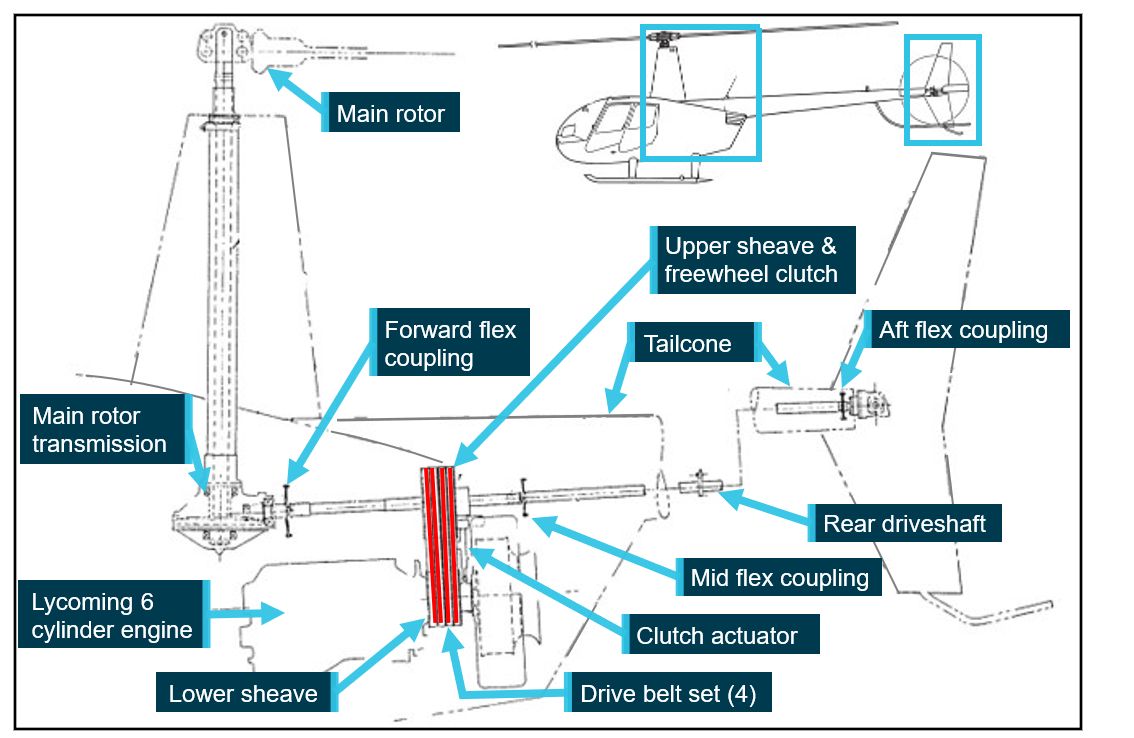
The freewheel clutch in the upper sheave was removed from the airframe for examination. The 2 bearings and sprag clutch were disassembled. All 3 units were visually inspected with no obvious failure or impact damage identified.
The upper sheave centring rod was secure. The upper sheave had scoring marks on the aft face aligning with contact from the centring rod for approximately 75% of the circumference. The scoring not being the full circumference of the sheave was indicative of drive sudden stoppage during contact.
All 4 drive belts were in good condition. On the upper sheave, the drive belts had all jumped forward 2 grooves, with the front belt departing the sheave. On the lower sheave, only the front belt had moved, and only by one pulley groove. This misalignment was consistent with the forward displacement of the engine in the airframe from impact forces with the gully. The front belt was also found turned back on itself and pinched on the left side of the lower sheave (looking airframe forward) consistent with the direction of engine rotation and is a signature that the engine was turning at the time belts jumped off the sheaves. The belt tensioner was at an extension consistent with normal operation, indicating the belts were tensioned and driving the upper sheave prior to the accident sequence.
Hydraulic system
There was evidence of a fine mist of old hydraulic fluid on the rear flex hose, rear servo and reservoir, however, there was no recent extensive or obvious fluid on the transmission deck or fuel tank housing directly behind these items. The hydraulic filter and filter bowl was found to be free of contamination, and the fluid level was appropriate.
Once removed, the hydraulic pump could be freely rotated and its drive spline displayed no damage. The corresponding drive also operated with main transmission rotation. The pump was then operated by a powered drive source and all 3 servo actuators were observed to be functional.
Fuel system
Approximately 55 L of usable low-lead aviation fuel was drained via the gascolator. The drained fuel was visibly clear of contaminants and tested negative to the presence of water. The fuel tanks were visually inspected and also found free of contamination.
Engine
The engine exhibited signs of forward inertial displacement in its mounts. The engine crankshaft rotated against cylinder compressions. With spark plugs removed, the engine was able to be rotated freely by hand, both with the direction of rotation, and against it.
The oil level was found to be at around 6 quarts (5.7 L).20 During inspection of the engine cylinders, a small quantity of engine oil was seen to flow from cylinders 1 and 5. Additionally, a small amount of oil was found in the induction manifold. Considering the helicopter was resting on its left side for a number of days, it was surmised that engine oil had flowed into the left bank of cylinders (the odd numbered cylinders) and a small amount would pass the piston rings, then flow into the inlet and exhaust ports when the engine was rotated by investigators.
Engine cylinder compression checks on a cold engine using a differential pressure tester (reference pressure 80 psi), were completed (Table 3).21 Differential pressure on all cylinders were within manufacturer’s specifications, with the exception of cylinder No 6.
Table 3: Cold cylinder compression test results
| Cylinder number | 1 | 2 | 3 | 4 | 5 | 6 |
| Differential pressure (psi) | 68 | 69 | 62 | 68 | 69 | 20 |
The lower differential pressure value on cylinder No 6 was likely due to the exhaust valve not fully closing. However, as the engine had been transported and rotated prior to the testing, the lower compression was not necessarily reflective of the condition during the accident flight. Further, a review of the maintenance records found that all cylinder compressions were satisfactory across several previous periodic inspections.
The engine starter motor pinion had been found engaged with the engine ring gear. When the engine was manually rotated by hand, the starter motor pinion disengaged and retracted. The pinion and ring gear teeth were in good condition. The engine’s rotational speed, even at idle, is faster than when driven by the starter motor. The starter motor electrical circuit design also has various lockout features. Regardless, with the engine running, the starter motor would always be disengaged even if electrical power was applied to the motor. It was concluded the starter motor was probably engaged by an electrical short circuit or by inertial forces acting on the starter solenoid during the impact sequence as the engine and main rotor systems stopped rotating at impact.
The engine air intake system was found to be serviceable. The air filter only had minor contamination, and the induction hose was not collapsed or delaminated, and in good condition.
Ignition system
With the inspection caps removed from each magneto, the internal gears were observed to rotate, indicating that the gear train to the magnetos were intact. The timing for both magnetos was correct, and the synchronisation was found to be less than the required ±1°.
Visual inspection identified all spark plugs and corresponding leads were secure. There was no obvious damage to the spark plugs but some exhibited oil contamination from when the aircraft was on its side post‑accident.
Agricultural spray system
Both chemical tanks were breached and released their contents, which pooled below the wreckage. While the pooled amounts were not able to be measured, it was evident that the tanks had contained a sizable amount of fluid at the time of the accident. Both spray booms were fractured close to their inboard ends. The quick acting valve was found in the ‘SPRAY ON’ position.
Post-onsite testing
Engine test runs
In April 2025, the engine was removed from the airframe and mounted to an engine test run stand and fitted with a test club propeller.22 The engine mechanical fuel pump was found to operate correctly with a pulsing flow at the outlet of the fuel pump when the engine was cranked on the starter. Oil residues (attributed to the engine being positioned on its side following the accident) were washed from the 3 left side lower bank spark plugs.
Within 3 rotations, the engine was observed to run roughly for about 10 seconds then it settled during warm‑up to run smoothly at 1,200 revolutions per minute (rpm). Magneto checks23 were conducted and an excessive reduction in engine rpm was observed when selected to the ‘RIGHT’ magneto. The fault was traced to a defect in the high‑tension lead of the No 4 cylinder lower spark plug. It could not be determined whether the defect was the result of the accident or a pre‑existing condition. The ignition switch, which includes magneto selection, tested correctly in all positions.
After engine warm up, the engine reached the desired static rpm with a fully open throttle.24 The test showed that the engine was capable of providing full power to the helicopter drive system.
RPM governor
In August 2025, the engine governor controller unit was sent to the RHC facilities in the United States for testing. An accredited representative from the National Transportation Safety Board supervised the testing on behalf of the ATSB. The unit was connected to a test bench that replicated being installed in a helicopter. The unit was tested using production test equipment and RHC reported that it worked without fault through several operational cycles and met new production performance specifications.
Fuel system flow and pressure testing
The auxiliary fuel pump, pressure relief valve, auxiliary pump warning light switch, and gascolator vacuum switch were removed from the wreckage for additional testing by the ATSB with no faults found.
Sources and submissions
Sources of information
The sources of information during the investigation included:
- the chief pilot of Riverina Helicopters
- employees of Riverina Helicopters
- Civil Aviation Safety Authority
- Bureau of Meteorology
- Wunderground.com
- New South Wales Police Force
- Robinson Helicopter Company
- recorded data from a flight tracking device
- recorded data from an agricultural spray GPS unit on the aircraft.
References
ATSB. (2005). Dangerous distraction: An examination of accidents and incidents involving pilot distraction in Australia between 1997 and 2004 (B2004/0324). https://www.atsb.gov.au/publications/research-and-analysis-report/2022/aviation/dangerous-distraction-examination-accidents
ATSB. (2011). Avoidable Accidents No. 2 Wirestrikes involving known wires: A manageable aerial agriculture hazard (AR-2011-028). https://www.atsb.gov.au/publications/avoidable-accidents/2022/aviation/avoidable-accidents-no-2-wirestrikes-involving-known
Canadian Aviation Safety Board. (1985). Light Bulb Filament Impact Dynamics Study (TP6254E). Aviaiton Safety Engineering Branch, Canadian Aviation Safety Board, Ottawa, Ontario, Canada.
CASA. (2012). Helicopter Flight Instructor Manual (3 ed.). https://www.casa.gov.au/sites/default/files/2021-11/flight-instructor-manual-helicopter.pdf
Chappelow, J. W. and Smith, P.R. (1999). Pilot Intervention Times in Helicopter Emergencies (paper 99001). London: United Kingdom Civil Aviation Authority.
Federal Aviation Administration. (2019). Helicopter Flying Handbook (FAA-H-8083-21B). U.S. Department of Transportation, Federal Aviation Administration, Oklahoma City, OK, USA.
Submissions
Under section 26 of the Transport Safety Investigation Act 2003, the ATSB may provide a draft report, on a confidential basis, to any person whom the ATSB considers appropriate. That section allows a person receiving a draft report to make submissions to the ATSB about the draft report.
A draft of this report was provided to the following directly involved parties:
- Riverina Helicopters
- employees of Riverina Helicopters
- Civil Aviation Safety Authority
- Robinson Helicopter Company
- United States National Transportation Safety Board.
Submissions were received from:
- Riverina Helicopters
- an employee of Riverina Helicopters
- Civil Aviation Safety Authority
- Robinson Helicopter Company
- United States National Transportation Safety Board.
The submissions were reviewed and, where considered appropriate, the text of the report was amended accordingly.
Purpose of safety investigationsThe objective of an ATSB safety investigation is to improve transport safety through:
In accordance with the TSI Act, the ATSB does not investigate for the purpose of taking administrative, regulatory or criminal action, and cannot apportion blame, assist in determining liability, or, as a general rule, assist in court proceedings. About ATSB reportsATSB safety investigation reports are developed in accordance with ATSB procedures and guidelines, and with regard to applicable international standards and instruments. Reports must include factual material of sufficient weight to support the investigation’s analysis and findings. At all times the ATSB endeavours to balance the use of material that could imply adverse comment with the need to properly explain what happened, and why, in a fair and unbiased manner. An explanation of terminology used in ATSB investigation reports is available here. Publishing informationReleased in accordance with section 25 of the Transport Safety Investigation Act 2003 Published by: Australian Transport Safety Bureau © Commonwealth of Australia 2026 Ownership of intellectual property rights in this publication Unless otherwise noted, copyright (and any other intellectual property rights, if any) in this report publication is owned by the Commonwealth of Australia. Creative Commons licence 
With the exception of the Commonwealth Coat of Arms, ATSB logo, and photos and graphics in which a third party holds copyright, this report is licensed under a Creative Commons Attribution 4.0 International licence. The CC BY 4.0 licence enables you to distribute, remix, adapt, and build upon our material in any medium or format, so long as attribution is given to the Australian Transport Safety Bureau. Copyright in material obtained from other agencies, private individuals or organisations, belongs to those agencies, individuals or organisations. Where you wish to use their material, you will need to contact them directly. |
- ^ The flight was conducted under Part 138 of the Civil Aviation Safety Regulations (aerial work operations).
- ^ Loader: the term used to denote ground support personnel whose functions include mixing chemicals, loading, and dispatching the aircraft for the purposes of aerial application.
- ^ A mountain flying rating is not a rating classification available under the Civil Aviation Safety Regulations Part 61 licencing system but is a valid rating in some countries, including New Zealand.
- ^ Cyclic: a primary helicopter flight control that is similar to an aircraft control column. Cyclic input tilts the main rotor disc, varying the attitude of the helicopter and hence the lateral direction.
- ^ Collective: a primary helicopter flight control that simultaneously affects the pitch of all blades of a lifting rotor. Collective input is the main control for vertical velocity.
- ^ Velocity never exceed: An airspeed limitation on an aircraft above which structural damage to the aircraft or equipment may occur.
- ^ Load factor is the ratio of the lift being generated to an aircraft’s weight. Since the load factor is the ratio of two forces, it is dimensionless.
- ^ Weather Underground: http://wunderground.com is a community-based weather information network designed to provide public access to personal weather stations.
- ^ Cloud cover: in aviation, cloud cover is reported using words that denote the extent of the cover – ‘few’ indicates that up to a quarter of the sky is covered and ‘broken’ indicates that more than half to almost all the sky is covered.
- ^ Chip level recovery: involves removing (desoldering) the memory integrated circuit (IC) package from the circuit board of the device and, using dedicated hardware and software tools, reading an image of the IC contents directly from the IC.
- ^ The tail skid is a tube extending from the base of the lower vertical stabiliser, intended to alert the pilot to a tail low attitude, which has the potential to damage the tail rotor.
- ^ The tail guard provides some protection to the tail rotor from coming into contact with obstacles. It was also painted red and white to alert people to the presence of the tail rotor, which could be difficult to see when operating.
- ^ The teeter stops are polyurethane blocks mounted in stainless steel brackets and affixed to the mast. They protect the mast from blade spindle contact with the mast during minor rotor head teetering.
- ^ The way main rotor blades bend during an impact with terrain can give indications of the main rotor system energy. Downward and rearward bending is a sign of low rotor energy.
- ^ Flexible couplings are located at the main rotor gearbox input and at each end of the tail rotor drive shaft.
- ^ RHC advised this damage can occur during a hard vertical impact when the engine is operating, and the upper and lower sheaves are forced closer together.
- ^ Test club propeller: a smaller diameter blunt propeller designed to be mounted on an aircraft engine shaft to absorb engine power and provide cooling air during testing.
- ^ Stall: occurs when airflow separates from the wing’s upper surface and becomes turbulent. A stall occurs at high angles of attack, typically 16° to 18°, and results in reduced lift and increased drag.
- ^ Chip detector: a magnetic device used to gather chips of metal from engine or transmission oil to provide early warning to maintenance personnel of impending engine failure. Depending on the installation, it can be linked to an in-cockpit indicating light to provide immediate advice to aircrew.
- ^ The Pilot’s Operating Handbook stated minimum oil quantity for take-off as 7 quarts (6.6 L).
- ^ The manufacturer’s procedures stated the differential pressure testing be carried out with the engine near operating temperature for optimal measurements.
- ^ Test club propeller: is a smaller diameter blunt propeller designed to be mounted on an aircraft engine shaft to absorb engine power and provide cooling air during testing.
- ^ Magneto check: aircraft have 2 magnetos each firing one spark plug in each engine cylinder. Both magnetos are selected and function during normal operations. Conducted by the pilot during preflight checks on the ground, the magneto check runs the engine for a short period on one magneto only, thereby enabling the detection of faults that may be masked by the operation of the other magneto. The associated normal ‘magneto drop’ of 25–50 rpm is the result of a loss of combustion efficiency from running on one spark plug rather than the normal 2 per cylinder, and variations from this result usually indicate a defect somewhere in the ignition system.
- ^ Static rpm is the revolutions per minute of the engine at full throttle and is used to provide a measure of engine performance.
Preliminary report
Report release date: 20/02/2025
| This preliminary report details factual information established in the investigation’s early evidence collection phase, and has been prepared to provide timely information to the industry and public. Preliminary reports contain no analysis or findings, which will be detailed in the investigation’s final report. The information contained in this preliminary report is released in accordance with section 25 of the Transport Safety Investigation Act 2003. |
The occurrence
On 4 December 2024, at about 0530 local time, a Robinson R44 Raven II helicopter, registered VH-XIX, departed from Griffith Regional Airport, New South Wales to conduct a ferry flight to a property approximately 50 km east of Young. Onboard were the operator’s Griffith base manager and a loader[1] (acting as pilot for the ferry flight). They arrived at a paddock on the farm at 0744, landing next to a chemical tank. They were met by the farm manager of the property, and the pilot for the day, who had arrived shortly before by motor vehicle from Crookwell. The tasking for the day was the aerial application of herbicide across 2 properties, to be conducted under Part 138 of the Civil Aviation Safety Regulations.
The base manager, pilot, loader and farm manager discussed the day’s work and then prepared the helicopter for spraying operations, including refuelling the helicopter, attaching the spray booms and mixing herbicide. At 0912, the pilot and base manager, who had sprayed the paddocks previously, flew the helicopter on a reconnaissance mission of the intended paddocks returning 5 minutes later.
The helicopter was loaded with herbicide and, at 0921, the pilot departed for application of the first load of the day. The pilot applied 10 loads consecutively. Each load took around 10 minutes to apply, with the pilot returning for the helicopter to be replenished with herbicide, and fuel as required, before immediately departing again.
Toward the end of this activity, the farm manager from an adjacent property arrived and discussed the task for the second property with the base manager. During this time, the pilot departed for the 11th and planned final load of the job on the first farm. After 15 minutes, the base manager realised the helicopter should have returned and tried, unsuccessfully, to contact the pilot via ultra‑high frequency radio in the work vehicle. The base manager then checked a flight tracking application on their mobile phone that showed the helicopter had not moved from its last indicated location for a couple of minutes. The base manager and second farm manager departed in the farmer’s vehicle toward the intended spray area, while the loader stayed to monitor the work vehicle’s radio.
Prior to the flight, high tension powerlines that ran through the middle of the intended spray area had been identified as a hazard to the operation. The base manager and farmer headed to a location near the powerlines but could not find the helicopter. After further searching, they located the wreckage of the helicopter in a gully. They made their way down to the helicopter and found the pilot had exited the helicopter and moved approximately 1 m away but was seriously injured. Emergency services attended, however, the pilot succumbed to their injuries.
Context
Pilot information
The pilot held a commercial pilot licence (helicopter) with a single-engine helicopter class rating. The pilot had 1,035 hours total aeronautical experience, of which 637 hours were on the R44 type. Most of the pilot’s recent flying had been on the R44. The pilot also held a gas turbine design feature endorsement, and numerous piston and turbine type ratings. In addition, the pilot held aerial application, low-level, and sling operational ratings. The pilot had spent approximately 3 years flying agricultural helicopters in New Zealand where they also obtained a mountain flying operational rating.[2]
The pilot held a valid class 1 aviation medical certificate and was reported as appearing well rested and fully alert for the flight.
Helicopter information
The Robinson R44 Raven II is a 4-seat helicopter, powered by a single Textron Lycoming IO‑540‑AE1A5 piston engine driving a 2 blade semi-rigid main rotor system and 2 blade tail rotor system. The helicopter was manufactured in the United States in 2003 and first registered in Australia in May 2003. It was issued with a special certificate of airworthiness in the restricted category in January 2017. The certificate permitted VH-XIX to be used in agricultural operations and aerial surveying, among other similar operations.
A periodic inspection and minor maintenance tasks were carried out on 30 October 2024. At the time of the accident, the helicopter had accumulated about 5,820 hours. The helicopter was configured with an agricultural spray system, which consisted of 2 fibreglass chemical tanks, a flexible hose and stainless-steel tubing distribution system, a petrol‑powered water pump, valving systems, and 2 cantilevered carbon fibre spray booms, one each on either side of the fuselage.
Meteorological information
The closest Bureau of Meteorology weather station was at Young Airport, 50 km to the west of the accident site, which reported winds of 7–8 kt from the north-west and a temperature of 28°C in 30‑minute windows around the time of the accident. Cloud cover[3] was measured as few at 3,500 ft and broken at 4,800 ft. Cowra weather station, 53 km to the north, reported winds of 4–7 kt varying between northerly and westerly and a temperature around 28–30°C. Cloud cover was not recorded.
Wunderground.com is a weather network designed to provide public access to community weather stations. A weather station at Boorowa, 14 km south-south-west of the accident site, reported wind, in 5-minute windows, of 6.8 km/h (3.6 kt) gusting to 7.3 km/h (3.9 kt), from the south‑south‑west and a temperature of 19°C around the time of the accident. Another weather station at Frogmore, 8 km to the north-east, reported wind of 0.9 km/h (0.5 kt) gusting to 1.9 km/h, (1.0 kt) from the north-north-west, with a temperature of 22°C.
Wreckage and impact information
The wreckage was located about 1,200 m south-south-east of the base of operations for that day, in a steep gully towards the southern end of the target spray area. The area was in hilly terrain and contained high dry grass with scattered large alive and dead eucalyptus trees.
The first items in the debris trail were the stabiliser assembly, right side carbon fibre spray boom and broken branches. These items were located next to a dead tree, with freshly broken branches on one side, near the top (Figure 1).
The helicopter was orientated on its left side and facing the direction of the travel. The main fuselage had sustained minor impact damage, with the exception of the cabin, which was significantly disrupted. Outboard sections of both main rotor blades had been liberated during the accident sequence. For the tail rotor assembly, one liberated tail rotor blade, and sections of the tailcone were scattered to the right of the ground path. Despite the disruption, all components of the helicopter were accounted for.
Two ground scars, consistent with the landing gear skids, were located between the tree and the wreckage in the gully. The ground marks were indicative of the upright helicopter sliding along the ground, prior to reaching the edge of the gully.
Figure 1: Wreckage site
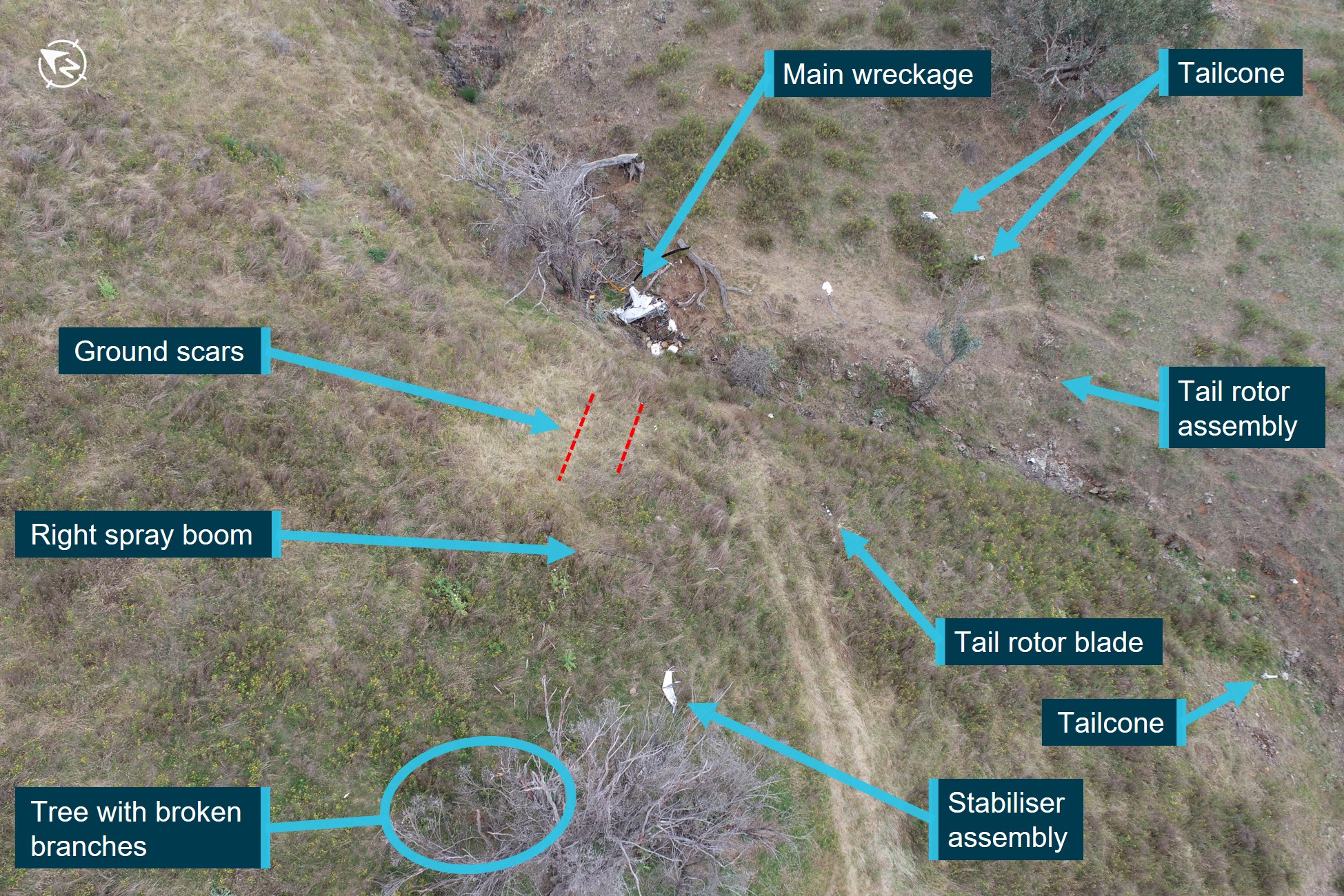
Note: Ground scars from the helicopter skids are highlighted red.
Source: ATSB
While the ATSB conducted a preliminary examination of the wreckage at the site, due to access restrictions, the wreckage was relocated to a secure facility for detailed examination. This further examination identified:
- no evidence of pre-impact defects with the flight controls or structure
- approximately 55 L of low-lead aviation fuel in the fuel system, which was visibly clear of contaminants and tested negative to the presence of water
- the engine was able to be rotated, contained oil and there were no obvious defects upon external examination
- the fuel gascolator, engine oil, hydraulic fluid, and intake air filters were clear of particles
- the air intake hose had no signs of collapse, delamination or restriction
- the main and tail rotor gearboxes contained oil, with no metal contamination on the respective chip detectors.[4]
Recorded data
The helicopter had analogue instrumentation and did not record any flight or engine parameters.
A SpotTrace device was carried inside the helicopter, which broadcast the device’s position every couple of minutes when movement was detected. Anybody with access rights could see the position of the tracking device using a computer or mobile phone application. The SpotTrace device broadcast the position of the helicopter from shortly after take‑off that morning, until the helicopter stopped moving, in a position coincident with the collision with terrain.
To assist with aerial application tasks, the helicopter was also fitted with a Tracmap GPS guidance device with recording capability. The flight tracks from the day of the accident were recorded and downloaded, including information about when the spray valve was open (Figure 2 in orange), up until a couple of minutes before the accident. Due to the sudden removal of power, some data collected towards the end of the flight was not able to be downloaded. A chip level recovery[5] was conducted from the device but it contained no further information.
Figure 2: Tracmap spray runs completed
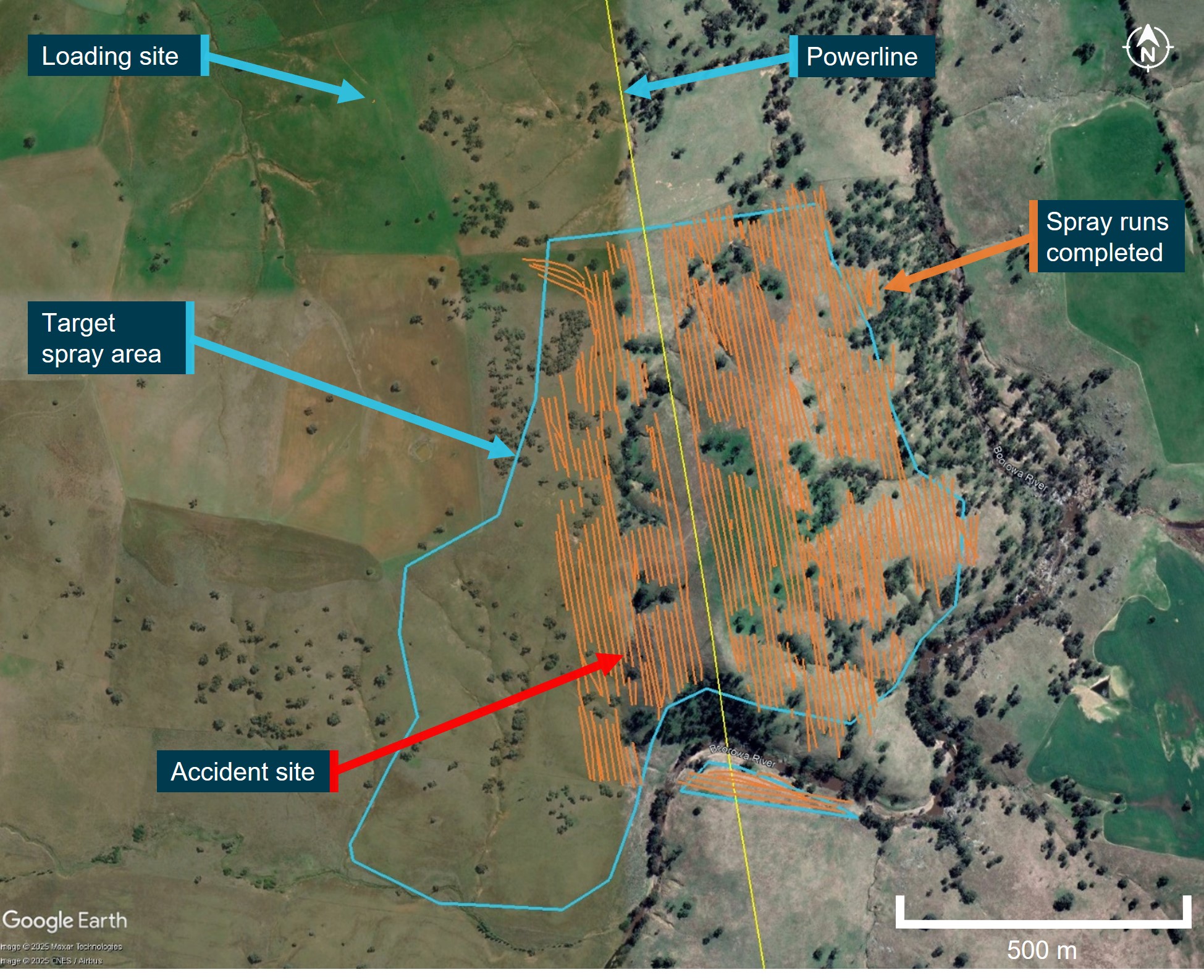
Note: The last few minutes of the flight and spray runs were not recorded.
Source: Google Earth Pro, annotated by the ATSB using operator and onboard data sources
Further investigation
To date, the ATSB has conducted witness interviews, collected documentation and recorded data, and examined the site and wreckage.
The investigation is continuing and will include review and examination of:
- witness accounts
- recorded data
- the wreckage
- helicopter documentation
- operational records
- pilot medical records, qualifications and experience.
A final report will be released at the conclusion of the investigation. Should a critical safety issue be identified during the course of the investigation, the ATSB will immediately notify relevant parties so appropriate and timely safety action can be taken.
Acknowledgements
The ATSB would like to acknowledge the assistance of the Young branch of the NSW Police Force during the onsite stages of the investigation.
Purpose of safety investigationsThe objective of a safety investigation is to enhance transport safety. This is done through:
It is not a function of the ATSB to apportion blame or provide a means for determining liability. At the same time, an investigation report must include factual material of sufficient weight to support the analysis and findings. At all times the ATSB endeavours to balance the use of material that could imply adverse comment with the need to properly explain what happened, and why, in a fair and unbiased manner. The ATSB does not investigate for the purpose of taking administrative, regulatory or criminal action. TerminologyAn explanation of terminology used in ATSB investigation reports is available here. This includes terms such as occurrence, contributing factor, other factor that increased risk, and safety issue. Publishing informationReleased in accordance with section 25 of the Transport Safety Investigation Act 2003 Published by: Australian Transport Safety Bureau © Commonwealth of Australia 2025 
Ownership of intellectual property rights in this publication Unless otherwise noted, copyright (and any other intellectual property rights, if any) in this report publication is owned by the Commonwealth of Australia. Creative Commons licence With the exception of the Commonwealth Coat of Arms, ATSB logo, and photos and graphics in which a third party holds copyright, this report is licensed under a Creative Commons Attribution 4.0 International licence. The CC BY 4.0 licence enables you to distribute, remix, adapt, and build upon our material in any medium or format, so long as attribution is given to the Australian Transport Safety Bureau. Copyright in material obtained from other agencies, private individuals or organisations, belongs to those agencies, individuals or organisations. Where you wish to use their material, you will need to contact them directly. |
[1] Loader: the term used to denote ground support personnel whose functions include assisting with mixing chemicals, loading and dispatching the aircraft.
[2] A mountain flying rating is not a rating classification available under the Civil Aviation Safety Regulations Part 61 licencing system but is a valid rating in some countries.
[3] Cloud cover: in aviation, cloud cover is reported using words that denote the extent of the cover – ‘few’ indicates that up to a quarter of the sky is covered, ‘scattered’ indicates that cloud is covering between a quarter and a half of the sky, ‘broken’ indicates that more than half to almost all the sky is covered, and ‘overcast’ indicates that all the sky is covered.
[4] Chip detector: a magnetic device used to gather chips of metal from engine or transmission oil to provide early warning to maintenance personnel of impending engine failure. Depending on the installation, it can be linked to an in-cockpit indicating light to provide immediate advice to aircrew.
[5] Chip level recovery: involves removing (desoldering) the memory integrated circuit (IC) package from the circuit board of the device and, using dedicated hardware and software tools, reading an image of the IC contents directly from the IC.
Occurrence summary
| Investigation number | AO-2024-062 |
|---|---|
| Occurrence date | 04/12/2024 |
| Occurrence time and timezone | 1138 Australian Eastern Daylight saving Time |
| Location | 50 km east of Young Airport |
| State | New South Wales |
| Report release date | 17/11/2026 |
| Report status | Final |
| Investigation type | Occurrence Investigation |
| Investigation phase | Final report: Dissemination |
| Investigation status | Completed |
| Mode of transport | Aviation |
| Aviation occurrence category | Collision with terrain |
| Occurrence class | Accident |
| Highest injury level | Fatal |
Aircraft details
| Manufacturer | Robinson Helicopter Co |
|---|---|
| Model | R44 II |
| Registration | VH-XIX |
| Serial number | 10073 |
| Aircraft operator | Riverina Rotor Work Pty Ltd trading as Riverina Helicopters |
| Sector | Helicopter |
| Operation type | Part 138 Aerial work operations |
| Activity | General aviation / Recreational-Aerial work-Agricultural spreading / spraying |
| Departure point | 50 km east of Young Airport, New South Wales |
| Destination | 50 km east of Young Airport, New South Wales |
| Injuries | Crew - 1 (fatal) |
| Damage | Destroyed |