

Final report
Report release date: 28/09/2016
What happened
On 20 July 2016, the pilot of a Schweizer 269C helicopter, registered VH-NTZ, conducted aerial spraying operations near Deloraine, Tasmania.
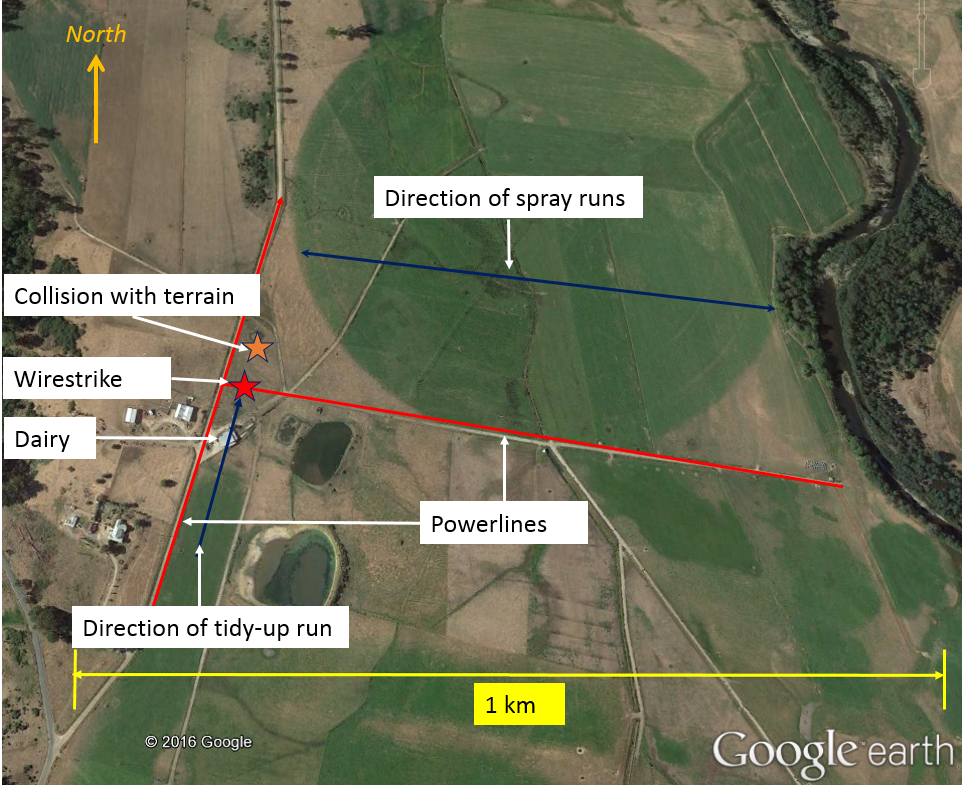
The pilot completed spraying one area, and prior to commencing spraying another, overflew it to assess the site. During that inspection, the pilot sighted two sets of powerlines, one running approximately north-south, and the other branching off to the east. Based on the location of the powerlines and the wind, which was a light northerly, the pilot elected to spray the paddock in an east-west direction (Figure 1). The helicopter was operating north of the powerline running east-west, and in each run, was overflying and remaining clear of the powerlines at the western end of the paddock.
Figure 1: Area of operations showing powerlines
Source: Pilot
At about 1230 Eastern Standard Time (EST), after completing two spray loads, the pilot tracked south over the powerline and turned to conduct a tidy-up run to the north along the road and powerlines running north-south.
After overflying a dairy building, the helicopter descended as the pilot intended to commence spraying. However, the helicopter struck the powerlines running east-west and subsequently collided with terrain.
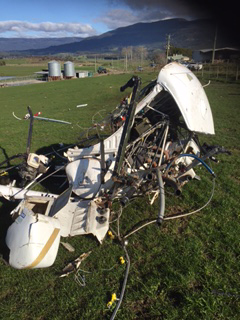
The pilot, who was the sole occupant of the helicopter, sustained serious injuries and the helicopter was destroyed (Figure 2).
Figure 2: Accident site
Source: Tasmania Police
Pilot comments
Prior to commencing the day’s operations, the pilot had obtained a map of the area and identified hazards including the powerlines. During the aerial inspection of the property prior to commencing spraying, the pilot had sighted those hazards.
The pilot commented that in the tidy-up run they should have been thinking ‘over the dairy and over the powerlines then descend’, but had momentarily forgotten about the powerlines and descended after passing over the dairy. Usually, they overflew the whole paddock again to check for hazards before commencing a tidy-up run, but had omitted to do it on this occasion.
The pilot was wearing a helmet at the time of the accident. The helmet was found some distance from the wreckage and was badly damaged.
Safety message
ATSB research indicates that in 63 per cent of reported wirestrike incidents, pilots were aware of the position of the wire before they struck it.
The Aerial Application Association of Australia (AAAA) suggests a way to keep focus is to ask yourself:
- Where is the wire now?
- What do I do about it?
- Where am I in the paddock?
For further risk management strategies for agricultural operations, refer to the AAAA Aerial application pilots manual.
The ATSB publication Avoidable Accidents No. 2 – Wirestrikes involving known wires: A manageable aerial agricultural hazard, explains strategies to help minimise the risk of striking wires while flying.
US military research[1] analysed helicopter accidents that were at least partially survivable. It found that occupants not wearing a protective helmet were significantly more likely to sustain severe and fatal head injuries. The US National Transportation Safety Board (NTSB) also acknowledged that the use of head protection can reduce the risk of injury and death. The NTSB issued Safety Recommendation A-88-009, recommending that crewmembers of emergency medical services helicopters wear protective equipment including helmets.
The ATSB investigation report (AO-2014-058) into an accident involving a Robinson R22 helicopter where the pilot sustained a serious head injury, reminded pilots and operators to consider the benefit of occupants wearing helmets to reduce the risk of head injury.
Aviation Short Investigations Bulletin- Issue 52
About this reportDecisions regarding whether to conduct an investigation, and the scope of an investigation, are based on many factors, including the level of safety benefit likely to be obtained from an investigation. For this occurrence, a limited-scope, fact-gathering investigation was conducted in order to produce a short summary report, and allow for greater industry awareness of potential safety issues and possible safety actions. Publishing informationReleased in accordance with section 25 of the Transport Safety Investigation Act 2003 Published by: Australian Transport Safety Bureau © Commonwealth of Australia 2016 
Ownership of intellectual property rights in this publication Unless otherwise noted, copyright (and any other intellectual property rights, if any) in this report publication is owned by the Commonwealth of Australia. Creative Commons licence With the exception of the Coat of Arms, ATSB logo, and photos and graphics in which a third party holds copyright, this publication is licensed under a Creative Commons Attribution 3.0 Australia licence. Creative Commons Attribution 3.0 Australia Licence is a standard form licence agreement that allows you to copy, distribute, transmit and adapt this publication provided that you attribute the work. The ATSB’s preference is that you attribute this publication (and any material sourced from it) using the following wording: Source: Australian Transport Safety Bureau Copyright in material obtained from other agencies, private individuals or organisations, belongs to those agencies, individuals or organisations. Where you wish to use their material, you will need to contact them directly. |
__________
Occurrence summary
| Investigation number | AO-2016-081 |
|---|---|
| Occurrence date | 20/07/2016 |
| Location | Devonport Airport, SE 45 km (Deloraine) |
| State | Tasmania |
| Report release date | 28/09/2016 |
| Report status | Final |
| Investigation level | Short |
| Investigation type | Occurrence Investigation |
| Investigation status | Completed |
| Mode of transport | Aviation |
| Aviation occurrence category | Wirestrike |
| Occurrence class | Accident |
| Highest injury level | Serious |
Aircraft details
| Manufacturer | Schweizer Aircraft Corp |
|---|---|
| Model | 269C |
| Registration | VH-NTZ |
| Serial number | S1405 |
| Sector | Piston |
| Operation type | Aerial Work |
| Departure point | Unknown |
| Damage | Destroyed |