

Final report
Report release date: 07/10/2015
What happened
On 27 July 2015, the pilot of an Eagle DW1 aircraft, registered VH-FHP, was conducting aerial spraying operations on a property about 77 km southeast of Townsville, Queensland. The pilot completed aerial spraying of two paddocks, and then loaded the aircraft with about 450 L of chemical (about half capacity), and half a tank of fuel.
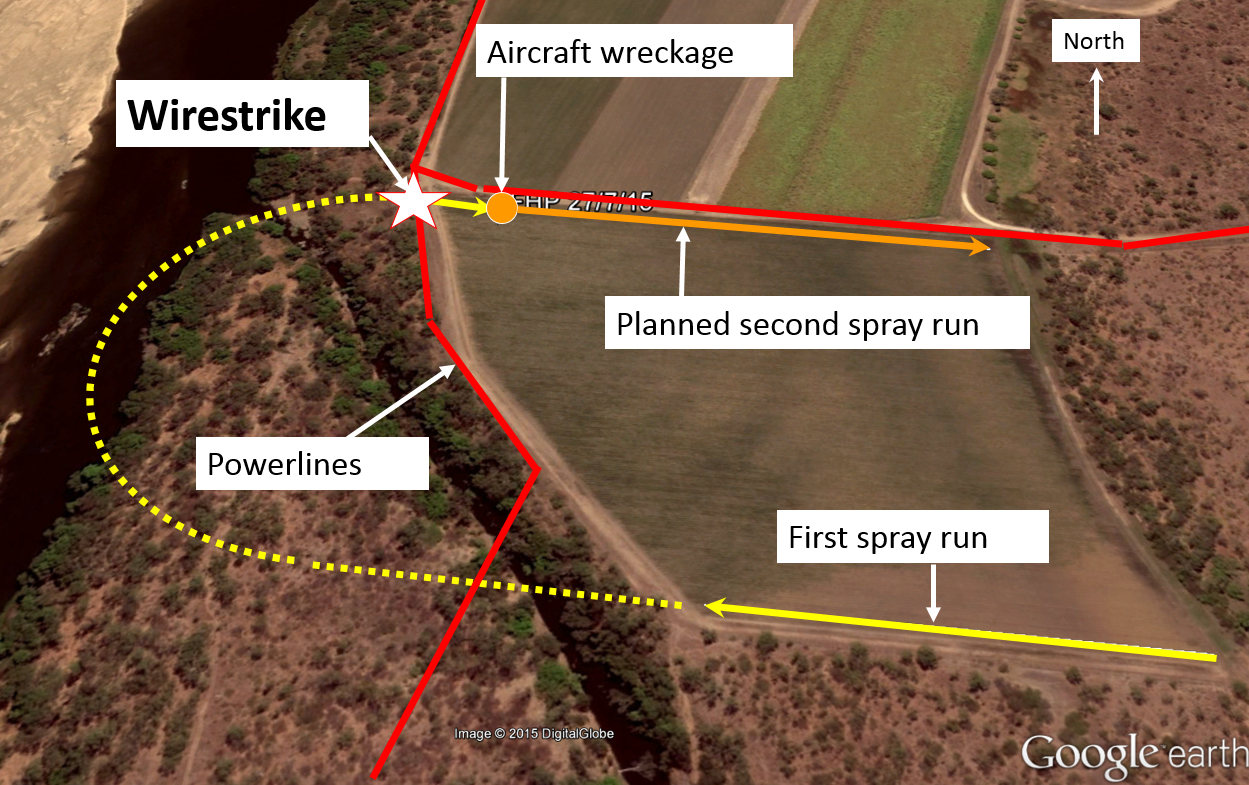
At about 0930 Eastern Standard Time (EST), the pilot took off to spray the third paddock for that day. The pilot overflew the paddock and identified two sets of powerlines. The pilot formed a plan to spray the paddock using a racetrack pattern and flying it in a clockwise direction. One set of powerlines ran parallel to the spray direction, and the other ran across it at the western end. There was a line of trees along the western powerline, which obscured vision of the power poles.
The pilot completed the first spray run towards the western powerline, overflew it, and then turned to line up for the second spray run (Figure 1). A small area of about 30 m of trees had been cleared for a pump installation and the clearing was in line with the start of the second spray run. The pilot noted the powerline ahead, but then diverted their attention to the other powerline, running parallel to the direction of flight, and about 5 m off the left wingtip. The pilot also looked inside at the GPS to check the aircraft’s line for the spray run.
Figure 1: Paddock to be sprayed showing powerlines and wirestrike location
Source: Google earth and the pilot of VH-FHP – annotated by the ATSB
The pilot commenced the descent into the paddock through the clearing in the trees and did not see the powerline at that time. As the aircraft descended, the pilot looked up and suddenly sighted the powerline. The pilot elected to push forwards on the controls to make the aircraft descend. The aircraft then struck the powerline above the propeller on the wing struts.
After the aircraft struck the wires, it yawed violently to the left. The pilot used the right rudder to turn the aircraft away from the other powerlines, and the force of the aircraft pulled the transformer off the power pole on the left. The aircraft then yawed to the right. The force broke the power pole on the right and severed the powerline.
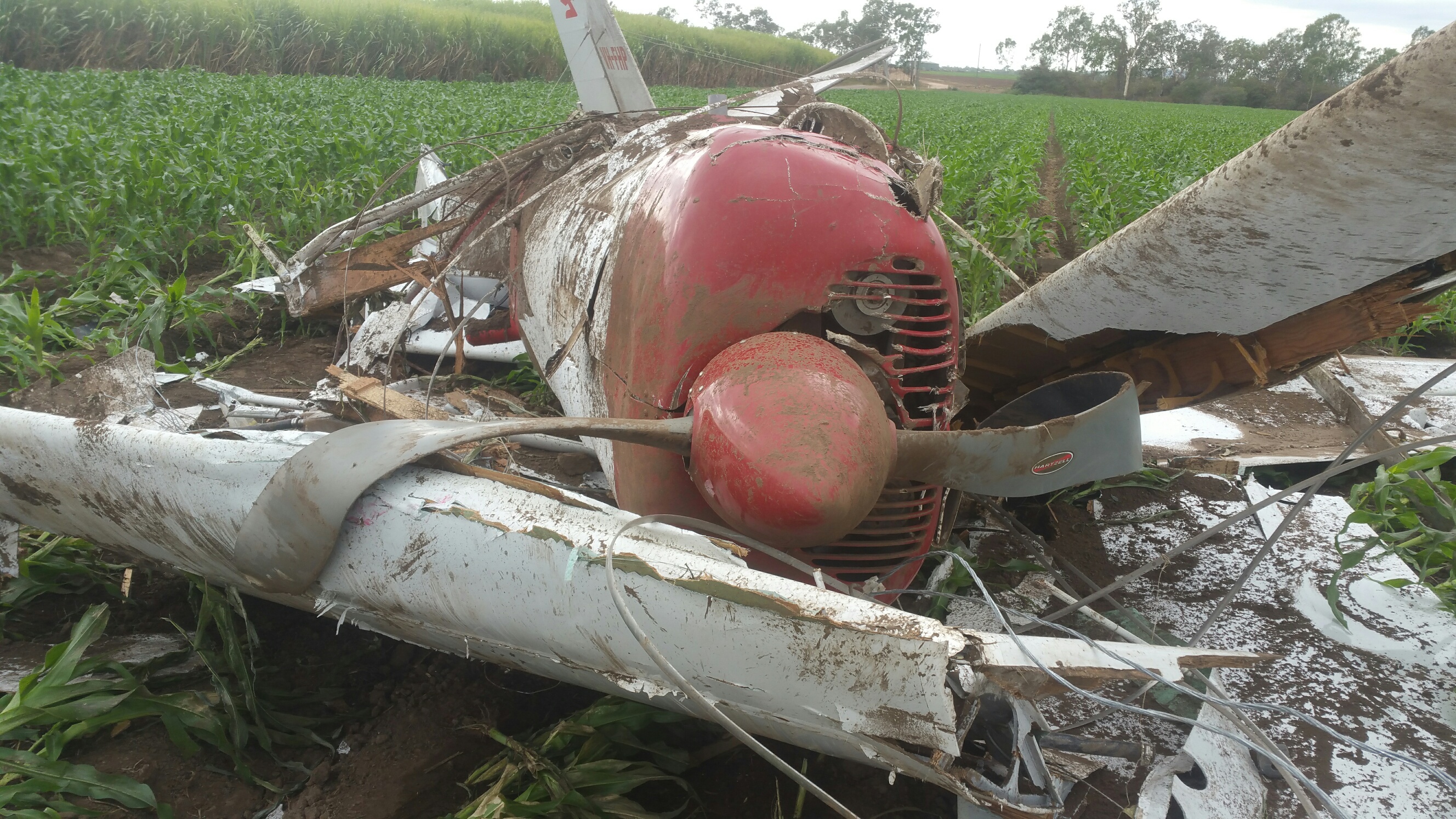
The aircraft decelerated rapidly, and the wires pulled the aircraft towards the ground. The pilot landed the aircraft with the wings level. The landing gear sheared off, the propeller struck the ground and the aircraft ground-looped, coming to rest facing the opposite direction. The pilot sustained minor injuries and the aircraft was destroyed (Figure 2).
Figure 2: VH-FHP at the accident site showing damage to the aircraft and wires
Source: Aircraft operator
Pilot comments
The pilot provided the following comments:
- The pilot had sprayed that paddock once previously, and had used an anticlockwise racetrack pattern. On that occasion, as the power poles were on the eastern side of the trees, they were more visible from that direction.
- The pilot elected to descend after sighting the powerline, to prevent the landing gear from potentially catching on the wires and flipping the aircraft over.
- The aircraft had a wire cutter on the undercarriage and a wire deflector between the top of the wing and the tail, but not on the struts where the wire struck.
- The powerlines were three phase.
Safety message
The pilot was aware of the powerline the aircraft collided with, but did not have it front-of-mind at the start of the spray run. The pilot’s attention was diverted to other powerlines, parallel to the direction of flight, and also inside the aircraft to the GPS. The pilot reported that stating aloud ‘powerlines ahead’, would have helped to maintain awareness of the wires.
The Aerial Agricultural Association of Australia suggests a way to keep focus is to ask yourself:
- Where is the wire now?
- What do I do about it?
- Where am I in the paddock?
For further risk management strategies for agricultural operations, refer to the Aerial Application Pilots Manual.
The ATSB research report Aerial application safety: 2014-2015 year in review, stated that aerial application operations have a high accident rate relative to other aviation sectors. These operations involve inherent risks. Those risks include low-level flying, high workloads and obstacles such as powerlines. More than half of the total accidents and serious incidents over the past 10 years were wirestrikes.
The report also stated that it is important to constantly monitor the environment, so the hazards that were identified in pre-planning can be recognised and avoided. If a pilot is not specifically looking for a hazard, it is unlikely they will notice it.
The ATSB investigated a similar accident, involving a Robinson R66 helicopter. A copy of that report is available here: AO-2014-142.
Read more about: Wirestrikes involving known wires: A manageable aerial agriculture hazard
Wirestrike involving known wires: A manageable aerial agriculture hazard
Aviation Short Investigations Bulletin - Issue 43
About this reportDecisions regarding whether to conduct an investigation, and the scope of an investigation, are based on many factors, including the level of safety benefit likely to be obtained from an investigation. For this occurrence, a limited-scope, fact-gathering investigation was conducted in order to produce a short summary report, and allow for greater industry awareness of potential safety issues and possible safety actions. Publishing informationReleased in accordance with section 25 of the Transport Safety Investigation Act 2003 Published by: Australian Transport Safety Bureau © Commonwealth of Australia 2015 
Ownership of intellectual property rights in this publication Unless otherwise noted, copyright (and any other intellectual property rights, if any) in this report publication is owned by the Commonwealth of Australia. Creative Commons licence With the exception of the Coat of Arms, ATSB logo, and photos and graphics in which a third party holds copyright, this publication is licensed under a Creative Commons Attribution 3.0 Australia licence. Creative Commons Attribution 3.0 Australia Licence is a standard form licence agreement that allows you to copy, distribute, transmit and adapt this publication provided that you attribute the work. The ATSB’s preference is that you attribute this publication (and any material sourced from it) using the following wording: Source: Australian Transport Safety Bureau Copyright in material obtained from other agencies, private individuals or organisations, belongs to those agencies, individuals or organisations. Where you wish to use their material, you will need to contact them directly. |
Occurrence summary
| Investigation number | AO-2015-087 |
|---|---|
| Occurrence date | 27/07/2015 |
| Location | 150 km SE Townsville |
| State | Queensland |
| Report release date | 07/10/2015 |
| Report status | Final |
| Investigation level | Short |
| Investigation type | Occurrence Investigation |
| Investigation status | Completed |
| Mode of transport | Aviation |
| Aviation occurrence category | Wirestrike |
| Occurrence class | Accident |
| Highest injury level | Minor |
Aircraft details
| Manufacturer | Eagle Aircraft Australia |
|---|---|
| Model | DW-1 |
| Registration | VH-FHP |
| Serial number | DW-1-0027-81 |
| Sector | Piston |
| Operation type | Aerial Work |
| Damage | Destroyed |