

Final report
Report release date: 27/08/2015
What happened
On 19 May 2015, the pilot of a Beech A36 aircraft, registered VH-ANX, conducted pre-flight preparations for a private flight from Bunbury Airport to Wongan Hills aeroplane landing area (ALA), Western Australia (Figure 1). The pilot assessed that based on the weather forecast, they would be able to conduct the flight in visual meteorological conditions (VMC).[1] The pilot submitted a flight plan for the flight under the visual flight rules (VFR).[2] The pilot planned to track via Northam ALA at 3,500 ft above mean sea level (AMSL), in accordance with VFR cruise altitudes. The pilot also planned to remain clear of Perth air traffic control zone. At about 1525 Western Standard Time (WST), the aircraft departed from Bunbury, with full fuel on board.
Figure 1: The pilot’s planned route from Bunbury to Wongan Hills via Northam (red) and the approximate actual track, via York (purple)
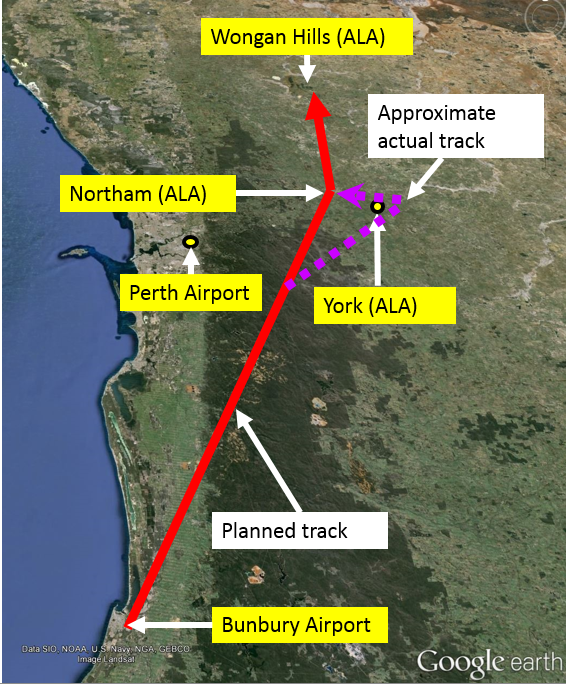
Source: Google earth annotated by ATSB
When approaching abeam Perth, the pilot observed significant cloud in the Perth area. The pilot reported seeing cloud to the left and right, but could see a clear path ahead. They then descended to about 3,000 ft to remain clear of cloud, and continued on the planned route.
When about 10 NM south-west of York ALA, the pilot observed the cloud start to close in, and build to the west. The pilot made multiple diversions to the right of the planned track, but the cloud continued to close in. The pilot then commenced turning back, but the cloud had closed in behind the aircraft. The pilot climbed the aircraft to 3,500 ft and elected to enter the cloud and continue towards Northam.
At about 1547 WST, when about 1 NM east of York ALA and at 3,500 ft AMSL, the pilot contacted Perth air traffic control (ATC) and requested assistance. The pilot advised that the flight was operating under a VFR flight plan, had entered cloud, and was instrument rated. The controller identified the aircraft on radar, then at 3,700 ft. The controller asked whether the pilot was able to remain in instrument meteorological conditions (IMC),[3] and the pilot responded in the affirmative. The controller then advised that the lowest safe altitude in the area was 3,300 ft, and asked whether the pilot wanted to continue the flight under the instrument flight rules (IFR),[4] to which the pilot replied ‘I have no choice I am in IMC’.
The controller then allocated the aircraft a unique transponder code, asked how many people were on board and the fuel endurance remaining. The controller also asked whether the pilot wanted to divert to Jandakot Airport and be provided with the radar lowest safe altitude. However, the pilot responded by asking for advice regarding the weather to the north.
As the aircraft was outside the Perth control area, the controller then coordinated[5] with the Melbourne centre controller to hand the aircraft over. The controller also requested an update on the weather be provided to the pilot. The controller then advised the pilot that the aircraft was now indicating an altitude of 2,800 ft and the pilot responded ‘just climbing back up’.
At about 1552 WST, the pilot communicated with the Melbourne centre controller, and advised that they were now visual and would continue tracking to Northam at about 2,400 ft AMSL. The aircraft landed at Wongan Hills ALA at about 1630 WST, without further incident.
Pilot experience
The pilot had about 800 hours total flying time, attained an instrument rating about 2 years prior to the incident, and had completed 82 hours of instrument flight time. The pilot had completed an instrument flight in the simulator three weeks prior to the incident, and was therefore current (and qualified) for flight under the instrument flight rules.
The aircraft was IFR approved and equipped.
Pilot comments
The pilot was not aware it was possible to contact ATC and request change from VFR to IFR flight while airborne. They had not set up any navigation aids prior to entering IMC, and reported that they were navigating primarily by reference to the directional indicator while in cloud.
The pilot could not recall why the aircraft descended below the applicable lowest safe altitude during the flight. They thought it was possibly because they were distracted by responding to ATC’s request for the aircraft’s fuel endurance, or checking the aircraft’s position on their iPad. The pilot assessed their own workload to be moderate, and only slightly increased when the aircraft entered cloud.
Weather forecast
The area forecast (ARFOR)[6] for area 60, current at the time of the incident, for the subdivision south of a line joining Cue and Geraldton, included:
Table 1: Area forecast for area 60
| Cloud cover | Cloud type | Cloud base | Cloud tops | Weather |
| Broken | Stratus | 1,000 ft AMSL (2,000 ft inland) | 2,000 ft AMSL (3,000 ft inland) | |
| Broken | Cumulus/stratocumulus | 2,000 ft AMSL (3,000 ft inland) | 8,000 ft AMSL | Showers of rain |
The terminal aerodrome forecast (TAF) current for Perth included scattered cloud with base at 3,500 ft above ground level.
ATSB comment
During flight, pilots are able to request ATC amend their flight plan from VFR to IFR, or vice versa. When requesting a change from VFR to IFR while in flight, the aircraft should remain at a VFR level and in VMC, until the IFR clearance is received. The details required by ATC include:
- aircraft callsign and type
- departure and destination points
- current location
- number of people on board
- fuel endurance.
Safety message
Pilots are encouraged to make conservative decisions when considering how forecast weather may affect their flight. If poor weather is encountered en route, timely and conservative decision making may be critical to a safe outcome. VFR pilots are encouraged to familiarise themselves with VMC criteria detailed in Aeronautical Information Publication (AIP) Australia. Where forecast or actual conditions are such that continued flight in VMC cannot be assured, pilots should assess all available options. Unplanned flight into conditions of limited visibility can rapidly lead to loss of orientation and loss of aircraft control.
The ATSB SafetyWatch highlights the broad safety concerns that come out of our investigation findings and from the occurrence data reported to us by industry. One of the safety concerns is flying with reduced visual cues www.atsb.gov.au/safetywatch/flying-with-reduced-visual-cues.aspx.
If the pilot and aircraft are rated and certified for instrument flight, and weather conditions may not be suitable for flight under the VFR, it may be judicious to be prepared for an IFR flight. During the flight, if the pilot is not assured that VMC conditions can be maintained, the pilot may then request changing to IFR flight. When amending from a VFR to IFR flight en route, it is important to have the necessary details ready and contact ATC for an IFR clearance prior to entering IMC. Ensuring all available navigation aids are set up correctly even for a VFR flight will reduce the pilot’s workload when changing to instrument flight.
Aviation Short Investigations Bulletin - Issue 42
About this reportDecisions regarding whether to conduct an investigation, and the scope of an investigation, are based on many factors, including the level of safety benefit likely to be obtained from an investigation. For this occurrence, a limited-scope, fact-gathering investigation was conducted in order to produce a short summary report, and allow for greater industry awareness of potential safety issues and possible safety actions. Publishing informationReleased in accordance with section 25 of the Transport Safety Investigation Act 2003 Published by: Australian Transport Safety Bureau © Commonwealth of Australia 2015 
Ownership of intellectual property rights in this publication Unless otherwise noted, copyright (and any other intellectual property rights, if any) in this report publication is owned by the Commonwealth of Australia. Creative Commons licence With the exception of the Coat of Arms, ATSB logo, and photos and graphics in which a third party holds copyright, this publication is licensed under a Creative Commons Attribution 3.0 Australia licence. Creative Commons Attribution 3.0 Australia Licence is a standard form licence agreement that allows you to copy, distribute, transmit and adapt this publication provided that you attribute the work. The ATSB’s preference is that you attribute this publication (and any material sourced from it) using the following wording: Source: Australian Transport Safety Bureau Copyright in material obtained from other agencies, private individuals or organisations, belongs to those agencies, individuals or organisations. Where you wish to use their material, you will need to contact them directly. |
__________
- Visual Meteorological Conditions is an aviation flight category in which visual flight rules (VFR) flight is permitted—that is, conditions in which pilots have sufficient visibility to fly the aircraft maintaining visual separation from terrain and other aircraft.
- Visual flight rules (VFR) are a set of regulations which allow a pilot to only operate an aircraft in weather conditions generally clear enough to allow the pilot to see where the aircraft is going.
- Instrument meteorological conditions (IMC) describes weather conditions that require pilots to fly primarily by reference to instruments, and therefore under Instrument Flight Rules (IFR), rather than by outside visual references. Typically, this means flying in cloud or limited visibility.
- Instrument flight rules (IFR) permit an aircraft to operate in instrument meteorological conditions (IMC), which have much lower weather minimums than visual flight rules. Procedures and training are significantly more complex as a pilot must demonstrate competency in IMC conditions, while controlling the aircraft solely by reference to instruments. IFR-capable aircraft have greater equipment and maintenance requirements.
- Coordination is the process of obtaining agreement on clearances, transfer of control, advice or information to be issued to aircraft, by means of information exchanged.
- An area forecast issued for the purposes of providing aviation weather forecasts to pilots. Australia is subdivided into a number of forecast areas.
- Cloud cover is normally reported using expressions that denote the extent of the cover. The expression few indicates that up to a quarter of the sky was covered, scattered indicates that cloud was covering between a quarter and a half of the sky. Broken indicates that more than half to almost all the sky was covered, while overcast means all the sky was covered.
Occurrence summary
| Investigation number | AO-2015-053 |
|---|---|
| Occurrence date | 19/05/2015 |
| Location | overhead York (ALA) |
| State | Western Australia |
| Report release date | 27/08/2015 |
| Report status | Final |
| Investigation level | Short |
| Investigation type | Occurrence Investigation |
| Investigation status | Completed |
| Mode of transport | Aviation |
| Aviation occurrence category | VFR into IMC |
| Occurrence class | Incident |
| Highest injury level | None |
Aircraft details
| Manufacturer | Beech Aircraft Corp |
|---|---|
| Model | A36 |
| Registration | VH-ANX |
| Serial number | E-1675 |
| Sector | Piston |
| Operation type | Private |
| Departure point | Bunbury, Western Australia |
| Destination | Wongan Hills, Western Australia |
| Damage | Nil |